Get a counselling call
What Will You Learn in a Performance Marketing Course? Full Syllabus, Skills, Tools and Salary
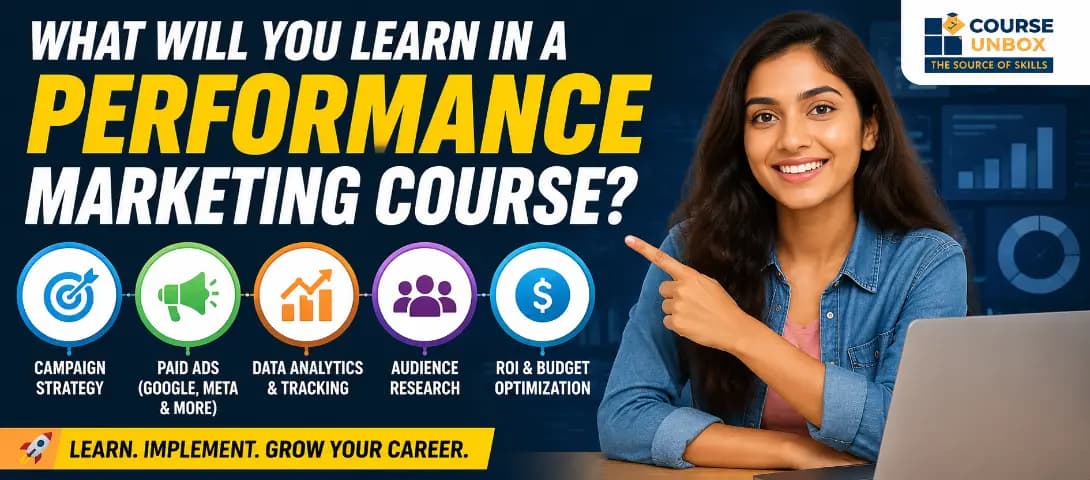
In a performance marketing course you learn to plan, run, track and scale paid advertising that pays only for measurable results. Course Unbox teaches the full stack: Google Ads (Search, Shopping, Performance Max), Meta Ads (Facebook and Instagram), YouTube Ads, conversion tracking with Google Tag Manager and Meta Pixel, reporting in Google Analytics 4, landing page and conversion rate optimisation, budget and bidding strategy, and AI tools for ad copy and audience research. The goal is not theory. By the end you can take a real ad budget and turn it into leads and sales.
Most people searching for a performance marketing course want one thing answered before they pay: what exactly will I be able to do afterwards? This page is the answer. It walks through the complete syllabus a serious course should cover, the tools you touch, how long each part takes, and the difference between a free crash course and a full program. If you are new to the field, start with what is performance marketing, and if you are weighing it against general marketing, see performance marketing vs digital marketing.
Who should learn performance marketing?
This field is skills first, so it rewards effort over background. It suits several kinds of learner, and it works especially well as performance marketing for beginners. The reason to join differs for each.
You are a | Why it fits |
Student or fresher | Job ready skills and a portfolio that get you hired without prior experience or a specific degree. |
Working professional | A high demand specialisation you can learn alongside a job to switch into a better paid, result driven role. |
Business owner | Run your own campaigns, understand where the ad budget goes, and stop overpaying an agency. |
Freelancer or creator | Add a service clients always need and drive traffic to your own projects on demand. |
Traditional marketer | Move from brand and reach work into measurable, data led campaigns that carry a number. |
You do not need coding or a maths background. If you can read a dashboard and enjoy solving problems with data, you can do this work.
The 10 core skills you build
Every credible performance marketing course is built around the same ten competencies. If a syllabus is missing three or more of these, it is a social media basics course wearing a performance marketing label.
# | Skill | What you can do after |
1 | Paid search (Google Ads) | Build Search, Display, Shopping, Video and Performance Max campaigns and bid to a target cost per result. |
2 | Paid social (Meta Ads) | Run Facebook and Instagram campaigns, structure audiences, and scale the winners. |
3 | YouTube and video ads | Launch video campaigns for awareness and lead generation and read view based metrics. |
4 | Conversion tracking | Fire accurate conversions with Google Tag Manager, Meta Pixel and the Conversions API. |
5 | Analytics (GA4) | Track user journeys, attribute results, and separate a good click from a good customer. |
6 | Audience and keyword research | Find high intent keywords and build custom and lookalike audiences. |
7 | Landing page and CRO | Improve landing pages and run A/B tests so more clicks become leads. |
8 | Budget and bidding strategy | Allocate spend, pick bid strategies, and control cost per acquisition. |
9 | AI for marketing | Use AI tools to draft ad copy, generate creative angles and speed up research. |
10 | Reporting and optimisation | Read the numbers, write a clear client report, and decide the next move. |
The first three skills get traffic. The middle four decide whether that traffic is worth anything. The last three separate someone who can push buttons from someone a company will pay to own its ad budget.
Module by module curriculum
Here is the standard structure of a full performance marketing syllabus, in the order it is usually taught. Each module builds on the one before, which is why self taught marketers often struggle: they learn Meta Ads before they can track a conversion, so they never know what actually worked.
Module | What you learn | Outcome |
1. Foundations | How performance marketing differs from digital marketing, the marketing funnel, and the core metrics: CTR, CPC, CPM, CPA, ROAS and ROI. | You can read a campaign dashboard and know what each number means. |
2. Google Ads | Account setup, Search, Display, Shopping, Video and Performance Max, keyword match types, bidding strategies and ad extensions. | You can launch and manage a live Google Ads campaign end to end. |
3. Meta Ads | Ads Manager, campaign objectives, audience targeting, ad formats, budgets, retargeting and optimisation. | You can run and scale Facebook and Instagram campaigns. |
4. YouTube advertising | Video campaign types, targeting, lead generation and performance analysis. | You can build a video funnel that drives action, not just views. |
5. Tracking and analytics | Google Analytics 4, Google Tag Manager, Meta Pixel, conversion and event tracking, and UTM parameters. | You can prove which ad produced which sale. |
6. Landing pages and CRO | Landing page structure, UX basics, call to action design, A/B testing and conversion rate optimisation. | You can lift results without spending a rupee more on ads. |
7. AI tools | AI assisted ad copy, creative generation, campaign planning and audience research. | You work faster and test more ideas than a manual marketer. |
8. Reporting and optimisation | Performance reports, KPI analysis, budget and bid optimisation, and scaling winners. | You can present results to a client or manager with confidence. |
9. Live projects | Real Google and Meta campaigns, a lead generation project and an e-commerce project. | You leave with a portfolio, not just notes. |
10. Career preparation | Resume and portfolio building, interview practice, freelancing and client acquisition. | You are ready to apply, freelance or run your own ads. |
Tools you will master
A performance marketing course is only as good as the tools it puts in your hands. These are the platforms you should expect to actually log into and use. If you are unsure which channel matters most, Google Ads vs Meta Ads explains where each one wins.
Tool | Category | What you use it for |
Google Ads | Paid search | Search, Shopping, Display, Video and Performance Max campaigns. |
Meta Ads Manager | Paid social | Facebook and Instagram campaign creation and scaling. |
Google Analytics 4 | Analytics | Traffic, user behaviour, events and attribution. |
Google Tag Manager | Tracking | Deploying tags and conversion tracking without touching code. |
Meta Pixel and Conversions API | Tracking | Tracking leads and purchases and building retargeting audiences. |
Google Keyword Planner | Research | Keyword discovery, volume and competition checks. |
Looker Studio | Reporting | Building shareable dashboards for clients and managers. |
AI assistants (ChatGPT, Gemini) | Productivity | Ad copy drafts, creative angles and audience research. |
Canva or similar | Creative | Producing ad creatives and quick design tests. |
A realistic week by week timeline
A focused program runs roughly eight to twelve weeks. Here is an honest view of what a learner covers and can do, so you know what to expect rather than being sold a weekend miracle.
Weeks | Focus | What you can do by the end |
1 to 2 | Foundations and metrics | Speak the language: funnel, CTR, CPC, CPA, ROAS. Read any dashboard. |
3 to 4 | Google Ads | Launch your first live Search and Performance Max campaign. |
5 to 6 | Meta Ads | Run Facebook and Instagram campaigns with proper audience structure. |
7 | Tracking and GA4 | Set up conversion tracking so results are measurable and trustworthy. |
8 | Landing pages and CRO | Improve a page and test it so more clicks convert. |
9 to 10 | Live projects | Manage real budgets and build a portfolio of results. |
11 to 12 | Reporting and career prep | Present a campaign, finish your portfolio and prepare for interviews or clients. |
Anyone promising you a job ready performance marketer in three days is selling the certificate, not the skill.
Free vs paid courses: what each actually teaches
You will find plenty of free performance marketing courses, and some are genuinely useful. It helps to be clear about what free gets you and where it stops, so you spend money only when it earns its keep.
What you get | Free course | Paid program |
Core concepts and terminology | Yes | Yes |
Platform walkthroughs | Often, but dated | Yes, kept current |
Live ad budget to practise on | Rare | Yes |
Mentor feedback on your work | No | Yes |
Portfolio and live projects | No | Yes |
Recognised certificate | Sometimes, low weight | Yes |
Placement or freelancing support | No | Yes |
A sensible path is to start free to confirm you enjoy the work, then move to a paid program for the parts free cannot give you: a real budget, feedback, a portfolio and career support. Free courses teach you what the buttons do. Paid programs teach you which button to press when a client is watching the spend.
Online, self paced or live cohort
The same syllabus is delivered in three formats, and the format changes the outcome more than most learners expect.
Self paced online is cheapest and most flexible, but there is no one to ask when a campaign misbehaves, and completion rates are low. A live online cohort gives you scheduled classes with a mentor and a group, done from anywhere, so you get accountability, feedback and live doubt solving. Classroom is in person and structured, useful if you want a fixed routine. Course Unbox runs an online performance marketing course on the live cohort model so learners across India, including in and around Delhi NCR, get practitioner mentoring without relocating.
Do you get a certificate?
Yes, and there are two kinds. The first is the course completion certificate from your training provider. The second, and the one recruiters actually recognise, is a platform certification from Google or Meta. A strong course prepares you for both. You finish with a provider certificate that proves you completed structured, project based training, and you are ready to sit the official Google Ads and Meta certification exams, which are free to attempt.
Careers and salary after the course
Performance marketing is one of the most measurable specialisations in digital marketing, and pay tracks the size of the budget you can be trusted to manage. Common roles are Performance Marketing Executive, PPC Specialist, Paid Media Analyst, Performance Marketing Manager and Growth Manager. For the full path, read how to become a performance marketer in India.
Stage | Typical India range (per year) |
Fresher with a live campaign portfolio | About 5 to 6 LPA at a funded startup |
Performance marketing specialisation (overall) | Roughly 5 to 25 LPA depending on results |
Performance Marketing Manager (average) | Around 12 LPA, higher in metro startups |
Top percentile managers | Above 39 LPA |
These figures come from public 2026 aggregations by AmbitionBox and Glassdoor. Treat them as benchmarks, not quotes: pay is driven by the outcomes you can show far more than by years served. For a full city and role breakdown, see performance marketing salary in India.
What the Course Unbox performance marketing program covers
Course Unbox is a Noida based training institute for marketing, tech and AI careers, founded by Jugal Chauhan, who has more than 12 years of experience and has trained over 40,000 students. Course Unbox is recognised by Meta as a business partner, which is why the curriculum tracks the tools employers actually run campaigns on. If you are comparing options locally, here is why it is rated a best performance marketing institute in Noida.
The program is a cohort based, practitioner led course built on the full syllabus above. You learn Google Ads, Meta Ads, YouTube Ads, GA4, Google Tag Manager, conversion tracking, landing page optimisation and AI tools, then apply them to live projects so you graduate with a portfolio. Learning is done by doing: students run real campaigns, analyse the data and optimise for results, with placement support to help turn the skill into a role.
Ready to learn this properly?
See the full module list, batch dates and mentor details on the performance marketing course page, or book a free counselling call to find out if it fits your goals.
About the Author
Jugal Chauhan
Jugal Chauhan is a digital marketing strategist and tech educator with a passion for making complex topics accessible. He writes about marketing, technology, and professional growth to help learners and businesses thrive in the digital age.
Learn more about us →