Get a counselling call
The Future of Performance Marketing: Trends, AI and Careers in 2026
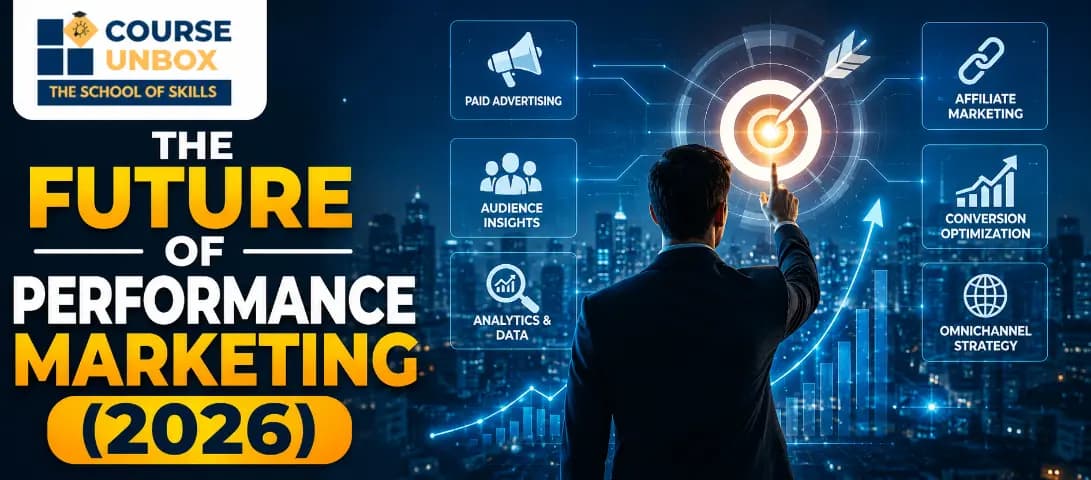
The future of performance marketing is a shift from manual campaign management to AI led growth engineering. By 2026 the platforms run the auctions, so the marketer's edge moves to strategy, first party data, creative and measurement. AI and automation such as Google Performance Max and Meta Advantage+ handle execution, discovery is spreading into AI answer engines, and privacy rules keep tightening even though the predicted cookieless web did not arrive. Performance marketing is not shrinking. It is becoming the operating system of business growth, and the people who can direct the machines will be more valuable, not less
Every year brings a new list of predictions, and most of them age badly. This page is written to survive contact with reality. It explains where performance marketing is actually heading, corrects the one prediction almost every rival article still gets wrong, and shows you what to learn so the shift works for you rather than against you.
A one minute primer
Performance marketing is paid advertising where you pay only for a measurable result, such as a click, a lead or a sale. If you are new to the idea, start with what is performance marketing, and for the contrast with the wider field, read performance marketing vs digital marketing. The reason it keeps growing is simple: it ties every rupee spent to an outcome, which is exactly what businesses want when budgets are tight.
The seven shifts shaping the future
Here is what is actually changing, and the practical response to each. This is the core of the future, in one place.
Shift | What is changing | What to do about it |
1. AI runs the auction | Google Performance Max and Meta Advantage+ already automate bidding, placements and audiences. Manual lever pulling is fading. | Move up the stack: feed the machine clean data and strong creative, and judge it on results. |
2. Creative becomes the main lever | When targeting and bidding are automated, the ad itself is what you still control, and short form video and user generated content are where attention now lives. | Learn creative strategy and use AI to produce and test many short video variations fast. |
3. First party data wins | Signal loss from other browsers and consent rules makes your own customer data the most reliable input. | Build email and phone lists, use server side tracking, and feed conversions back to the platforms. |
4. Discovery moves into AI answers | People increasingly ask AI assistants instead of only searching. A new field, answer engine optimisation, is emerging. | Structure content so AI systems can quote it, and treat AI search as a real channel. |
5. Measurement grows up | Last click attribution is being replaced by incrementality testing, modelled conversions and marketing mix modelling. | Learn to measure true lift, not just the last click before a sale. |
6. New inventory, especially retail media | Retailers, marketplaces and connected TV are fast growing ad channels beyond Google and Meta. | Get comfortable running campaigns across more than two platforms. |
7. Privacy first is the default | Consent requirements are unchanged and enforcement is rising, regardless of what any single browser does. | Treat consent and clean data collection as a skill, not an afterthought. |
The cookie myth, corrected
Almost every article about the future of performance marketing still tells you to brace for a cookieless web. That advice is out of date, and getting it wrong makes the rest of the article suspect.
What actually happened: In April 2025 Google confirmed it would keep third party cookies in Chrome and would not add a standalone choice prompt. On 17 October 2025 it retired most of the Privacy Sandbox APIs, effectively ending the six year project that was meant to replace cookies. Third party cookies remain on by default in Chrome, while Safari, Firefox and Brave continue to block them.
So the dramatic Chrome led cookie apocalypse was called off. The practical lesson survives anyway: a large share of users already browse without third party cookies, and consent law did not change. That is why first party data and server side tracking still matter. The future is not cookieless by decree, but it is signal poor, and the marketers who own their own data will keep an edge. Getting this detail right is how you tell a serious source from a recycled one.
Is performance marketing a good career in the future?
Yes, and the reason is structural. Every business with an online presence needs someone who can turn ad spend into revenue, and that need grows as more budget shifts to measurable channels. AI changes the job rather than removing it: the machine executes, and a person still sets strategy, judges the numbers and owns the budget. If anything, automation raises the ceiling for skilled marketers because one person can now manage far more. For the practical route in, see how to become a performance marketer in India, and for what the pay looks like, see performance marketing salary in India.
The roles that will grow
As execution automates, demand shifts toward people who can think across data, creative and strategy. These are the titles worth aiming at.
Role | Why it grows |
Performance marketing specialist | The core operator who runs and reads campaigns across platforms. |
Growth marketer | Owns the whole funnel and runs experiments, not just ads. |
Creative strategist | Turns data into winning ad concepts, the lever automation cannot pull. |
Marketing data and measurement analyst | Builds tracking and proves what actually drove results. |
AI marketing operator | Directs AI tools and agents to plan, produce and optimise at scale. |
How to future-proof yourself
The safest response to automation is to learn the parts of the job the machine cannot own. Think of it as a roadmap.
Priority | Skill to build | Where it fits |
1 | Platform fluency across Google Ads and Meta Ads | You still need to steer Performance Max and Advantage+ well. |
2 | First party data and measurement | Server side tracking, GA4 and incrementality are the new edge. |
3 | Creative strategy | The main lever once targeting is automated. |
4 | AI tools and prompting | Produce, test and analyse faster than a manual marketer. |
5 | Answer engine optimisation | Win visibility as discovery moves into AI assistants. |
If you are starting from zero, our guide to performance marketing for beginners shows the order to learn things in, and the full performance marketing syllabus maps every module you should cover.
What will not change
Predictions are loud about what is new and quiet about what lasts. The fundamentals are not going anywhere. You will still need a clear offer, a message that speaks to a real person, a landing page that converts, and honest measurement. AI can draft a hundred ads, but it cannot decide what makes your product worth buying. The marketers who pair new tools with these old fundamentals are the ones who compound results over a career.
Preparing for this future with Course Unbox
Course Unbox is a Noida based training institute for marketing, tech and AI careers, founded by Jugal Chauhan, who has more than 12 years of experience and has trained over 40,000 students. Course Unbox is recognised by Meta as a business partner, so the curriculum tracks the tools and shifts described on this page rather than teaching last year's playbook. If you are comparing options locally, here is why it is rated a best performance marketing institute in Noida.
The performance marketing course is a cohort based, practitioner led program built on live projects, so you learn to direct AI driven platforms, set up modern measurement and build creative that performs, then prove it on real campaigns. That is exactly the skill set this future rewards.
Build the skills this future rewards
See the full module list, batch dates and mentor details on the performance marketing course page, or book a free counselling call to plan your path.
About the Author
Jugal Chauhan
Jugal Chauhan is a digital marketing strategist and tech educator with a passion for making complex topics accessible. He writes about marketing, technology, and professional growth to help learners and businesses thrive in the digital age.
Learn more about us →