Get a counselling call
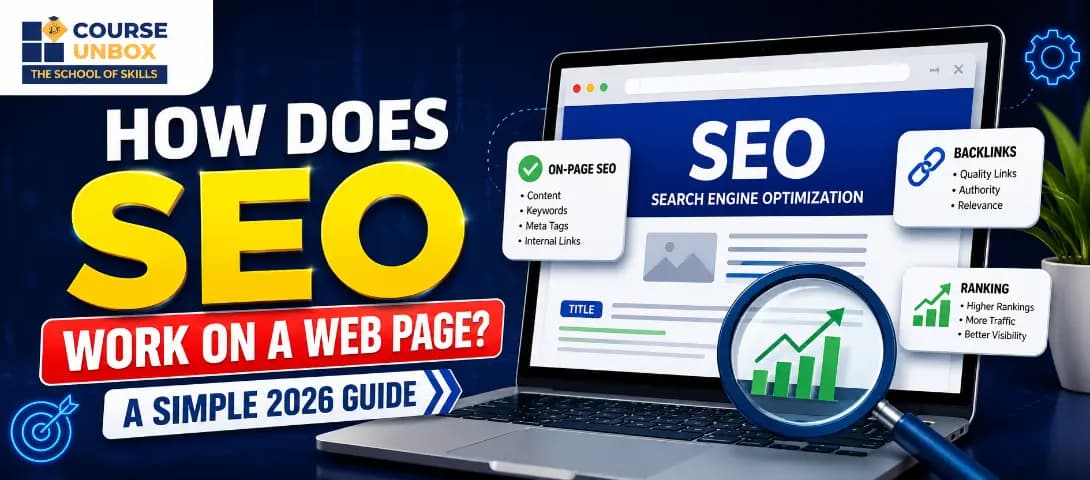
How Does SEO Work on a Web Page? A Simple 2026 Guide
SEO, short for search engine optimisation, is the practice of building a web page so a search engine can find it, understand it, and rank it in unpaid results for what it is
SEO, or search engine optimisation, is the work of building a web page so a search engine can find it, understand it, and rank it in the free results, without paying for ads. On one page it happens in three stages: Google crawls the page to find it, indexes it to understand it, and ranks it against other pages. In 2026, AI answers like Google’s AI Overviews and tools like ChatGPT also pull from these pages, so a page now competes to be quoted as well as clicked.
What is SEO?
SEO stands for search engine optimisation. It is the work of getting a web page to show up higher in the unpaid, or organic, results on Google. In digital marketing, SEO is the channel that brings people who are already searching for what you offer, which is why it usually costs less and converts better than paid ads over time. If you want the plain definition with examples, see our what is SEO explainer.
The traffic is free. The work behind it is not.
How does SEO work on a web page?
Follow one page. For it to appear in a Google search, it must pass three stages, in order. Miss one and the page never reaches the next. Google explains these stages in its own How Search Works documentation.
1. Crawling, being found. Google uses a program called Googlebot to move across the web by following links and reading sitemaps. When it reaches your page, it downloads the content. For this to happen, the page must be linked from somewhere Google already knows, must not block crawlers, and must load quickly.
2. Indexing, being understood. Google reads the page’s text, title, headings, image alt text and code, then files it in its index, its library of pages. If a page is not indexed, it cannot appear in any result. Being crawled is not the same as being indexed. Google skips thin or duplicate pages, and picks one main version when several pages are similar.
3. Ranking, being chosen. When someone searches, Google finds every indexed page that fits and orders them in a moment. It weighs how well the page matches the search, how good and complete the content is, how many trusted sites link to it, and how fast and stable the page is. Our guide on how to rank on Google covers this stage in detail.
In one line: a page is found if it is linked, understood if it is clear, and chosen if it answers the search better than the rest.
The four types of SEO
On-page SEO: the title, headings, content, links and images on the page itself. The fastest to fix. See the clear split in on-page vs off-page SEO.
Technical SEO: speed, mobile friendliness, clean URLs, sitemaps and structured data. The plumbing that lets crawling and indexing happen, covered hands on in the technical SEO course.
Off-page SEO: links and mentions from other sites, which build reputation. The hardest to control, which is why Google trusts it.
Local SEO: ranking a business for a place, mostly through a Google Business Profile.
For a single web page, on-page SEO matters most.
What Google rewards in 2026
Helpful content first. Google rewards content written to help a person by someone with real experience. This is the idea behind E-E-A-T: Experience, Expertise, Authoritativeness and Trustworthiness, set out in Google’s helpful, people-first content guidance. It is about Google SEO fundamentals, not tricks.
Good links. A link from a respected site is a vote. Spam links are a liability.
Page experience. Google measures three Core Web Vitals from real users:
Largest Contentful Paint, how fast the main content loads: 2.5 seconds or less.
Interaction to Next Paint, how fast the page responds to a tap: 200 milliseconds or less.
Cumulative Layout Shift, how much the page moves while loading: 0.1 or less.
One recent change to know: Interaction to Next Paint replaced First Input Delay on 12 March 2024, and it is stricter. You can read how these thresholds were set. Any guide still naming First Input Delay is out of date.
SEO and AI search
Since 2024, Google shows AI answers above the usual links. AI Overviews are short summaries at the top of the results, explained in Google’s AI Overviews help page. AI Mode is a separate chat style tab, which Google introduced in 2025 and which passed one billion monthly users by May 2026. Alongside them sit ChatGPT, Perplexity, Gemini and Claude.
They choose sources the same way search does. Google’s documentation on AI features says that to be quoted, a page only needs to be indexed and clear enough to lift. Two habits help. Put a complete answer in the first two sentences of each section, and shape headings like questions. This is what AEO, answer engine optimisation, and GEO, generative engine optimisation, mean, and our guide to SEO in 2026 and AI Overviews goes deeper.
The old risk was ranking lower. The new risk is being summarised with no click. The fix is the same either way: be the clearest source, and name yourself inside your best sentences.
How to optimise one page, step by step
Pick the one search this page will answer.
Put the answer in the first two sentences.
Use the words people actually search for.
Add clear headings, short paragraphs, and a table or list.
Include a detail only someone with real experience would know.
Make the page fast and stable.
Link to it from your other pages and your sitemap.
Earn links from other sites over time.
Check Search Console and improve the searches the page is close on.
Does SEO still work in 2026?
Yes. People still search, and AI answers are built from the same pages SEO produces, so the basics matter more, not less. What has ended is easy SEO. Thin, keyword-stuffed pages are being cleared out. Useful content from a credible source on a fast site still wins, and the roles pay for it, as our SEO salary in India breakdown shows.
How long does it take, and what does it cost?
SEO is slow. Most pages take two to three quarters to settle, because trust and links build over time. The clicks are free, but the work, the tools and the time are not. Paid ads buy instant traffic. SEO earns traffic that keeps coming.
How to learn SEO
You can start free with Google’s Search Central docs and Moz’s beginner guides. What they cannot give you is feedback on your own pages. A structured course fills that gap by letting you rank a real page and telling you why it did or did not work. Course Unbox teaches this as a focused SEO Course Online. If you are starting cold, SEO for beginners assumes no background, and the full SEO course syllabus lists every module, including the newer AEO and GEO skills.
Judge any course by one test: did a page you built actually rank.
About the Author
Jugal Chauhan
Jugal Chauhan is a digital marketing strategist and tech educator with a passion for making complex topics accessible. He writes about marketing, technology, and professional growth to help learners and businesses thrive in the digital age.
Learn more about us →