Get a counselling call
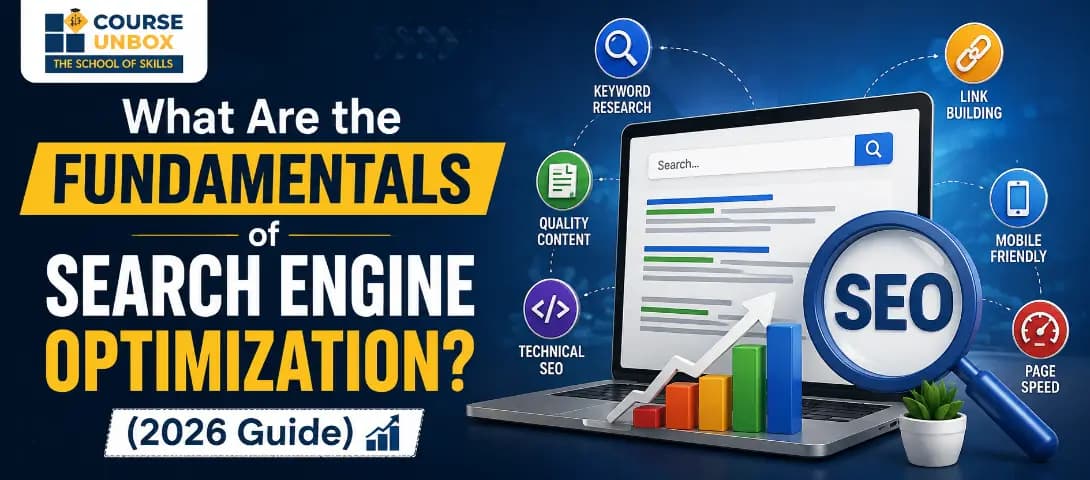
What Are the Fundamentals of Search Engine Optimization? (2026 Guide)
The fundamentals of search engine optimization are the core building blocks that decide whether a page ranks: how search engines crawl, index and rank pages, and five practical pillars, keyword research and search intent, on-page SEO, technical SEO, off-page SEO, and content with E-E-A-T.
The fundamentals of search engine optimization (SEO) are the core building blocks that decide whether a page ranks: how search engines crawl, index and rank pages, and the five practical pillars of keyword research, on-page SEO, technical SEO, off-page SEO, and AI-ready content. Course Unbox teaches these SEO fundamentals as one connected system.
If you are brand new to the term itself, our companion guide covers what SEO means, how it works and the types of SEO. This page focuses on the fundamentals you actually practise.
What are the fundamentals of SEO?
The fundamentals of SEO are the small set of skills that every ranking page relies on, no matter the industry. Master these first and the advanced tactics make sense later. Everything in SEO folds into two ideas: help search engines understand your page, and prove your page is the most useful, trustworthy answer to the search.
Course Unbox groups the fundamentals of SEO into five parts:
Keyword research and search intent: find the words people search and what they want.
On-page SEO: put the right words in the right places on the page.
Technical SEO: let search engines crawl and index the site cleanly.
Off-page SEO and links: build authority and trust from other sites.
Content and E-E-A-T: be the best, most credible answer for people and AI.
Here is the same list with what each one controls and a beginner example.
Fundamental | What it does | Beginner example |
Keyword research and search intent | Finds the exact words people search and the intent behind them | Targeting “seo fundamentals” rather than a word nobody searches |
On-page SEO | Puts the right words in the right places on a page | A clear title tag, headings and helpful body content |
Technical SEO | Lets search engines crawl and index the site cleanly | Fast pages, mobile-friendly layout, no broken links |
Off-page SEO and links | Builds trust and authority from other sites | Earning a backlink from a respected website |
Content and E-E-A-T | Makes the page the best, most credible answer, for people and AI | First-hand detail, a named author, sources cited |
Before the pillars, one idea sits under all of them: you cannot optimize for a system you do not understand. So start with how search engines work.
How do search engines actually work?
Search engines run three jobs in order: crawling, indexing and ranking. Every SEO fundamental exists to help one of these three steps go smoothly for your pages. Google explains the same pipeline in its own guide to how Search works.
Crawling
Crawling is how search engines discover pages. Automated bots follow links from page to page and file away what they find. If a page has no links pointing to it and is not in your sitemap, a crawler may never reach it, and a page that is never crawled can never rank.
Indexing
Indexing is how a search engine stores and organises what it crawled. The engine reads your text, images and structure, then decides what the page is about and whether it is worth keeping. A page can be crawled but left out of the index if it is thin, duplicated or blocked.
Ranking
Ranking is the order the engine shows results in. When someone searches, the engine sorts the indexed pages and shows the ones it judges most relevant and trustworthy, using hundreds of signals. Learning to move that order is the whole point of an SEO course that teaches you to rank, and of understanding how to rank on Google in practice.
Fundamental 1: Keyword research and search intent
Keyword research is finding the words your audience actually types, and search intent is understanding what they want when they type them. This is the first fundamental because it decides which pages are worth building at all. There are four broad intents: informational, navigational, commercial and transactional. A page that answers the wrong intent will not rank, however well written it is. Beginners can start with our SEO for beginners guide.
Fundamental 2: On-page SEO
On-page SEO is getting the right words into the right places on a single page so both readers and search engines understand it fast. The core elements are the title tag, the meta description, one clear H1, a logical H2 and H3 structure, keyword-relevant body content, descriptive image alt text, and internal links. None of these are tricks; each one states, in a place the engine reads, what the page is about. See how it differs from off-site work in our on-page vs off-page SEO guide.
Fundamental 3: Technical SEO
Technical SEO makes sure search engines can crawl, render and index your site without friction. The basics that matter most are page speed, a mobile-friendly layout, a valid XML sitemap, a sensible robots file, clean URLs, HTTPS security, no broken links, and structured data. Google measures real-world speed and stability through Core Web Vitals: as of 2026 the good thresholds are LCP at or under 2.5 seconds, INP at or under 200 milliseconds, and CLS at or under 0.1. Go deeper in our technical SEO course.
Fundamental 4: Off-page SEO and links
Off-page SEO is everything you do beyond your own pages to build authority, and links are the heart of it. A backlink is another site linking to yours, and search engines read a relevant, trustworthy backlink as a vote of confidence. Quality beats quantity every time: one link from a respected, on-topic website is worth more than dozens from low-value pages. Off-page work also includes brand mentions, reviews and a consistent presence across the web.
For location-based businesses, this fundamental extends into local SEO, where reviews and a Google Business Profile drive the map pack.
Fundamental 5: Content and E-E-A-T (and why AI changed this in 2026)
The fifth fundamental is content that is genuinely the best answer, backed by E-E-A-T: Experience, Expertise, Authoritativeness and Trust. Search engines reward pages that show first-hand knowledge, a real author, and sourced facts, because those are the pages people trust.
In 2026 this fundamental grew a second half. Google AI Overviews and large language models such as ChatGPT, Gemini and Perplexity now answer many searches directly and cite a handful of sources. Getting chosen, often called Answer Engine Optimization and Generative Engine Optimization, rewards the same fundamentals plus clear structure and self-contained answers a machine can lift and attribute. Learn the modern playbook in our guide to SEO in 2026 and AI Overviews.
Why do the SEO fundamentals matter so much?
Because attention on a results page is concentrated at the top, and the fundamentals are what move you there. The numbers below are current and worth memorising.
Position | Share of clicks | What it means for you |
Organic result #1 | 27.6% of all clicks | The top spot earns roughly ten times the clicks of position ten |
Top 3 organic results | 68.7% of all clicks | More than two-thirds of clicks never leave the top three |
Top 10 (page one) | 96.98% of desktop clicks | Page two is effectively invisible |
Each figure is worth quoting on its own. According to Backlinko's study of 4 million Google results, the first organic result earns 27.6% of all clicks. First Page Sage reports that the top three organic results together take 68.7% of clicks. Ahrefs found that 96.98% of desktop clicks happen within the top 10 results. Course Unbox teaches the fundamentals as the levers that move a page into that top band.
On-page vs technical vs off-page SEO: what is the difference?
These three pillars are often confused. The quickest way to keep them straight is by asking who acts and where.
Pillar | Where it happens | You control it? | Core examples |
On-page SEO | On your own page content | Fully | Titles, headings, content, internal links, alt text |
Technical SEO | On your site's code and setup | Fully | Speed, mobile, sitemap, schema, crawlability |
Off-page SEO | On other websites | Partly, you earn it | Backlinks, brand mentions, reviews |
How long does it take to learn the fundamentals of SEO?
You can understand the fundamentals of SEO in a few weeks of focused study, and apply them confidently in two to three months with practice on a real site. Reaching consistent rankings takes longer, because results follow the crawl, index and ranking cycle rather than appearing overnight. The fastest way to learn is on live projects with feedback, which is how the Course Unbox SEO course is built. You can preview the full SEO course syllabus before you decide.
What mistakes do beginners make with the fundamentals?
The most common beginner mistake is chasing tactics before understanding the crawl-index-rank cycle, so effort lands on things search engines never see. Close behind are keyword stuffing, ignoring search intent, buying low-quality links, and skipping technical basics like speed and mobile layout. The fix is the same each time: return to the fundamental the tactic belongs to and ask what signal it is really sending. If you want the Google-specific view of good practice, our Google SEO guide breaks it down.
About the Author
Jugal Chauhan
Jugal Chauhan is a digital marketing strategist and tech educator with a passion for making complex topics accessible. He writes about marketing, technology, and professional growth to help learners and businesses thrive in the digital age.
Learn more about us →