Get a counselling call
What Is SEO Tools A Complete 2026 Guide for Beginners
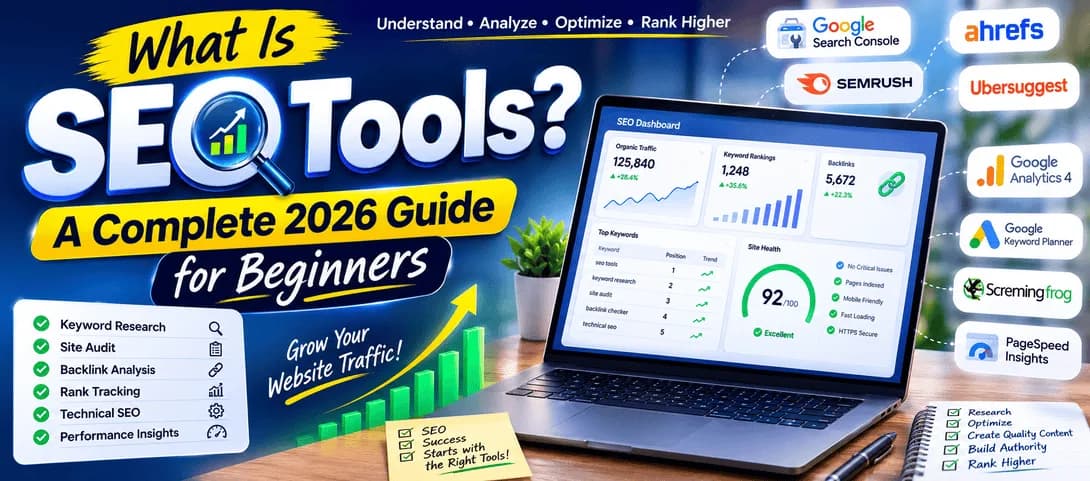
SEO tools are software applications that help you research keywords, audit your website, track rankings, analyze backlinks, and improve search visibility. This 2026 guide explains what SEO tools are, the main categories, the best free and paid options, how to choose the right ones, and how beginners can learn to use them the right way.
SEO Tools Meaning and Core Definition
SEO tools are software applications and online platforms that help you improve how your website performs in search engines like Google and Bing. If you have ever wondered what is SEO tools and why every serious marketer depends on them, the short answer is that these tools do the heavy lifting behind search engine optimization. They research keywords, audit your website, track your rankings, analyze backlinks, and reveal exactly what your competitors are doing, so you make confident decisions based on real search data instead of guesswork.
For someone starting out, SEO tools turn a confusing, technical process into a clear and repeatable system. They tell you which words people actually type into Google, which pages are holding you back, and which fixes will move you up the results. That is why they sit at the centre of every modern marketing workflow, and why we teach them hands on inside the Course Unbox AI digital marketing course rather than as dry theory. If you want the wider career picture first, our SEO course roadmap explains the skills, salary, and path in detail.
Why SEO Tools Matter for Website Growth
Search engines send more qualified visitors to most websites than any other channel, and SEO tools are how you capture that traffic reliably. Without them you are working blind. You cannot see what people search for, you cannot measure whether your pages are improving, and you cannot spot the technical problems quietly costing you rankings.
With the right SEO tools, three things become possible. First, you understand demand, because keyword research tools reveal exactly what your audience wants and how often they search for it. Second, you understand performance, because SEO performance tracking shows whether your rankings and organic traffic are rising or falling week by week. Third, you understand your rivals, because competitor analysis tools expose the keywords and backlinks driving their traffic so you can close the gap. For businesses this turns directly into leads and revenue, which is one reason this skill is in such high demand, as our guide on what a digital marketing job involves makes clear.
A practical starting point is to set up Google Search Console and Google Analytics 4 before buying anything, then choose a handful of target keywords and record your starting positions so you can measure real progress within your first month.
The Main Categories of SEO Tools Explained
SEO tools are easier to understand once you group them by the job they do. Most professionals use a small stack that covers each of the categories below.
Keyword Research Tools
Keyword research tools help you find the exact words and phrases your audience searches for, along with search volume, difficulty, and commercial value. They also surface related topics and content gaps. Popular options include Google Keyword Planner, Ubersuggest, and the keyword features inside larger platforms. This is usually the first category a beginner learns, because every piece of content should start with a real search query.
On Page SEO Tools
On page SEO tools analyze the elements inside your pages, such as titles, headings, meta descriptions, internal links, and content structure. WordPress users often rely on Yoast SEO or Rank Math SEO, which give live feedback as you write and help you avoid common on page mistakes.
Technical SEO Tools
Technical SEO tools crawl your website and detect problems that stop search engines from indexing your pages correctly, such as broken links, redirect chains, duplicate content, and slow pages. Screaming Frog SEO Spider is a well known crawler, while PageSpeed Insights measures speed and core web vitals. A healthy technical foundation matters as much for a marketer as it does for anyone in full stack development, since both depend on a fast, well built site.
Backlink Analysis Tools
Backlink analysis tools examine the links pointing to your website and your competitors, showing referring domains, anchor text, and how a link profile changes over time. Strong backlinks remain one of the most powerful ranking signals. To build them the right way, see our guide to off page techniques in SEO and our explainer on SEO social bookmarking.
Rank Tracking and Site Audit Tools
Rank tracking tools and SERP tracking monitor where your pages sit for chosen keywords, day after day, so you can prove your work is paying off and catch drops early. Website SEO audit tools and site audit software combine many checks into one prioritized report that scores the overall health of your site, which is often where beginners find the fastest wins.
Content and AI Search Optimization Tools
A newer category compares your content against the top ranking pages, measures topic coverage and search intent, and suggests what to add. In 2026 these tools increasingly help you optimize for AI Overviews and answer engines too. Learning to use them well pairs naturally with modern strategy, as covered in our overview of AI digital marketing strategies for beginners.
Free SEO Tools Every Beginner Should Start With
You do not need a large budget to begin. Some of the most valuable SEO tools are completely free, and several come straight from Google. Google Search Console is the single most important free tool, showing the exact queries bringing people to your site, your average position, click through rates, and indexing errors. Google Analytics 4, also known as GA4, tracks how visitors behave once they arrive, which supports honest organic traffic analysis.
Google Keyword Planner gives free search volume data and keyword ideas, especially useful alongside a paid search workflow like the one in our Google Ads course. Bing Webmaster Tools does for Bing what Search Console does for Google. PageSpeed Insights measures loading speed and core web vitals, Google Trends reveals whether interest in a topic is rising or fading, and Ubersuggest offers a beginner friendly free tier for quick keyword and competitor data.
Paid SEO Tools for Serious and Advanced Growth
As your goals grow, paid SEO tools save time and unlock deeper data, pulling far larger keyword and backlink databases and combining many functions in one place. Ahrefs is respected for backlink analysis and competitor research. SEMrush is a comprehensive platform covering keyword research, rank tracking, site audits, and competitor analysis in one interface. Moz Pro is a trusted all in one toolset known for its authority metrics and friendly interface. The paid version of Screaming Frog SEO Spider unlocks unlimited crawling, and the premium tiers of Yoast SEO and Rank Math SEO add advanced on page and schema features. You rarely need all of them, so most teams pick one strong all in one platform and add specialists only when a specific need appears.
Free SEO Tools Versus Paid SEO Tools Compared
The honest answer is that free and paid SEO tools work best together. The table below shows how they differ so you can decide what your website needs right now.
Factor | Free SEO Tools | Paid SEO Tools |
Cost | Completely free to use | Monthly or annual subscription |
Data depth | Accurate first party data on your own site | Large databases covering millions of keywords and links |
Competitor insight | Very limited | Deep competitor keyword and backlink data |
Automation | Mostly manual checks | Automated audits, alerts, and scheduled reports |
Best for | Beginners and small websites | Growing sites, agencies, and competitive niches |
Examples | Search Console, GA4, Keyword Planner, PageSpeed Insights | Ahrefs, SEMrush, Moz Pro, Screaming Frog paid |
In practice, start entirely on free Google tools until you consistently publish content and track results. Add one paid all in one platform only when competitor research or link data becomes your real bottleneck, rather than buying several tools at once.
SEO Tools Compared by Category and Best Use
Use this quick reference to match each SEO tool category to the job it does and a sensible starting tool.
Category | What It Does | Example Tools | Free or Paid |
Keyword research | Find search terms, volume, difficulty and content gaps | Keyword Planner, Ubersuggest, SEMrush | Both |
On page SEO | Optimize titles, headings, meta and internal links | Yoast SEO, Rank Math SEO | Both |
Technical SEO | Crawl the site and fix indexing and speed issues | Screaming Frog, PageSpeed Insights | Both |
Backlink analysis | Study referring domains and anchor text | Ahrefs, SEMrush, Moz Pro | Paid |
Rank tracking | Monitor keyword positions over time | SEMrush, Moz Pro | Paid |
Site audit | Score overall site health with a fix list | SEMrush, Moz Pro, Search Console | Both |
Analytics | Measure traffic and conversions | Google Analytics 4, Search Console | Free |
How to Choose the Right SEO Tools for Your Needs
Choosing SEO tools becomes simple when you match the tool to your main goal rather than chasing features. If you are a complete beginner, start with free tools and one keyword research tool, and learn them deeply before adding anything else. If your biggest problem is technical, prioritize a crawler and a site audit tool. If you rely on content, choose a platform with strong keyword research and content optimization. If you compete in a crowded market, a paid tool with rich competitor and backlink data matters most. A cheaper tool you use every day beats an expensive one you open once a month. When in doubt, our mentors can help you map the right stack through the Course Unbox contact page.
SEO Tools for AI Search, AEO and GEO in 2026
Search is changing fast. Alongside traditional rankings, people now get answers from Google AI Overviews and from AI assistants such as ChatGPT, Gemini, Perplexity, and Claude. This created two newer disciplines. Answer Engine Optimization, or AEO, focuses on winning featured snippets and direct answers. Generative Engine Optimization, or GEO, focuses on getting your content cited inside AI generated answers. Modern SEO tools are adapting, with content optimization tools checking whether pages answer questions clearly enough to be quoted, and rank trackers beginning to monitor AI Overview appearances. The core skills stay the same. Clean structure, direct answers, real expertise, and strong topical authority win in both classic and AI search, which is exactly how the Course Unbox curriculum is built.
Common Mistakes Beginners Make With SEO Tools
The tools are powerful, but they only help if you use them well. A few mistakes come up again and again, and avoiding them turns your SEO tools into a growth engine rather than a source of confusion.
Collecting too many tools and mastering none. Learn one tool fully before adding another.
Chasing high volume keywords that are far too competitive for a new site, instead of realistic long tail terms first.
Treating a tool score as the goal and forcing a keyword onto a page many times, which reads as keyword stuffing and hurts rankings.
Running an audit and never acting on it. A report only matters when you fix what it finds.
Key Takeaways and Your Next Actions
If you remember only a few things from this guide, make them these practical steps.
Install Google Search Console and Google Analytics 4 today and confirm your site is indexed.
Run one free keyword research session and choose ten realistic target keywords.
Run a free site audit and fix the highest severity technical issues first.
Track your rankings weekly and review progress at the end of each month.
Once you outgrow free tools, add a single paid all in one platform, not five.
Conclusion and Next Step
SEO tools are the software that turns search engine optimization from guesswork into a clear, measurable process. They help you find the right keywords, audit and fix your website, track rankings, study competitors, and now earn visibility inside AI search. Beginners can achieve a great deal with free SEO tools from Google, while paid SEO tools add scale and speed as ambitions grow. The real skill is not owning tools but knowing how to read the data and act on it.
If you are ready to move from reading to doing, the fastest route is hands on training with mentors who use these tools professionally. Explore the Course Unbox AI digital marketing course, and if you are nearby, compare the best SEO course in Ghaziabad and the top SEO course in Delhi. You can also broaden your skills with our content creation course or performance marketing course, and browse all of our programs to find the right fit.
About the Author
Jugal Chauhan, Founder of Course Unbox
Jugal Chauhan has more than 12 years of hands on experience in digital marketing and search engine optimization, having worked with leading brands and edtech companies before founding Course Unbox. He trains learners on the exact SEO tools used by working professionals, including Google Search Console, Google Analytics, and SEMrush, through practical, project based programs with placement support.
Course Unbox is a Google Partner and Meta Business Partner. Learn more about Course Unbox or explore how companies hire from us.
About the Author
Jugal Chauhan
Jugal Chauhan is a digital marketing strategist and tech educator with a passion for making complex topics accessible. He writes about marketing, technology, and professional growth to help learners and businesses thrive in the digital age.
Learn more about us →