Get a counselling call
SEO Course Explained: Skills, Salary & Career Roadmap 2026
Thinking about an SEO course but unsure what you'll actually learn or whether it's worth it in the AI search era? This guide breaks down what a modern SEO curriculum should cover — from technical audits and on-page optimization to the newer disciplines of AEO and GEO (getting cited by ChatGPT, Gemini, and Perplexity). You'll find realistic salary expectations across experience levels, the industries actively hiring SEO talent in India, the tools you should expect hands-on exposure to, and the mistakes that keep beginners stuck. Whether you're a student, a career-switcher, or a business owner trying to understand SEO before hiring for it, this roadmap will help you evaluate any SEO course — including ours — with a clear, practical lens.
SEO Course Explained: Skills, Salary & Career Roadmap 2026
Introduction
Search has quietly split into two battlefields. There's still the familiar one — ten blue links on Google — but there's a second, faster-moving one now: AI Overviews, ChatGPT answers, Perplexity citations, and Gemini summaries that skip the click entirely and just tell the user the answer. If you're evaluating an SEO course in 2026, this split is the single most important thing to understand, because most course content on the internet still teaches SEO as if 2019 never ended.
This guide isn't a sales pitch dressed up as an article. It's the resource we wish existed when we were mapping out what a genuinely modern SEO curriculum should cover — one that treats classic search engine optimization and the newer disciplines of AEO (Answer Engine Optimization) and GEO (Generative Engine Optimization) as one connected skill set, not two separate worlds. Use it to evaluate any SEO course, including ours.
What Is an SEO Course, Really?
An SEO course should do three things: teach you how search engines and AI systems actually decide what to show, give you enough hands-on practice that you can audit and fix a real website without hand-holding, and prepare you for how a business actually hires and pays for this skill.
A lot of "SEO courses" fail on the middle point. They teach vocabulary — meta tags, backlinks, keyword density — without ever putting you in front of a messy, real website with real crawl errors and real ranking problems. That gap is exactly why so many self-taught marketers know the words of SEO but freeze the first time a client asks, "Why did our traffic drop 30% last month?"
A well-structured course should feel less like a lecture series and more like an apprenticeship: theory in the morning, a live audit or optimization task in the afternoon.
Who Should Join an SEO Course?
SEO pulls from an unusually wide talent pool because it rewards curiosity and pattern recognition more than a specific degree. People who tend to do well include:
College students and recent graduates who want a practical, in-demand skill that doesn't require a technical degree to start
Content writers and bloggers looking to make their existing writing skill measurably more valuable by understanding what actually ranks
Working professionals in unrelated fields (HR, operations, sales) who want a career pivot into digital marketing without starting from zero
Business owners and founders who want to either do their own SEO or, more commonly, understand it well enough to hire and manage an SEO person without getting oversold
Freelancers and consultants who want to add a high-value, recurring-revenue service to their offering
The honest disqualifier isn't background — it's mindset. SEO rewards people who like investigating "why," reading data, and iterating. If you want a purely creative role with zero analytics involved, SEO will frustrate you.
Skills You Should Expect to Learn
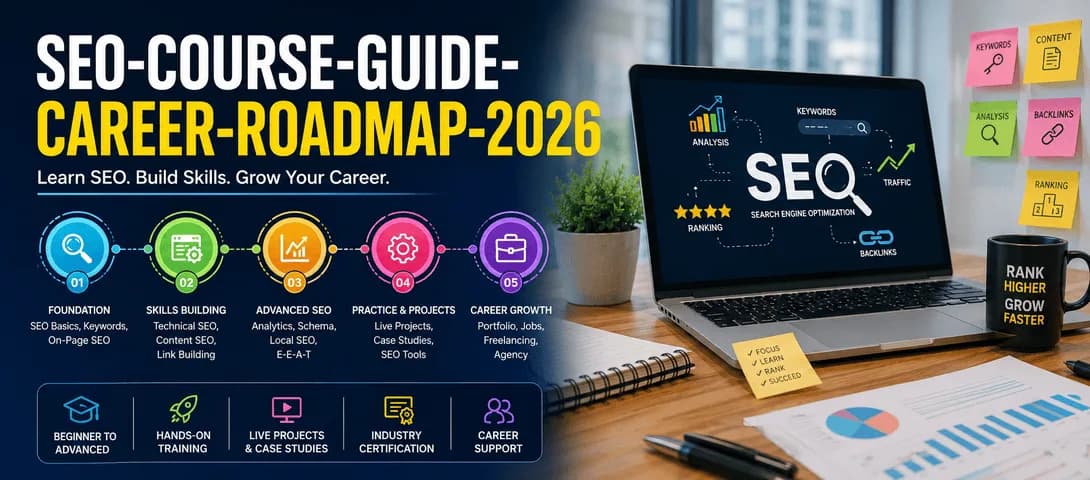
A complete, modern SEO education spans five interconnected layers. Weak courses teach one or two of these in isolation; strong ones teach all five as parts of a single system.
1. Technical SEO
How search engines crawl, render, and index a site. This includes site architecture, Core Web Vitals, mobile-friendliness, XML sitemaps, robots.txt, canonical tags, hreflang for multi-language sites, and the notorious "JavaScript rendering trap" that quietly tanks the visibility of many modern web apps built on frameworks like React or Next.js.
2. On-Page & Content SEO
Title tags, meta descriptions, heading hierarchy, internal linking, image optimization, and — the part most courses underweight — actually writing content that satisfies both a human reader and E-E-A-T (Experience, Expertise, Authoritativeness, Trustworthiness) signals. This also covers topical authority and hub-and-spoke content architecture, which is how sites build genuine subject-matter credibility over time.
3. Off-Page SEO & Digital PR
Backlink strategy has changed shape. It's less about mass outreach emails now and more about digital PR, broken-link building, brand mention tracking, and earning citations because your content is genuinely the best resource on a topic — not because you asked nicely.
4. AEO — Answer Engine Optimization
This is the discipline of winning featured snippets, People Also Ask boxes, and Google's AI Overview panel. It requires formatting content for direct extractability: clear question-answer structures, concise definitions up top, and structured data (schema markup) that makes your content machine-readable.
5. GEO — Generative Engine Optimization
The newest and fastest-growing layer: getting your brand or content actually cited inside ChatGPT, Gemini, Claude, and Perplexity answers. This involves making claims falsifiable and specific (AI models cite specificity, not vague marketing language), building entity recognition around your brand, understanding llms.txt, and tracking AI citations the way you'd track keyword rankings.
Course Curriculum: What a Complete Syllabus Looks Like
Here's a realistic module-by-module structure for a curriculum that actually takes you from beginner to job-ready, rather than beginner to "familiar with the terminology."
Module | Focus Area | What You Should Be Able to Do After |
|---|---|---|
1 | Search Foundations | Explain crawling, indexing, ranking, and SERP anatomy; read a live SERP like a map |
2 | Keyword Research & Intent | Build an intent-mapped, opportunity-scored keyword plan for a real site |
3 | On-Page SEO | Optimize any page against a full on-page checklist |
4 | Technical SEO | Run a full technical audit and prioritize fixes by impact |
5 | Content & Copywriting | Build a topical content cluster with proper pillar-and-spoke structure |
6 | Off-Page & Link Building | Plan and execute an outreach-based link-building campaign |
7 | Optimize a Google Business Profile and rank in the local map pack | |
8 | AEO | Format content to win featured snippets and AI Overview placements |
9 | GEO | Optimize a page to earn and track citations in ChatGPT, Gemini, and Perplexity |
10 | AI Tools for SEO | Build an AI-assisted workflow for research, briefs, and audits |
11 | Analytics & Reporting | Build a client-ready SEO dashboard using GSC and GA4 |
12 | Advanced Strategy | Handle programmatic, international, and e-commerce SEO at scale |
13 | Career Prep & Capstone | Ship a full audit-to-ranking capstone project and enter a real internship |
Notice the sequencing: foundations first, then execution skills (on-page, technical, content), then acquisition (off-page, local), then the newer AI-search layer (AEO, GEO), then measurement, and finally career translation. That order matters — a lot of shorter, cheaper courses skip straight from basics to "tips and tricks" without this scaffolding, which is why their graduates struggle with anything outside a checklist.
Career Opportunities After an SEO Course
SEO skills translate into a surprisingly wide set of job titles, not just "SEO Executive." Common entry and mid-level roles include:
SEO Analyst / SEO Executive — day-to-day optimization, audits, reporting
Content Strategist / SEO Content Writer — content planning informed by search data
Technical SEO Specialist — the highest-demand, highest-paid specialization, focused on site architecture and crawl/index issues
Digital Marketing Executive — SEO as one skill within a broader marketing role
SEO Freelancer / Consultant — independent client work, often the fastest path to higher earnings
In-house SEO Lead — owning organic strategy for a single brand or e-commerce store
Salary Expectations in India (2026)
Compensation varies by city, specialization, and whether you're in-house, agency-side, or freelance. As a general, realistic range for the Indian market:
Experience Level | Typical Monthly Salary (INR) | Notes |
|---|---|---|
Fresher / 0–1 year | ₹15,000 – ₹30,000 | Agencies often pay less than in-house brand roles |
1–3 years | ₹30,000 – ₹55,000 | Technical SEO and content specializations command a premium |
3–5 years | ₹55,000 – ₹90,000 | SEO leads managing small teams or full client portfolios |
5+ years | ₹90,000 – ₹1,80,000+ | Head of SEO / Growth roles, or established freelance/consulting income |
Freelancers and consultants with a strong portfolio and case studies frequently out-earn equivalent in-house salaries, but income is less predictable, especially in the first year of building a client base.
Industries Actively Hiring SEO Talent
SEO is no longer a niche "digital agency" skill. Sectors currently hiring aggressively include:
E-commerce and D2C brands — organic traffic directly offsets rising ad costs
SaaS and B2B tech companies — long sales cycles make content-driven organic acquisition especially valuable
EdTech — highly competitive keyword space with large content budgets
Travel, hospitality, and real estate — local and transactional search intent is central to these businesses
Digital marketing and PR agencies — SEO remains one of the most requested standalone services
Media and publishing — dependent on both classic SEO and now AEO/GEO for AI-search visibility
Tools You Should Get Hands-On With
A course is only as good as the tools it puts in your hands. At minimum, expect real, hands-on (not just demo-video) practice with:
Research & rank tracking: Google Search Console, SEMrush or Ahrefs, Google Keyword Planner
Technical auditing: Screaming Frog, PageSpeed Insights, Google Rich Results Test
Analytics & reporting: GA4, Looker Studio
AI & GEO tools: ChatGPT, Gemini, Claude, Perplexity, plus emerging AI-citation trackers and schema validators
CMS & platforms: WordPress and Shopify, since technical SEO differs meaningfully between them
Real-World Projects That Actually Matter
The single biggest gap between a good SEO course and a mediocre one is whether you graduate with a portfolio or just a certificate. Look for a curriculum that has you build, at minimum:
A full technical SEO audit with a prioritized fix list on a real (not dummy) website
An intent-mapped keyword strategy for an actual niche
A pillar-and-spoke content cluster
A local SEO setup (Google Business Profile + landing page)
A page specifically optimized and tracked for an AI Overview or LLM citation
A client-ready analytics dashboard and report
These become the case studies you show in interviews or pitch to freelance clients — arguably more valuable than the certificate itself.
Certification: What It Should (and Shouldn't) Promise
A course certificate signals that you completed structured, practical training — it is not the same as an official Google certification, and no legitimate course should claim otherwise. What a strong certificate should represent is a portfolio of completed, real-world projects behind it. When evaluating a course, ask specifically what you'll have built by the end, not just what you'll be certified in.
How This Compares Across Course Types
Factor | Short Online Course (2–4 weeks) | University/Long Diploma | Practical Industry Course (2–3 months) |
|---|---|---|---|
Depth of technical SEO | Shallow | Often outdated | Deep, current |
AEO/GEO coverage | Rarely included | Almost never included | Should be core, not optional |
Live projects | Minimal or none | Academic exercises | Real client/brand work |
Placement support | Rare | Sometimes | Should be structured |
Cost | Low | High | Mid-range |
Time to job-readiness | Slow (gaps remain) | Slow (theory-heavy) | Fastest, if genuinely practical |
The cheapest option often costs more in the long run — in the extra months spent closing skill gaps after "finishing" the course.
Common Mistakes Beginners Make
Memorizing checklists instead of understanding why a factor matters, which falls apart the moment a site doesn't match the textbook scenario
Ignoring technical SEO because it feels intimidating, then hitting a ceiling in every audit
Treating link building as a numbers game instead of a relevance and quality game
Writing content for keywords instead of intent, producing pages that rank briefly and then fall
Skipping analytics and being unable to prove impact — the single fastest way to lose a client or a job
Ignoring AI search entirely, which is quickly becoming as important as classic Google rankings
A Realistic Learning Roadmap
Weeks 1–2: Search fundamentals, how ranking actually works, SERP anatomy
Weeks 3–5: Keyword research, on-page optimization, technical SEO basics
Weeks 6–8: Content strategy, off-page/link building, local SEO
Weeks 9–10: AEO and GEO — the AI-search layer
Weeks 11–12: Analytics, reporting, and one advanced specialization
Final phase: Capstone project, portfolio building, and (ideally) a real internship
Future Trends Shaping SEO
Zero-click search keeps growing — more queries get answered directly on the results page or inside an AI chat, without a click at all
Entity-based SEO matters more than keyword-based SEO — search engines increasingly understand topics and brands as connected entities, not just strings of text
Structured data becomes non-negotiable — schema markup is now a baseline requirement for AEO/GEO visibility, not a nice-to-have
First-party data and E-E-A-T rise in importance as AI-generated content floods the web and search engines lean harder on trust signals to filter it
How AI Is Changing the SEO Industry
AI hasn't replaced SEO — it's split it into two connected disciplines. Classic SEO still governs whether a page can rank on a traditional results page. But a growing share of searches never reach a results page at all; they get answered inside an AI Overview or a chatbot conversation. That's GEO's territory, and it plays by different rules: specificity beats persuasion, structured facts beat marketing copy, and being citable matters more than being keyword-optimized.
Practically, this means SEO professionals now also use AI tools daily — for faster keyword research, first-draft content briefs, technical audit summarization, and prompt-engineering workflows that used to take hours manually. The professionals thriving right now are the ones who treat AI as a force multiplier for their strategic thinking, not a replacement for it.
How to Choose the Right SEO Course
Ask any course you're evaluating these direct questions:
Does the curriculum explicitly cover AEO and GEO, or only classic SEO?
Will I complete real audits and campaigns on live sites, or only case-study exercises?
What tools will I get genuine hands-on practice with — not just a demo video?
Is there a capstone project or internship component?
What does placement support actually include, concretely?
Who is teaching — a practitioner with a verifiable track record, or a generic instructor reading slides?
If a course can't answer these clearly, that's your answer.
Why Practical Learning Matters More Than Theory Alone
SEO is a discipline you learn by doing, not by memorizing. Two people can both "know" what a canonical tag is; only one of them can walk into a messy 10,000-page e-commerce site and correctly diagnose a duplicate-content crawl budget issue in twenty minutes. That difference is entirely built through repeated, guided, hands-on practice — which is exactly what separates a course that gets you hired from one that gets you a certificate.
Frequently Overlooked Skills
Stakeholder communication — translating technical findings into business language for non-technical clients or managers
Prioritization frameworks — knowing which of fifty audit findings to fix first based on impact and effort
Basic data literacy in GA4 — beyond vanity metrics, understanding what actually correlates with revenue
AI-citation tracking — a genuinely new skill most "SEO experts" haven't learned yet, and an easy way to stand out
Final Verdict
A good SEO course in 2026 has to do more than teach meta tags and backlinks — it has to prepare you for a search landscape where Google, AI Overviews, and tools like ChatGPT and Perplexity are all deciding, in different ways, whose content gets seen. Evaluate any course — including ours — against that bar: real projects, current curriculum that includes AEO and GEO, hands-on tool exposure, and a clear path from learning to earning.
Ready to Build These Skills Hands-On?
If this roadmap matches what you're looking for, our SEO Course is built around exactly this structure — 13 modules from foundations through GEO, real client projects, and a paid internship at the end. [Explore the full syllabus and apply here.]
About the Author
Jugal Chauhan
Jugal Chauhan is a digital marketing strategist and tech educator with a passion for making complex topics accessible. He writes about marketing, technology, and professional growth to help learners and businesses thrive in the digital age.
Learn more about us →