Get a counselling call
What Is Full Stack Development? Skills, Stack & Career Path
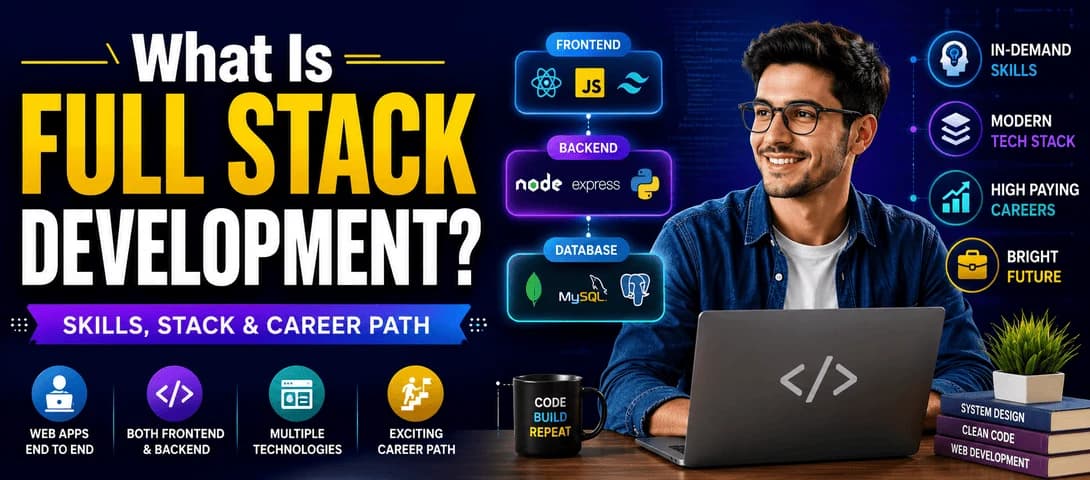
Full stack development is the practice of building both the front end and back end of a web application, meaning one developer designs the interface, writes the server logic, and manages the database that connects them
Why Full Stack Development Matters in 2026
Anyone who has ever used a food delivery app, a banking dashboard, or a booking website has interacted with the result of full stack development, even if they never noticed the term. If you are exploring this field for the first time, our full stack development program walks through the entire journey from writing your first line of HTML to shipping a production ready application, and this guide is built to give you the same clarity in written form. Full stack development sits at the center of almost every modern digital product, because it is the discipline that connects what a user sees to what actually makes an application function behind the scenes. This guide covers what the term means in practice, how the different layers of an application actually work together, the exact skills and tools involved, real examples you can relate to, and the career and business outcomes that make this one of the most searched paths in tech today.
The Real Meaning of Full Stack Development
Full stack development is the practice of designing, building, and maintaining both the front end and the back end of a software application within a single, connected workflow. A person working across the full stack is not specializing in only the interface or only the server logic. They understand how a button click on a screen travels through a network request, gets processed by application logic, touches a database, and returns a response the user can see, all without needing a second person to bridge the gap.
This definition matters because the term is often used loosely. Some people assume full stack development just means knowing a bit of everything at a surface level. In practice, it means being able to take a feature from a rough idea to a deployed, working product. A developer might sketch a login screen, write the interface in a front end framework, build the authentication logic on the server, design the database table that stores user credentials securely, and then deploy the entire feature to a live environment. That end to end ownership is the defining trait, not just technical breadth for its own sake.
The word stack itself refers to the layered set of technologies used to build an application. Every application has at least three layers working together. The presentation layer is what the user sees and touches. The application layer contains the business logic that decides what happens when a user takes an action. The data layer stores and retrieves information reliably. Full stack development means being conversant enough in each layer to build, debug, and improve the application as a whole, rather than only owning one horizontal slice of it.
How Full Stack Development Works, Layer by Layer
Full stack development works by connecting three distinct layers, the front end, the back end, and the database, through a defined communication path, usually an API, so that user actions on screen reliably trigger the correct logic and data changes behind the scenes. Understanding this flow is more useful than memorizing definitions, because it explains why full stack developers need both design sense and systems thinking.
Here is how a typical request moves through a full stack application, step by step. First, a user interacts with the interface, for example by submitting a signup form. Second, the front end code captures that input and validates basic formatting before sending anything further. Third, the front end sends a structured request, typically over HTTP, to a back end server, carrying the user's data. Fourth, the back end receives that request through a defined route, checks permissions, and applies business rules, such as confirming the email is not already registered. Fifth, the back end talks to the database, either writing new data or reading existing records needed to complete the action. Sixth, the database returns a result to the back end, which then formats an appropriate response. Seventh, the back end sends that response back across the network to the front end. Eighth, the front end updates the interface, showing a success message, an error, or redirecting the user to their new dashboard.
Every production application you use daily, from a ride hailing app to an online classroom portal, repeats variations of this same eight step flow thousands of times a second. A person practicing full stack development needs to be comfortable at every one of those steps, which is precisely why the discipline is treated as its own specialization rather than simply frontend plus backend bolted together.
Core Skills and Technologies Behind Full Stack Development
The core skills behind full stack development split into four groups, front end technologies, back end technologies, database and API knowledge, and supporting tools like version control and deployment platforms, and a capable developer needs working fluency in all four rather than expertise in only one. For a complete, categorized checklist of exactly what to learn inside each group, our full stack developer skills required guide lists every skill hiring managers actually screen for.
Front End Technologies and Responsibilities
The front end is everything a user sees and directly interacts with inside a browser or app screen. Front end development starts with HTML for structuring content, CSS for visual styling and layout, and JavaScript for interactivity and logic that runs directly in the browser. Beyond these foundations, most professional teams rely on a front end framework such as React, Angular, or Vue to manage complex interfaces efficiently, along with responsive design techniques using flexbox and grid systems so pages adapt correctly across phones, tablets, and desktops.
Back End Technologies and Responsibilities
The back end is the invisible engine that processes logic, enforces rules, and talks to storage systems. Back end development commonly uses languages such as JavaScript through Node.js, Python, Java, or PHP, paired with frameworks like Express, Django, or Spring that speed up building secure, well structured APIs. Back end responsibilities include authentication and authorization, request validation, business logic, and communicating with databases through queries or an object modeling layer.
To make the front end and back end comparison concrete, consider this side by side breakdown. On the front end side, the developer focuses on layout, styling, interactivity, accessibility, and client side performance, working directly with what the user sees. On the back end side, the developer focuses on data validation, business rules, authentication, server performance, and secure communication with the database, working with what the user never sees but always depends on. A capable full stack developer moves fluidly between both columns rather than treating them as separate jobs.
Databases, APIs, and Popular Stack Combinations
No application is complete without a place to store data reliably. Full stack developers work with relational databases such as MySQL and PostgreSQL for structured, table based data, and non relational databases such as MongoDB for flexible, document based data. APIs, particularly REST and increasingly GraphQL, define the contract through which the front end and back end exchange information predictably.
Certain technology combinations have become popular enough to earn their own names. The MERN stack combines MongoDB, Express, React, and Node.js into a fully JavaScript based workflow, which is one reason JavaScript has become close to essential across the entire stack. The MEAN stack swaps React for Angular. Other developers prefer a Django based stack using Python, or a Ruby on Rails based stack. None of these combinations is objectively superior, and choosing between them usually comes down to team preference, hiring availability, and the specific performance needs of the project. If you are trying to decide between two of the most common options, our detailed comparison of MERN versus MEAN breaks down the practical differences in tooling, learning curve, and job market demand.
Real World Examples and Use Cases
Full stack development is easiest to understand through concrete examples rather than abstract definitions, because nearly every application people use daily is a full stack product built by developers moving across the entire layer stack. A ride booking app is a textbook example. The front end shows a map, a fare estimate, and a booking button. The back end calculates real time pricing, matches available drivers using location data, and manages payment processing securely. The database stores ride history, driver ratings, and user profiles. None of these pieces work in isolation, and a full stack developer is trained to reason about all of them together when something breaks or needs improvement.
A second example is an e-commerce storefront. The front end handles product browsing, filtering, and checkout screens. The back end manages inventory counts, applies discount logic, and integrates with a payment gateway. The database tracks orders, stock levels, and customer accounts. A common mistake early developers make here is building beautiful checkout screens without properly validating stock availability on the back end, which leads to overselling products that are actually out of stock. Handling this correctly, by re-checking inventory at the exact moment of payment rather than only when the page loads, is the kind of practical, experience based judgment that separates production ready full stack development from a tutorial project.
A third example worth mentioning is internal business tooling, such as an admin dashboard that lets a company track sales, manage employee records, or monitor customer support tickets. These tools rarely make headlines, but a huge share of full stack development work inside companies involves building and maintaining exactly this kind of internal software, which makes strong fundamentals more valuable in the long run than chasing the newest framework.
Career Outcomes, Salary, and Business Value
Full stack development consistently ranks among the most in demand technology careers because it offers employers flexibility, since one skilled developer can move between front end and back end tasks depending on what a project needs at a given moment. This flexibility translates into strong hiring demand across startups, mid sized product companies, and large enterprises, particularly because smaller teams often cannot afford to hire separate frontend and backend specialists for every project.
From a career standpoint, full stack developers typically progress from building guided features under supervision, to owning entire modules independently, to eventually leading architecture decisions across a product. Compensation tends to reflect this breadth of responsibility, and many professionals use full stack skills as a foundation before specializing further into areas like backend architecture, DevOps, or technical leadership later in their careers. If you want a realistic sense of what compensation looks like at each experience level in the Indian market specifically, our detailed breakdown of full stack developer salary in India uses current market data rather than rough estimates.
From a business perspective, the value of full stack development goes beyond individual salaries. Teams built around full stack developers tend to ship features faster, since the same person who designs an interface can also wire up the logic behind it without waiting on handoffs between separate frontend and backend teams. This is particularly valuable for early stage startups building a minimum viable product, and for growing companies scaling a lean engineering team. To see this pattern reflected across industries, our overview of the scope of full stack development looks at where demand is concentrated and how that demand is shifting.
Full Stack Development Versus Frontend or Backend Specialization
Choosing between full stack development and a narrower specialization in only frontend or only backend development depends primarily on the kind of role and company you want to work in, not on which path is objectively better. Full stack development suits people who enjoy variety, want maximum flexibility in the job market, or plan to eventually start their own product or freelance practice. Specializing deeply in one layer suits people who want to go extremely deep into a narrow area, such as advanced frontend performance engineering or backend systems architecture at scale.
Here is a direct comparison to help with that decision. A full stack path gives you broad, end to end ownership of features, strong flexibility to work at startups and small teams, and the ability to build complete side projects independently, though it can mean covering more ground with slightly less depth in any single layer early on. A frontend specialist path gives you deep mastery of interface performance, accessibility, and design systems, strong fit for large consumer facing products, though it can mean depending on backend teams to ship complete features. A backend specialist path gives you deep expertise in databases, system architecture, and scalability, strong fit for infrastructure heavy companies, though it can mean less involvement in the visual and interactive side of a product.
Many experienced developers actually move through more than one of these paths across a career, starting broad with full stack development to understand the whole system, and later choosing to specialize once they discover which layer they enjoy most. For a more detailed side by side breakdown with concrete examples of daily tasks in each role, our comparison of full stack versus frontend versus backend development is worth reading before making a final decision.
How to Start Learning Full Stack Development the Right Way
The fastest reliable way to start learning full stack development is to follow a structured sequence, front end fundamentals first, then a front end framework, then back end fundamentals, then databases, and only then move into advanced topics like testing, security, and deployment, rather than jumping between random tutorials without a clear order. Skipping fundamentals to chase the newest framework is one of the most common mistakes beginners make, and it usually shows up later as confusion about why something works rather than genuine understanding. For a full step by step breakdown of this exact sequence, our guide on how to become a full stack developer walks through each stage in order.
Curriculum Overview
A well structured full stack development course should mirror how real applications are built. As one practical reference point, our own full stack development program is organized as a fourteen module path that starts with web foundations using HTML, CSS, and responsive design, then moves into modern JavaScript, version control with Git and GitHub, front end development with React, state management, and back end development with Node.js and Express. From there it covers databases using MongoDB alongside SQL basics, full stack integration and authentication, AI assisted development workflows using tools like Copilot and Claude, building AI powered features, TypeScript and Next.js, testing and security, DevOps and deployment, and finishes with interview preparation, a capstone project, and a paid internship. If you want to see the exact week by week breakdown before committing to a learning path, our full stack developer roadmap lays out each stage in the order it should be tackled. For the subject wise breakdown of exactly what each individual module teaches, our full stack developer syllabus page lists every topic covered end to end.
Full Stack Development Course Basics
Before comparing providers or reading the full curriculum in detail, it helps to see the core program facts in one place, the same way you would check duration, mode, level, and fees for any course before enrolling.
Course | Duration | Mode | Level | Fees | Certification | Placement Support | Live Projects |
|---|---|---|---|---|---|---|---|
Full Stack Development | 6 Months | Online | Beginner to Advanced | Rs 70,000 | Industry Recognised Certificate | 100% Placement Assistance | Real Client and Brand Projects |
Duration, Format, and Practical Information
Full stack development is typically learned over a timeline of four to eight months for a structured, mentor led course, depending on prior experience and weekly time commitment. As a concrete reference point, a comprehensive full stack development program can run around six months, delivered fully online with flexible weekday and weekend batch options, which makes it realistic for both students and working professionals to complete without pausing their current commitments. Course fees for a comprehensive, mentor led full stack development program in India commonly sit in a similar range to seventy thousand rupees, though this varies based on curriculum depth, live project access, and whether placement support is included. Our detailed page on full stack development course fees breaks down exactly what is typically included at different price points, so you can compare offers accurately instead of judging a course on price alone.
Certification, Projects, and Placement Support
A credible full stack development program should require you to build real, working projects rather than only watching lecture videos, since employers consistently value a strong project portfolio over a certificate alone. Look for programs that include live projects on real client style requirements, a capstone application built end to end, and structured interview preparation, ideally backed by placement assistance and an internship component that gives you actual working experience before you apply for full time roles. Programs with strong industry placement track records, meaningful recruiting partner networks, and mentors who are still practically active in the field tend to translate into faster, more confident job transitions. If you are completely new to the field and unsure where to even begin, our guide on full stack development for beginners is written specifically for people starting from zero prior coding experience. And if you are comparing multiple training providers in the same city, our breakdown of the best full stack developer institute in Noida explains exactly what to check before enrolling anywhere.
About the Author
Jugal Chauhan
Jugal Chauhan is a digital marketing strategist and tech educator with a passion for making complex topics accessible. He writes about marketing, technology, and professional growth to help learners and businesses thrive in the digital age.
Learn more about us →