Get a counselling call
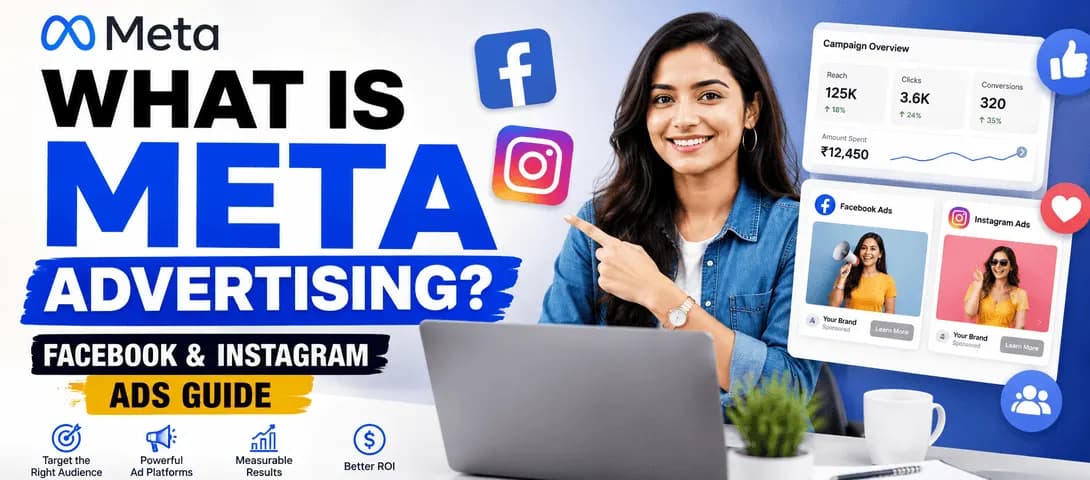
What Is Meta Advertising? A Complete Guide to Facebook and Instagram Ads
Meta advertising is paid promotion run through Meta's platforms, mainly Facebook and Instagram, using the Meta Ads Manager. Businesses set a goal, choose a target audience, set a budget, and create ads that appear in feeds, Stories, Reels, and more. Meta's system then shows those ads to the people most likely to act, and you pay for the resulting views, clicks, or conversions. It is simply the modern name for what was long called Facebook advertising.
A Simple Definition of Meta Advertising
Meta advertising, often called Meta ads or Facebook ads, is the paid promotion of products, services, and brands across Meta's family of apps, primarily Facebook and Instagram. In plain terms, it is how a business pays to put its message in front of a chosen audience on these platforms, instead of relying only on unpaid, organic reach. A single Facebook ad is one such paid message, and the meaning of Meta ads is simply the whole system that delivers them.
The reason it matters is scale and precision. Billions of people use Facebook and Instagram, and Meta knows a great deal about their interests and behaviour. That lets advertisers reach very specific groups, such as new parents in a particular city or people who recently viewed a product, with a relevance that traditional media cannot match.
In one line
Meta advertising is paid marketing on Facebook and Instagram, managed through Meta Ads Manager, where you pay to show targeted ads and Meta optimises who sees them. It is one of the core paid channels taught in a modern AI digital marketing course.
How Facebook Advertising Became Meta Advertising
For most of its history, this was simply known as Facebook advertising. In 2021, Facebook the company renamed itself Meta, bringing Facebook, Instagram, Messenger, and WhatsApp under one brand. The advertising system was unified under the Meta name, which is why you now see the terms Facebook ads and Meta ads used to mean much the same thing.
The practical takeaway is that Facebook ads and Meta ads are the same core product, run from the same Meta Ads Manager. The rebrand reflected that a single campaign can now place ads across Facebook and Instagram together, rather than treating them as separate silos. When people ask what a Facebook ad is today, the honest answer is that it is a Meta ad shown on Facebook.
Where Meta Ads Appear Across Facebook, Instagram, and Beyond
One reason Meta advertising is so powerful is the sheer number of places an ad can appear, all managed from one account. These positions are called placements, and Meta can automatically choose the best mix for your goal.
Facebook: the main feed, Stories, Reels, Marketplace, video feeds, and the right column on desktop.
Instagram: the feed, Stories, Reels, Explore, and the shop.
Messenger: the inbox and Stories.
Audience Network: partner apps and websites outside Meta's own platforms.
For most beginners, the simplest approach is to let Meta place ads automatically across these positions and learn from the results, rather than trying to control every placement manually from day one.
How Meta Advertising Actually Works
Meta advertising works through an auction: you tell Meta your goal, audience, and budget, and its system decides which ads to show each person to get the best result for the lowest cost. You do not bid against competitors in a simple highest-price-wins sense. Meta weighs your bid alongside how relevant and engaging your ad is likely to be for each user, so better ads often cost less.
The core building blocks
Objective: what you want, such as awareness, traffic, leads, or sales.
Audience: who sees the ad, defined by location, demographics, interests, or your own customer data.
Budget and schedule: how much you spend and when.
Creative: the image, video, and text that make up the ad itself.
Optimisation: Meta learns who responds and shifts delivery toward them automatically.
All of this is managed in Meta Ads Manager, the free tool at the centre of the platform. Learning to use it well is the heart of a performance marketing skill set, and it is exactly what a good paid-ads course teaches through live campaigns.
The Main Meta Ad Formats
Meta offers several ad formats, each suited to a different goal and creative style. Choosing the right format for your message is a core skill. The table below summarises the most common ones.
Format | What it is | Best for |
Image ad | A single still image with text | Simple, clear messages |
Video ad | A short video in feed, Stories, or Reels | Storytelling and demos |
Carousel | Multiple images or videos users can swipe | Showcasing several products |
Collection | A cover plus a grid of products | Mobile shopping |
Stories and Reels | Full-screen vertical ads | Younger, mobile-first audiences |
Lead ad | A form that opens inside the app | Collecting leads with less friction |
Beginners usually start with simple image and video ads, then test carousels and lead forms as they learn what their audience responds to. The format matters less than the clarity of the message and the strength of the offer.
How a Meta Advertising Campaign Is Structured
A Meta advertising campaign has three levels: the campaign, the ad set, and the ad. This structure is the same whether people call it a Facebook ads campaign or a Meta ads campaign, and understanding it is the first practical step to running ads that work.
Level | What you set here | Think of it as |
Campaign | Your objective, such as sales or leads | The overall goal |
Ad set | Audience, budget, schedule, and placements | Who, where, and how much |
Ad | The actual creative and copy people see | The message itself |
A single campaign can hold several ad sets, and each ad set can hold several ads. This lets you test different audiences and creatives at once, then put more budget behind whatever performs best. Getting this hierarchy right is what separates guesswork from a structured, improvable campaign.
What Meta Ads Cost and How Pricing Works
Meta ads do not have a fixed price; you set a budget and pay based on results, such as per click or per thousand views, decided by an auction. You can start with a very small daily budget and scale up as you see what works, which is part of why the platform suits small businesses and beginners.
Actual costs vary widely by industry, audience, location, and how good your ads are. More relevant, engaging ads tend to win the auction more cheaply, so skill directly lowers your cost. Rather than memorising a rate, the useful lesson is that budget plus quality plus targeting together decide what you pay and what you get back.
A realistic expectation on cost
Ignore anyone promising an exact guaranteed cost per result. Prices move constantly with competition and season. The reliable path is to start small, measure honestly, improve the ad and the targeting, and let the winners scale.
Why Businesses Use Meta Advertising
Meta advertising has become a default channel for businesses of every size, from local shops to global brands. The reasons are consistent and practical.
Benefit | Why it matters |
Massive reach | Access to billions of active users across Facebook and Instagram |
Precise targeting | Reach specific interests, behaviours, locations, and custom audiences |
Low entry budget | Start with small daily spend and scale what works |
Measurable results | Track clicks, leads, and sales clearly in Ads Manager |
Strong for visuals | Ideal for products and brands with images and video |
Retargeting | Re-reach people who visited your site or engaged before |
This mix of reach, precision, and low entry cost is why Meta advertising is a core part of almost every modern marketing plan, and why paid-ads skills are in strong demand. It sits alongside SEO and content as one of the pillars taught in a full AI digital marketing course
Meta Advertising Compared With Google Ads
Meta ads and Google ads are the two giants of digital advertising, and they work differently. Neither is simply better; they suit different goals, and many businesses use both together.
Factor | Meta advertising | Google Ads |
Core idea | Show ads to likely-interested people | Show ads to people actively searching |
Demand | Creates and captures demand | Captures existing demand |
Best for | Discovery, brand, visual products | High-intent, ready-to-buy searches |
Targeting | Interests, behaviour, lookalikes | Keywords and search intent |
Creative | Highly visual, feed-native | Text, shopping, and video |
A simple way to think about it: Google ads meet people who are already looking for what you sell, while Meta ads introduce you to people who would want it if they knew about it. Skilled marketers learn both and choose the right tool for each goal.
The Skills You Need to Run Meta Ads Well
Running effective Meta ads is a learnable skill, not a mystery. It blends creativity, analysis, and a clear understanding of the platform. None of these require a technical degree.
Skill area | What it involves |
Audience and targeting | Defining and testing who should see your ads |
Creative and copy | Making thumb-stopping visuals and clear, persuasive text |
Campaign structure | Setting up campaigns, ad sets, and ads correctly |
Budgeting and bidding | Allocating spend and reading the auction |
Analytics | Reading results and deciding what to change |
Testing mindset | Running experiments and scaling the winners |
The fastest way to build these skills is on real campaigns with feedback, which is why hands-on training beats theory. A structured performance marketing course focuses specifically on paid channels like Meta ads, while a broader AI digital marketing course places them alongside SEO, content, and analytics.
How AI Has Changed Meta Advertising
Artificial intelligence now sits at the centre of Meta advertising. Meta's own tools, sometimes grouped under names like Advantage and Advantage Plus, use AI to choose audiences, place ads, and optimise budgets automatically. Alongside this, marketers use AI tools to generate and test creative and copy far faster than before.
AI has made Meta ads easier to start but not easier to master. The platform automates more of the manual work, which raises the value of the human skills AI cannot replace: strategy, offer, creative judgement, and knowing what to test and why. Beginners can get running quickly, while the marketers who understand the fundamentals still get far better results from the same AI tools.
This is why modern paid-ads training teaches you to direct AI rather than compete with it. The goal is to use automation to move faster while keeping human control of the strategy, which is the skill set employers now look for.
How to Learn Meta Advertising and Build a Career
Meta advertising is one of the most in-demand and beginner-friendly skills in digital marketing, and it opens roles from ads specialist to performance marketer to freelance media buyer. CourseUnbox is a Noida-based institute serving Delhi-NCR, founded by Jugal Chauhan, with more than 12 years in digital marketing, over 40,000 learners trained, and recognition from Outlook India, and its training is built around live campaigns rather than theory.
Founder's note
In more than a decade of teaching paid advertising, the marketers who stand out are not the ones who memorise settings, but the ones who learn to test, read the data, and improve the offer. Meta ads reward that habit, which is why we teach it on real campaigns from day one rather than through slides.
- Jugal Chauhan, Founder, CourseUnbox
If you want to learn it properly, the fastest route is a hands-on program. Explore the performance marketing course, which focuses on paid channels including Meta ads, or the broaderAI digital marketing course, which covers Meta ads alongside SEO, content, and analytics. You can also see where the skill leads through performance marketing salary in India and digital marketing salary in India. If you are just out of school, many learners begin with a digital marketing course after 12th and specialise in paid ads from there. Learners in the Noida area can explore AI digital marketing courses in Noida and programs across Noida sectors.
Prefer to talk first? Get in touch with the CourseUnbox team to discuss which path and batch suit your goals before you enrol.
Sources and Further Reading
The explanations above reflect how Meta advertising works at the time of writing. Meta updates its tools, formats, and policies regularly, so confirm current details in Meta's own resources before you rely on them.
Meta Business Help Center and Meta Ads Manager: official guidance on campaigns, formats, and policies.
Meta for Business: current ad objectives, placements, and best-practice documentation.
Reputable marketing publications for independent tutorials and benchmarks, verified against Meta's own docs.
Related CourseUnbox programs and guides, including the performance marketing course, the AI digital marketing course, and digital marketing course fees
About the Author
Jugal Chauhan
Jugal Chauhan is a digital marketing strategist and tech educator with a passion for making complex topics accessible. He writes about marketing, technology, and professional growth to help learners and businesses thrive in the digital age.
Learn more about us →