Get a counselling call
What Is Social Media Communication? Definition, Types and Examples
Social media communication is the process of creating, sharing and exchanging information, ideas and messages through online platforms and networks, using text,
Social media communication is the process of creating, sharing and exchanging information, ideas and messages through online platforms and networks, using text, images, video or a mix. What makes it different from traditional media is that it is two-way and many-to-many: anyone can publish, reply and share in real time, rather than receiving a one-way broadcast. More than 5.7 billion people, close to 70 percent of the world, now use social media, so it has become one of the main ways we talk to each other.
What is social media communication?
Social media communication is the exchange of information and ideas between people, communities and brands over platforms like Facebook, Instagram, YouTube, WhatsApp, LinkedIn and X. The message can be text, an image, a video, a voice note or a live stream, and it flows in every direction at once.
The clearest way to understand it is by contrast. Traditional media, a newspaper or a TV channel, is one to many and one way: one publisher speaks and everyone else listens. Social media communication is many to many and two way: the audience can reply, share and start its own thread, and the person or brand on the other side is expected to answer. That shift from broadcast to conversation is the whole idea, and it is why social media marketing is a communication skill before it is an advertising one. If the term is new to you, start with what social media marketing is.
A related term worth clearing up: social networking is the act of building connections on these platforms, while social media communication is what actually passes between those connections. Networking is the road, communication is the traffic.
The main types of social media communication
It takes a few clear forms, and most platforms mix several.
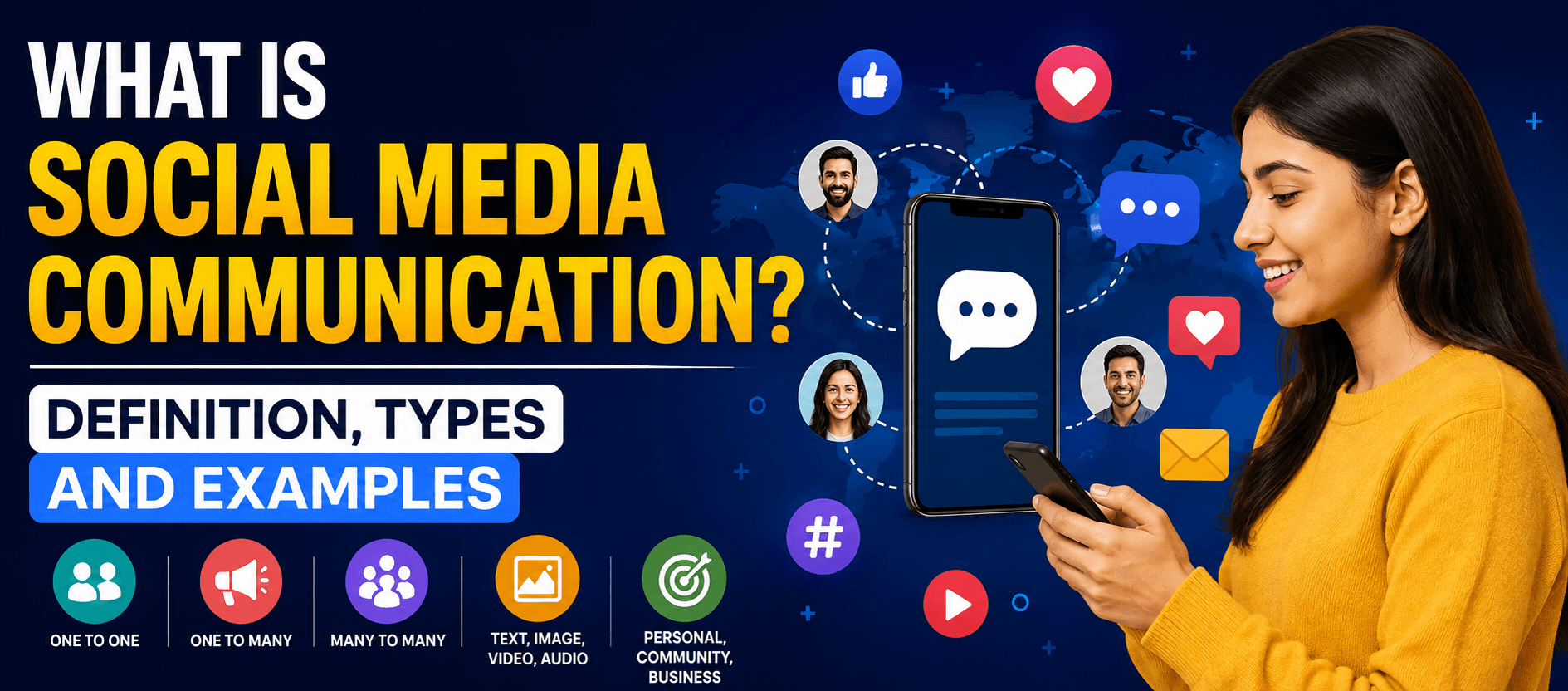
By direction: - One to one: private messages, like a WhatsApp chat or an Instagram DM. - One to many: a post, story or video published to your followers. - Many to many: a comment thread, a Reddit community, or a hashtag conversation where everyone talks to everyone.
By format: text, image, video and audio. Video, including short video and live streams, is now the dominant format.
By purpose: personal, community, and brand or business communication. Handling the last one well is a real skill, and one of the skills required for social media marketing.
Most real communication blends these. A brand might post a video, get comments, and answer a complaint by DM, all from one campaign.
How social media communication works
Three features make it behave differently from a phone call or an email.
It is instant and public. A message can reach millions in seconds, mostly in the open where others can join in.
It is interactive. Likes, comments, shares and reactions are all communication. The audience are participants, not just receivers.
It is filtered by algorithms. The platform decides who sees a message based on their interests, so you write for both a human and the algorithm.
Together these turn communication from a message you send into a conversation you host.
How social media changed the way we communicate
Communication got faster and shorter, compressed into posts, captions and messages. It went global and instant, reaching most of the world the moment it is posted. It became two way, so people and brands are expected to reply. And it became always on, a constant stream rather than set moments.
There is a cost side too, and an honest answer says so. Heavy use is linked to shorter attention for in-person conversation and to the fast spread of misinformation, because the same speed and reach that carry a good message also carry a false one. Communicating well means using the reach without feeding those problems.
Advantages and challenges
Advantages | Challenges |
Reaches a huge audience instantly and for free | Messages can be misread without tone or body language |
Two-way, so you hear back from your audience | Misinformation spreads as fast as facts |
Cheap compared with traditional media | The algorithm, not you, decides who sees a post |
Builds community and direct relationships | Public mistakes are visible and permanent |
Works across text, image, video and live | Constant presence can blur work and personal life |
Social media communication for business
For a business, social media communication is three jobs at once: marketing, when you post to build awareness; customer service, when you answer questions in public and by DM; and public relations, when you manage what people say about you. Getting the tone right across all three, on the right platform, is a profession.
If that is the direction you want, the social media marketing course covers it hands on, including the organic vs paid split and how to pick the best social media platforms for business in India. It is a growing career, which the career scope of social media marketing and the social media manager salary in India both show, with a clear route in through the how to become a social media manager guide.
How to get better at social media communication
Knowing the definition is the easy part. Communicating in a way that reaches and moves people is the skill, and it is learnable. You can start by studying what performs on the platforms you use, but that is slow and gives no feedback. A structured course fills that gap by letting you run real campaigns and telling you what worked, with a track for beginners and a full course syllabus covering communication across every platform type.
About the Author
Jugal Chauhan
Jugal Chauhan is a digital marketing strategist and tech educator with a passion for making complex topics accessible. He writes about marketing, technology, and professional growth to help learners and businesses thrive in the digital age.
Learn more about us →