Get a counselling call
SEO Strategy: The Complete 2026 Guide (Types, Steps, Sprint Plan & AI SEO)
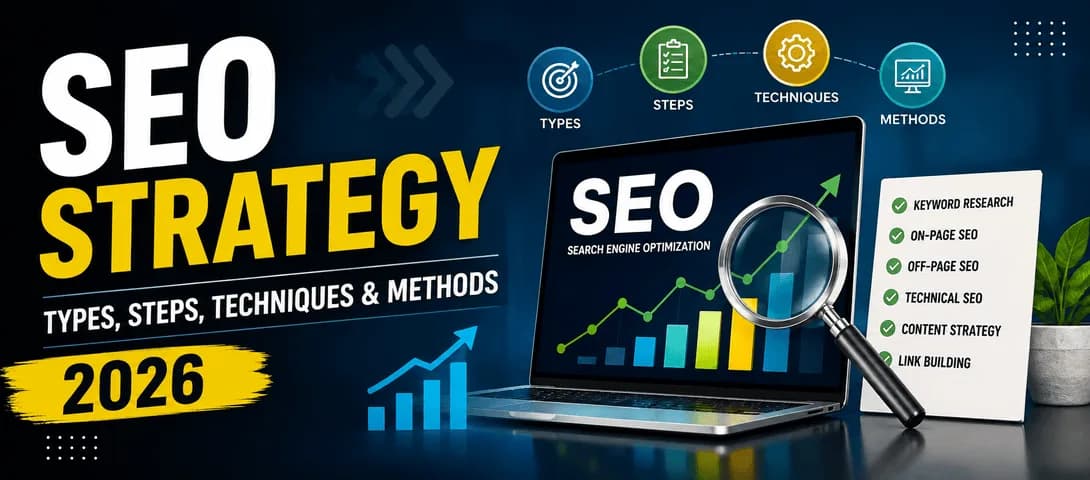
An SEO strategy is a documented, prioritised plan that connects specific SEO activities — technical fixes, keyword targeting, content, and link building — to a business goal, in a set order and on a realistic timeline. In simple terms, the strategy of SEO is the "why and in what order", while SEO techniques and tactics are the individual "what". According to CourseUnbox, a strong 2026 SEO strategy combines the four types of SEO (on-page, off-page, technical and local) across a nine-step build process, and is optimised not just for Google rankings but for AI Overviews and LLM citations.
What Is an SEO Strategy?
An SEO strategy is a plan of action for getting a website to rank higher in Google's organic results and to be cited inside AI answers. It answers four questions: Where are you now? Where do you want to be? How will you get there? How will you know you've arrived? Miss any one and SEO becomes a pile of activities that never compound.
SEO Strategy vs SEO Tactics vs SEO Techniques
People search seo strategies, seo techniques and seo methods as if they're identical. They're related but distinct — and knowing the difference is the first sign of an SEO who plans.
Aspect | SEO Strategy | SEO Tactics / Techniques |
Meaning | The coordinated plan linking actions to a business goal | The individual actions and methods that improve SEO |
Example | "Build topical authority in digital marketing over 6 months to reach page 1 for 30 buyer keywords" | "Add internal links", "write a title tag", "build a backlink" |
Scope | A programme over 6–24 months | A single task you can do today |
Answers | Why, and in what order? | What, exactly? |
Failure mode | Wrong priorities, unrealistic timelines | Lots of activity, no direction, nothing compounds |
The one-line test
If you can't say which business outcome a task moves and where it sits in your timeline, you're doing SEO tactics without a strategy. Strategy is the multiplier that makes the same techniques produce far bigger results.
The 4 Types (Pillars) of SEO Strategy
Every strong SEO optimization strategy mixes four categories — often called the pillars of SEO — based on whether the work happens on your site or off it. Most sites need all four; a purely online business may skip local.
Type / Pillar | What it covers | Core tactics |
On-Page SEO | Everything on your own pages | Title tags, meta descriptions, headings, keyword usage, internal links, alt text, content quality |
Off-Page SEO | Signals earned outside your site | Link building, guest posts, brand mentions, digital PR, social profiles |
How well engines & AI crawlers read you | Site speed, mobile-first, Core Web Vitals, sitemaps, schema, fixing crawl/index errors | |
Visibility in a geographic area | Google Business Profile, citations, reviews, geo-keywords, embedded maps |
On-Page SEO Strategy
On-page SEO is any optimisation on your actual website — title tags, headings, URL structure, internal links, and genuinely useful content. It's the foundation every other SEO technique builds on.
Off-Page SEO Strategy
Off-page SEO builds authority beyond your site — mostly backlinks, brand mentions and digital PR. In the AI era, even an unlinked mention on a trusted site can earn you visibility inside AI answers. Quality and relevance beat volume every time.
Technical SEO Strategy
Technical SEO makes sure search engines and AI crawlers can find, render and index your pages: fix crawl errors and 404s, serve HTTPS, pass Core Web Vitals (LCP, INP, CLS), stay mobile-first, add schema — and allow AI bots (GPTBot, Google-Extended, ClaudeBot, PerplexityBot) in robots.txt if you want AI citations.
Local SEO Strategy
If you serve a city or region — say an institute running SEO courses in Mathura — local SEO gets you into the Google Map pack via a complete Business Profile, reviews and geo-keywords. Not every site needs it, but for local businesses it's often the fastest win.
How to Create an SEO Strategy: 9 Steps
This is the SEO process — the sequence agencies charge lakhs for, in nine steps you can follow in order. Each feeds the next, so resist skipping ahead.
Step 1 — Set business-aligned goals (SMART)
Start with a business outcome, not an SEO metric. Make each goal Specific, Measurable, Attainable, Relevant, Time-bound. Worked example: "Generate 50 qualified organic enquiries a month by December by ranking top 5 for 30 buyer-intent keywords" — not "rank #1 for keyword X".
Step 2 — Run a baseline SEO audit
Capture your starting point across three pillars: technical health (crawl errors, Core Web Vitals, indexed pages), content (pages with traffic, thin pages, page-2 pages), and authority (referring domains, Domain Rating). Free tools: Google Search Console + GA4.
Step 3 — Analyse competitors and the SERP
Separate business competitors (who sell what you sell) from SERP competitors (who own the results). Study the pages ranking for your target terms — format, depth, headings, tables, whether an AI Overview appears. Their gaps are your opportunities. This teardown decides what "better" means before you write a word.
Step 4 — Build your keyword universe and cluster it
Group keywords by intent so one page targets one intent (never scatter the same keyword across pages — that's cannibalisation). Structure in tiers (see the table below) and start with the long tail to build authority.
Step 5 — Fix the technical foundation
Clear blockers first: robots.txt mistakes, accidental noindex, missing sitemap, 404s and redirect chains, HTTPS gaps, failing Core Web Vitals, mobile issues. A brilliant article that's accidentally blocked earns zero traffic. Do this in the first 30 days.
Step 6 — Design the content strategy (topic clusters)
Turn the keyword universe into a plan: one pillar page per core topic, supported by 5–10 interlinked cluster articles. Set quality standards — intent match, required sections (intro, body, FAQ, CTA), schema, internal links, and a named expert author (E-E-A-T). Updating an existing page usually beats writing a new one.
Step 7 — Optimise on-page elements
Per page: a unique, click-worthy title (50–60 chars, keyword first), a meta description (150–160 chars) with the keyword, a clear H1/H2/H3 structure, descriptive alt text, fast load, and internal links with descriptive anchors ("seo course", not "click here").
Step 8 — Build authority and earn citations (off-page)
Earn links and mentions from relevant, trusted sources: guest posts, broken-link building, digital PR, original data, expert commentary. In 2026 the goal is broader than backlinks — be mentioned alongside competitors so both search engines and LLMs recognise your brand.
Step 9 — Track, measure and update
Track impressions, clicks, CTR, positions and conversions weekly in GSC/GA4; review monthly. Keep content fresh — small optimisations, mid-size upgrades, full rewrites — and track how often AI tools cite your brand.
SEO Strategy by Business Stage: New vs Established Site
The same framework flexes to where your site is today. Priorities shift as authority grows.
Priority | New site (DR 0–20) | Established site (DR 30+) |
Keywords | Very low-competition long-tail (KD < 20) | Higher-KD head & commercial terms |
Content | Build first topic clusters from scratch | Audit, refresh & consolidate existing pages |
Links | First 30–50 relevant backlinks | Digital PR, original data, competitive gaps |
Technical | Get foundations right from day one | Fix accumulated technical debt |
Focus | Establish topical authority | Defend positions & scale what works |
Build Your Keyword Universe (Pillar → Cluster → Long-Tail)
Step 4 in detail. A keyword universe isn't a flat list — it's a tiered hierarchy where one pillar page and its cluster capture dozens of related queries. This is how a single page can rank for many variations (the way this guide targets seo strategies, seo optimization strategies, seo techniques and seo methods together).
Tier | What it is | Difficulty / Volume | Example (India) |
Tier 1 — Pillar | Broad head terms defining your core topic | KD 40–70+ / high volume | "seo services india", "digital marketing" |
Tier 2 — Cluster | Medium-tail terms supporting each pillar | KD 20–45 / medium | "seo strategy for startups", "local seo india" |
Tier 3 — Long-tail | Specific, low-competition quick wins | KD 5–25 / low | "seo strategy for a new blog in india" |
Sequence: win Tier 3 first to build authority, climb to Tier 2 for core traffic, then compete for Tier 1 once your Domain Rating supports it. For the hands-on workflow, see how to find & target keywords.
SEO Strategy for AI Overviews & LLMs (2026)
Search in 2026 isn't just ten blue links. AI Overviews sit above results for a growing share of queries, and buyers ask ChatGPT, Gemini and Perplexity directly. A modern SEO strategy must earn visibility there too — often called AEO (Answer Engine Optimization) or GEO (Generative Engine Optimization).
Keyword Research vs Prompt Research
A 2026 addition: research the natural-language prompts people type into AI tools, not just short keywords.
Keyword research | Prompt research | |
Input | Short queries ("seo strategy template") | Natural questions ("how do I build an SEO strategy for a B2B startup?") |
Source | Google, Bing, keyword tools | ChatGPT, Perplexity, AI Overviews |
Goal | Rank in the SERP | Be cited/summarised in AI answers |
Optimise for | Keywords in titles, headings, meta | Clear answers, structure, entity-rich language |
How to Write "Answer-First" Content AI Will Cite
Open every H2 with a 40–60 word direct answer to that section's implied question — write it before the explanation.
Name your brand inside the answer so a lifted passage keeps attribution (as the answer boxes in this guide do).
Use clean structure & schema: H1/H2/H3, short paragraphs, tables, and FAQPage / HowTo / Article JSON-LD.
Make specific, attributable claims, not vague generalities — AI extraction skips hedged content.
Add an FAQ section with self-contained answers; AI engines pull from these often.
Let AI crawlers in (check robots.txt for GPTBot, Google-Extended, ClaudeBot, PerplexityBot).
Good SEO Practices vs Practices to Avoid
Do | Don't |
Start from business goals and work back to activities | Chase vanity metrics (impressions, DA) with no revenue link |
Fix technical issues in the first 30 days | Publish 20 articles while crawl errors block pages |
Target one intent per URL; cluster keywords | Spread the same keyword across pages (cannibalisation) |
Write for people first, then optimise | Keyword-stuff or spin low-value AI content at scale |
Earn relevant, quality links | Buy spammy links, PBNs or link farms |
Set 6–12 month targets and stay consistent | Expect big results in 30–60 days and quit early |
5 SEO Strategy Mistakes That Guarantee Failure
Mistake | Why it fails | Fix |
Tactics with no documented strategy | Busy work with no direction; nothing compounds | Write the strategy down; review monthly |
Vanity-metric goals | DA 45 or 10k impressions mean nothing without revenue | Tie every goal to leads/revenue |
Skipping technical SEO | Content on a broken site underperforms | Run the audit in the first 30 days |
Expecting results in 30–60 days | Teams quit right before compounding kicks in | Set 12-month targets; show leading indicators |
Treating SEO as a one-off project | Rankings erode when you stop | Run SEO as a permanent programme |
Your 90-Day SEO Strategy Sprint Plan
Strategy only works through execution. Here's a week-by-week first-quarter plan to turn this guide into momentum.
Weeks | Focus | Success metric |
1–2 | Technical foundation: fix GSC crawl errors, HTTPS, submit sitemap, set up GA4 conversions | Zero GSC errors; baseline recorded |
3–4 | Content audit + quick wins: optimise 5 page-2 pages, rewrite weak titles/meta | CTR improvement visible in GSC |
5–8 | Content production: publish 8–10 long-tail (Tier 3) articles; build first cluster's internal links; add FAQ schema | 8 articles indexed; internal links live |
9–10 | Link building launch: 30 outreach prospects, 5 guest-post pitches, broken-link analysis | 3+ pitch responses; pipeline active |
11–12 | Review + plan month 2: 30-day performance review; first monthly report | Report delivered; next calendar set |
10-Point SEO Strategy Checklist
Business-aligned SMART goals set (business → SEO outcome → activity).
Baseline audit done: technical, content and authority recorded.
3–5 competitors analysed for keyword, content and backlink gaps.
Keyword universe built and clustered by intent (pillar/cluster/long-tail).
Critical technical issues fixed in the first 30 days.
Content plan documented: topic clusters, calendar, quality standards.
On-page standards applied: titles, meta, headings, internal links.
Link-acquisition plan with monthly referring-domain targets.
Tracking live: GA4 + GSC + rank tracker with baseline.
90-day sprint written with owners, deadlines and success metrics.
SEO Strategy Examples (India Context)
Local coaching institute (Delhi): lead with Local SEO — Google Business Profile, reviews, "digital marketing course in Delhi" geo-keywords — plus a few high-intent posts.
D2C e-commerce brand: prioritise on-page + technical for product/category pages, buyer-intent keywords, and comparison content that earns links.
Freelancer / personal brand: build topical authority with one niche cluster, target long-tail first, and use guest posts for authority.
How Much Does an SEO Strategy Cost in India?
Approach | Typical monthly cost (India) | Best for |
DIY / in-house + tools | ₹15,000 – ₹50,000 | Founders and small teams learning SEO |
Freelancer (content + links) | ₹25,000 – ₹75,000 | SMBs wanting execution without a full team |
Full-service agency | ₹80,000 – ₹4,00,000+ | Competitive niches needing a full skill set |
Indicative 2026 ranges; vary by city, niche and scope — verify current quotes before budgeting.
Where to Learn SEO Strategy in India
A guide gives you the map; a structured course gives you the reps. The SEO Masters Course by CourseUnbox covers this exact framework — fundamentals, keyword research, on-page, technical, off-page, content, local and AI-assisted SEO — with live projects and job assistance. For a placement track, see advanced SEO courses with placement; for the keyword workflow behind Step 4, read how to find & target keywords.
Ready to build your SEO strategy the right way?
Learn the complete 2026 framework — on-page, off-page, technical, local and AI SEO — with live projects, certification and job assistance. Explore the CourseUnbox SEO Masters Course →
Expert Tips to Make Your Strategy Compound
Document the strategy — a plan in your head dies when priorities shift.
Win the long tail first; it builds the authority you need for head terms.
Build topic clusters, not orphan posts — that's how Google learns you own a subject.
Update before you create; refreshing a page-2 page usually beats a new one.
Optimise for the click, not just the rank — a strong title/meta wins CTR even at
Bringing It All Together
A great SEO strategy isn't a secret technique — it's the discipline of connecting the right activities to a real goal, in the right order, and sticking with it long enough to compound. Combine the four types of SEO, follow the nine steps, run the 90-day sprint, optimise for both Google and AI, and measure honestly. Do that and rankings, traffic and trust follow.
When you're ready to build the skills to execute it end-to-end, the CourseUnbox SEO Masters Course walks you through this exact framework with hands-on projects.
About the Author
Jugal Chauhan
Jugal Chauhan is a digital marketing strategist and tech educator with a passion for making complex topics accessible. He writes about marketing, technology, and professional growth to help learners and businesses thrive in the digital age.
Learn more about us →