Get a counselling call
On-Page vs Off-Page SEO: The Difference Explained (2026 Guide)
On-Page SEO is everything you do on your website to rank — keywords, content, title tags, headings, and speed. Off-Page SEO is everything you do outside it to build trust, mainly backlinks from other sites. You need both to rank well on Google
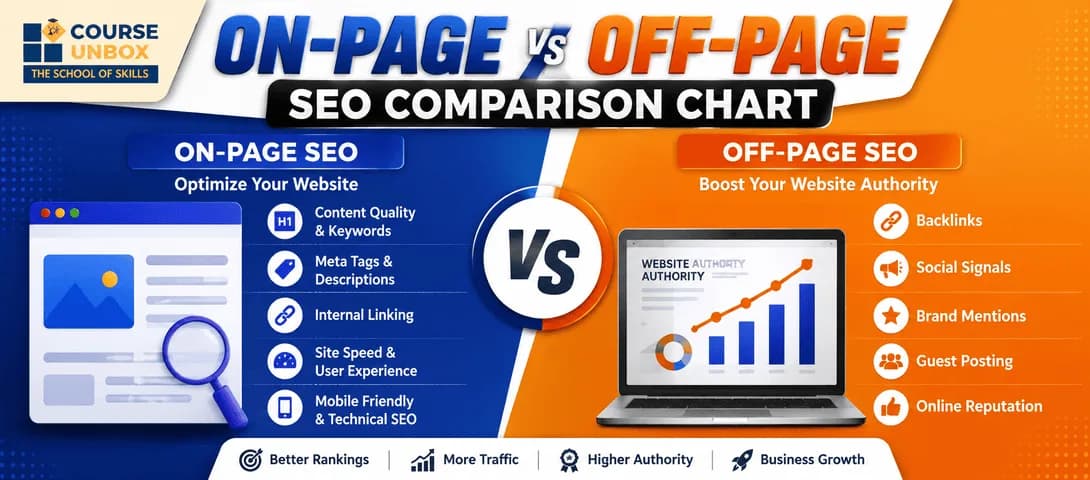
On-page vs off-page SEO at a glance
Here is the difference between on-page and off-page SEO in one view, before we break each down.
Aspect | On-Page SEO | Off-Page SEO |
Where it happens | On your own website | Outside your website |
You control it? | Yes — directly | Mostly no — you earn it |
Main goal | Help search engines understand your page | Build authority, trust and reputation |
Key activities | Content, titles, headings, internal links, images | Backlinks, brand mentions, reviews, social shares |
Ranking role | Tells Google what your page is about | Tells Google how trustworthy your site is |
Speed of results | Faster — you make the changes | Slower — depends on others |
Core tools | GA4, Search Console, on-page checkers | Backlink checkers, outreach, GBP, review tools |
What is on-page SEO?
On-page SEO (also called on-site SEO) is everything you optimise on your own website to help it rank and to give users a great experience. Because you control every element directly, on-page work usually delivers the fastest, most predictable gains.
The core on-page SEO elements are:
Title tags — keep them 50–60 characters with the primary keyword near the front
Meta descriptions — a compelling ~150-character summary that earns the click
Headings (H1–H3) — one clear H1, logical subheadings for structure
Content quality & search intent — original, helpful content that answers the query
URL structure — short, descriptive, hyphen-separated slugs
Internal linking — connect related pages so Google (and users) can navigate
Image alt text — describe images for accessibility and search
Page experience — fast load, mobile-friendly, easy to use
What is off-page SEO?
Off-page SEO (or off-site SEO) is everything that happens away from your website that influences how search engines perceive your authority and trust. You earn it rather than set it, so it takes longer — but it is what separates similar pages in competitive results.
The core off-page SEO elements are:
Backlinks — quality links from other trusted sites, the biggest off-page factor
Brand mentions — even unlinked mentions signal authority
Google Business Profile — essential for local visibility and Maps
Reviews & ratings — trust signals that also help local rankings
Social media & shares — indirect reach and brand-awareness signals
Digital PR & guest posting — earning links and exposure on relevant sites
Backlinks are the heart of off-page SEO. If you want the mechanics, see our guides on what backlinks mean and the types of SEO backlinks.
Expert tip
Off-page SEO is not just link building. Reviews, brand mentions, and a complete Google Business Profile all build the trust signals Google weighs — and they are often easier wins than chasing links.
On-page vs off-page SEO: key differences explained
The simplest way to hold the difference in your head: on-page SEO is about relevance; off-page SEO is about authority. On-page work makes your page the best possible answer to a query. Off-page work convinces search engines that other people vouch for you, so your page deserves to outrank equally relevant competitors.
Two other differences matter in practice. First, control: you own every on-page change, but off-page depends on other websites and customers, so it is slower and less predictable. Second, timing: on-page fixes can move rankings within weeks, while off-page authority compounds over months.
Where does technical SEO fit in?
People often ask about a third bucket: technical SEO. Technical SEO covers crawlability, indexing, site speed, mobile-friendliness, structured data and Core Web Vitals — the foundation that lets search engines access and understand your site at all. Some of it overlaps with on-page (it happens on your site), but it is best treated as the groundwork you fix first, before on-page content and off-page authority can pay off.
On-page or off-page SEO: which should you do first?
You need both, but the order matters. Follow this sequence:
Fix the technical foundation — make sure your site is crawlable, indexable, fast and mobile-friendly.
Nail on-page SEO — publish helpful, intent-matched content with strong titles, headings, internal links and page experience. You control this, so start here.
Then build off-page authority — earn quality backlinks, mentions and reviews once your pages are worth linking to.
Maintain both continuously — refresh content and keep earning links; SEO is ongoing, not one-and-done.
Expert tip
Building links to a weak page wastes effort. Get on-page right first so every backlink you earn points to a page that can actually convert the ranking into traffic and leads.
How on-page and off-page SEO work together
Think of it like opening a restaurant. On-page SEO is the food, menu and dining room — everything you control to make the experience great. Off-page SEO is the reviews, word of mouth and reputation that get people through the door. A brilliant restaurant nobody has heard of stays empty; a famous name with bad food closes fast. Rankings work the same way: relevance (on-page) and authority (off-page) reinforce each other, and the sites that win invest in both. This is exactly how a complete program like the CourseUnbox SEO Course teaches SEO — on-page, off-page and technical together.
On-page and off-page SEO checklist
A quick starting checklist for each. For a deeper off-page workflow, see our full off-page SEO guide.
On-page checklist | Off-page checklist |
Unique, intent-matched title & meta | Earn links from relevant, trusted sites |
One clear H1 + logical headings | Claim & optimise Google Business Profile |
Helpful, original content | Collect and respond to reviews |
Internal links to related pages | Build brand mentions via digital PR |
Optimised images with alt text | Share content and engage on social |
Fast, mobile-friendly pages | Guest post on industry sites |
The verdict: you need both
On-page vs off-page SEO is not an either/or. On-page earns relevance, off-page earns authority, and technical SEO holds it together. Master the sequence — technical, then on-page, then off-page — and you build rankings that last. Want to learn all three hands-on with placement support? Explore the SEO Masters Course or an advanced SEO course with placement from CourseUnbox. Curious about pay? See SEO salary for freshers.
About the Author
Jugal Chauhan
Jugal Chauhan is a digital marketing strategist and tech educator with a passion for making complex topics accessible. He writes about marketing, technology, and professional growth to help learners and businesses thrive in the digital age.
Learn more about us →