Get a counselling call
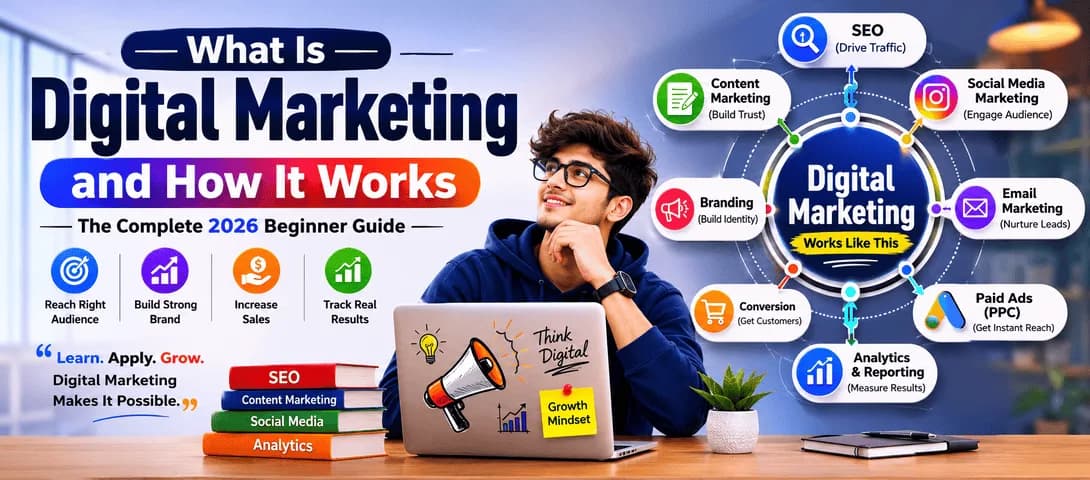
What Is Digital Marketing and How It Works The Complete 2026 Beginner Guide
Digital marketing is the practice of promoting products and services online through channels like SEO, social media, paid ads, email, and content, then measuring every result to improve it. This guide explains what digital marketing is and how it works, the main channels, the role of AI in 2026, and how to start a rewarding career.
What is digital marketing and how it works is one of the most searched questions by students, business owners, and career switchers today, and the answer now shapes almost every modern career path. In simple terms, digital marketing is the practice of promoting a brand, product, or service to the right people online, and then measuring and improving every result. It works by attracting attention across digital channels, guiding interested people toward a decision, and turning them into paying customers. If you want to move from understanding this to doing it professionally, a structured AI digital marketing course turns this overview into job ready skills.
This guide is written from the perspective of working practitioners who train marketers every day, so it focuses on how digital marketing actually works in the real world, not just textbook theory.
Digital Marketing Explained in Simple Terms
At its core, digital marketing is any marketing effort that uses the internet or an electronic device to reach and influence people. The digital marketing basics come down to one idea. Your future customers already spend hours every day on search engines, social feeds, video apps, and email, so you meet them there with the right message at the right moment. This is why online marketing strategies have replaced a large share of print, radio, and billboard spending across almost every industry.
It helps to know that digital marketing is the umbrella term. Internet marketing and online marketing are subsets that sit under it. A complete internet marketing guide covers everything from a website and a blog to paid ads, email flows, and social content working together as one connected system.
The biggest difference from traditional marketing is direction. A billboard talks at people and cannot be changed once printed. Digital marketing is a two way conversation. You publish, the audience reacts, data flows back in real time, and you adjust within hours. That feedback loop is exactly why it is measurable, flexible, and far more cost effective for small and growing brands. If you are curious how these skills translate into actual roles and pay, our breakdown of what a digital marketing job involves maps it out clearly, and you can browse more free digital marketing guides on the Course Unbox blog
How Digital Marketing Works From First Click to Loyal Customer
The clearest way to understand how digital marketing works is to follow a customer through a simple funnel with four stages: awareness, interest, decision, and loyalty.
Imagine a small brand that sells home baking kits online. Here is how the machine runs from start to finish.
1. Awareness. Someone searches a phrase like easy baking kit for beginners. The brand ranks on Google because it published a helpful article, which is website traffic growth driven by search engine optimization. The same person also sees a short reel on Instagram. This is the top of the funnel, where the goal is reach and brand awareness.
2. Interest. The visitor lands on the website and reads a guide. A small popup offers a free recipe book in exchange for an email address. This is a lead generation method, and now the brand can keep in touch.
3. Decision. Over the next few days the person receives a short email sequence with tips, a customer review, and a first order discount. Meanwhile a retargeting ad follows them across social platforms. This nurturing is where marketing automation tools do the heavy lifting, sending the right message automatically based on behavior.
4. Loyalty. The person buys, receives great service, and gets a follow up email inviting them to review the kit and refer a friend. Strong customer engagement online turns a one time buyer into a repeat customer and an advocate.
Behind every stage sits measurement. Marketers watch how many people arrive, how many sign up, and how many buy, then run conversion rate optimization to improve the weak steps. That constant testing, measuring, and refining is the real answer to how digital marketing works. It is not one big campaign. It is many small improvements compounding over time.
Core Digital Marketing Channels That Drive Growth
Digital marketing is not a single tactic. It is a set of connected digital marketing channels that work best together. Here are the ones every marketer should understand.
Search Engine Optimization for Long Term Organic Traffic
Search engine optimization, or SEO, is the practice of improving your website so it ranks higher in unpaid search results when people look for what you offer. It covers on page content, technical health, and off page authority. SEO is slow to start but powerful because the traffic keeps arriving without paying for every click. If you want to see exactly what a modern curriculum covers, this SEO course and career roadmap breaks down on page, technical, and local SEO in depth.
Search Engine Marketing and Pay Per Click Advertising
Search engine marketing, or SEM, puts your brand at the top of search results through paid ads. The most common model is pay-per-click advertising, or PPC, where you only pay when someone clicks. Google Ads is the dominant platform, and it rewards tight keyword research, relevant landing pages, and clean conversion tracking. Our complete Google Ads course guide walks through search, display, shopping, and the shift toward AI powered bidding.
Social Media Marketing That Builds Community
Social media marketing, or SMM, uses platforms like Instagram, LinkedIn, YouTube, and Facebook to build an audience, tell your brand story, and drive traffic and sales. The strongest social strategies mix consistent organic content with paid promotion. A structured look at platform strategy, content systems, and paid social lives in this social media marketing course guide.
Content Marketing Strategy That Earns Trust
A content marketing strategy is the engine that feeds almost every other channel. Blogs, videos, guides, and infographics answer real questions, build authority, and give search engines and AI tools something worth citing. Great content is also the foundation of a career in content creation where writing, scripting, and audience building come together.
Email Marketing Campaigns and Marketing Automation
Email remains one of the highest return channels in all of digital marketing. Email marketing campaigns nurture leads, recover abandoned carts, and re engage past customers. Paired with marketing automation tools, a single well designed flow can run around the clock, sending personalized messages triggered by what each person does. Low cost and high control make email a favorite of small businesses.
Affiliate Marketing and Influencer Partnerships
Affiliate marketing explained simply is a performance based model where partners promote your product and earn a commission on each sale they drive. Influencer marketing is closely related. You collaborate with creators whose audience trusts them, borrowing that trust to reach new buyers. Both extend your reach without a large upfront media budget.
Performance Marketing and Paid Digital Advertising
Performance marketing is the discipline of spending ad budget to hit measurable outcomes like leads or revenue, not vanity numbers. It brings together the sharpest digital advertising techniques across Google, Meta, and other networks, all judged by cost per result and return on ad spend. You can go deeper with this performance marketing career guide, and for paid social specifically, this Meta Ads course for Facebook and Instagram.
The Role of AI in Modern Digital Marketing
This is where 2026 looks very different from even two years ago, and where most older guides fall short. Artificial intelligence now sits inside almost every part of digital marketing. Marketers use tools like ChatGPT, Gemini, and Claude to research audiences, draft content, brainstorm campaigns, and analyze data in minutes instead of days.
Search itself is changing too. Google AI Overviews and answer engines summarize results directly, which means brands now optimize not only to rank but to be quoted. This is the rise of answer engine optimization and generative engine optimization, where the goal is to become the trusted source that AI tools cite. Building that kind of authority relies heavily on strong content and off page techniques in SEO that earn mentions and links across the web.
The winners are not people who fear these tools. They are marketers who combine human strategy with AI speed to scale content, sharpen targeting, and strengthen brand awareness strategies. If you are new to this, these AI digital marketing strategies for beginners are a practical starting point.
Key Benefits of Digital Marketing for Businesses and Careers
The benefits of digital marketing explain why budgets keep shifting online year after year.
For businesses, it is measurable. Every rupee spent can be tracked to a click, a lead, or a sale, so you always know what works. It is cost effective, letting a small brand compete with large ones through smart targeting rather than big budgets. It is precise, reaching specific ages, interests, locations, and behaviors. And it is fast, since campaigns can be launched, tested, and improved in real time. Together these strengths drive website traffic growth, stronger brand awareness strategies, and better returns.
For your career, the demand is enormous, especially in India. Companies of every size need people who can generate leads and prove results, and salaries reward measurable skills more than years alone. You can see realistic numbers in this guide to digital marketing salary in India. Few career paths offer this mix of creativity, data, and long term security.
How to Start a Career in Digital Marketing Step by Step
You do not need a technical background or a coding degree to begin. What you need is a clear learning path and real practice.
Start with the fundamentals so you understand how every channel fits together. Then go deep in one area, such as SEO, performance marketing, or social media, because employers value a T shaped marketer who has broad awareness and one strong specialization. Next, get hands on with the industry tools professionals actually use, including Google Ads, Meta Ads, Google Analytics, Search Console, SEMrush, WordPress, and modern AI assistants. Finally, build a portfolio through live projects, because proof of results beats a certificate alone.
This is exactly how the Course Unbox AI Digital Marketing program is designed. It is a six month, beginner to advanced, live online course covering the full modern stack across eight practical modules, from SEO and performance marketing to content and AI tools. It is taught by working practitioners, including a founder with more than twelve years in digital marketing and trainers who have managed large real world ad budgets, which is the kind of experience that builds genuine expertise and trust. Course Unbox is also a Google Partner and a Meta Business Partner, with a reported 94 percent placement rate and more than 500 hiring partners.
To plan your own path, these resources help. Compare programs and pricing with this guide to digital marketing course fees. If you are a fresher, see how to begin with a digital marketing course after graduation. When you are ready to apply, prepare with these digital marketing interview questions. And if you are weighing other high demand tech fields, explore the full stack development course as well.
Common Digital Marketing Mistakes to Avoid
Most beginners lose time on the same avoidable errors. They chase vanity metrics like likes instead of leads and sales. They run tactics with no overall strategy, so channels pull in different directions. They rely on a single channel and stay exposed when it changes. They ignore analytics, which makes conversion rate optimization impossible because they cannot see where people drop off. And in 2026, many still ignore AI search entirely, missing visibility in the AI Overviews and answer engines where more decisions now begin. Avoiding these traps early is often what separates a marketer who grows a budget from one who quietly wastes it.
Conclusion and Next Step
Understanding what is digital marketing and how it works is now a core life skill, not a niche specialty. It is the connected system of attracting the right people online, guiding them from first click to loyal customer, and improving every step with data and, increasingly, with AI. The businesses and professionals who win are the ones who treat it as a measurable, repeatable process rather than a lucky campaign.
If you are ready to turn this understanding into a real, job ready skill set, the Course Unbox AI digital marketing course gives you live training, real projects, industry tools, and placement support. Learn more about our mentors and mission on the About Course Unbox page, or talk to a career mentor for free to map the right path for your goals. Your digital marketing career can start this week.
About the Author
Jugal Chauhan
Jugal Chauhan is a digital marketing strategist and tech educator with a passion for making complex topics accessible. He writes about marketing, technology, and professional growth to help learners and businesses thrive in the digital age.
Learn more about us →