Get a counselling call
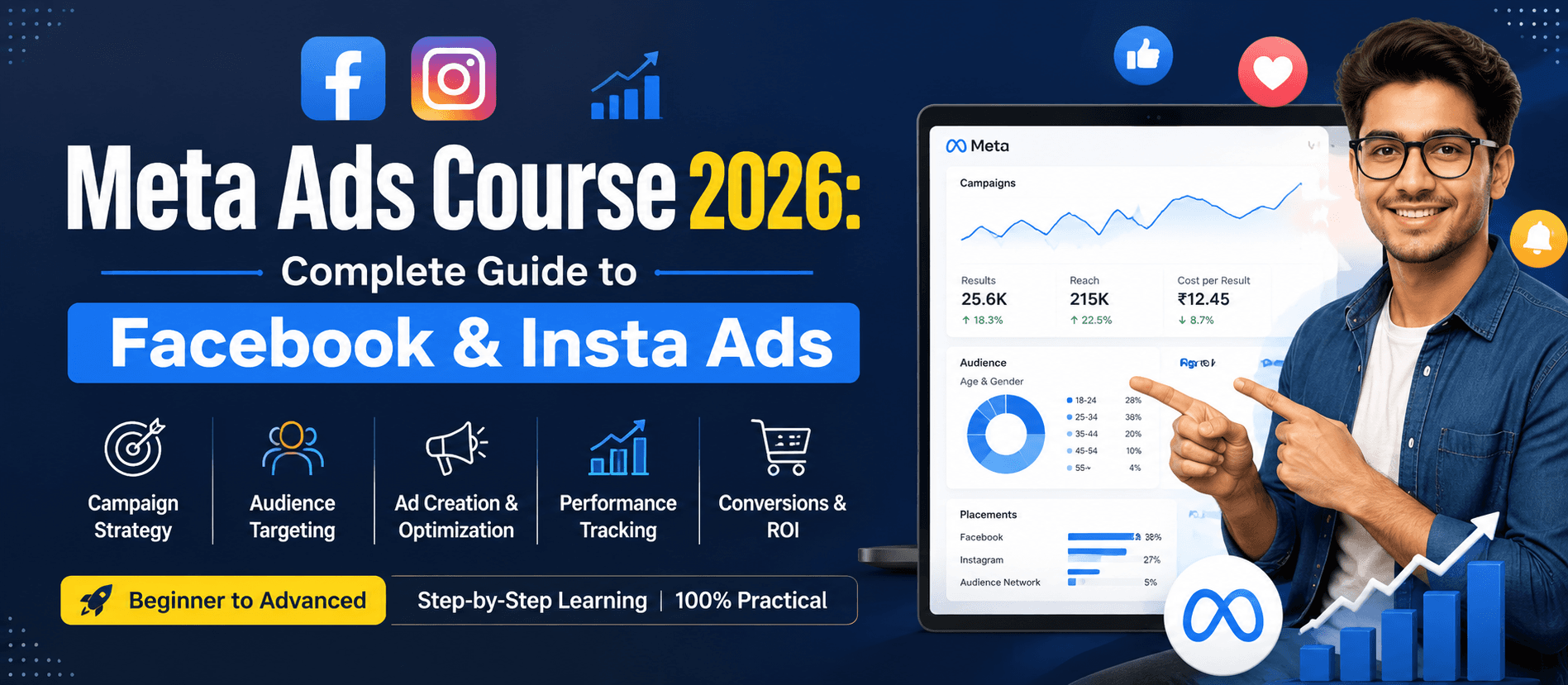
Meta Ads Course 2026: Complete Guide to Facebook & Insta Ads
Want to master Facebook and Instagram advertising? This Meta Ads course guide covers skills, tools, career paths, and salaries for 2026.
Introduction
If you scroll through Instagram or Facebook today, chances are you've clicked on at least one sponsored post this week. That's Meta Ads at work — and behind every high-performing campaign is someone who knows exactly what they're doing. A good Meta Ads course teaches you how to plan, launch, and optimize ads across Facebook, Instagram, Messenger, and WhatsApp so businesses get real, measurable results.
Whether you're a student exploring career options, a working professional looking to upskill, or a business owner tired of wasting ad budget, learning Meta Ads is one of the most practical skills you can pick up in 2026. This guide walks you through everything — from the basics to career prospects — in simple, beginner-friendly language.
If you want structured, hands-on training, CourseUnbox's Meta Ads Course is built exactly for this journey, alongside broader options in digital marketing.
What is a Meta Ads Course
A Meta Ads course is a structured training program that teaches you how to create, manage, and optimize paid advertising campaigns on Facebook, Instagram, Messenger, and WhatsApp using Meta Business Suite and Meta Ads Manager, with a focus on targeting, budgeting, creatives, and performance analysis.
These courses typically combine video lessons, live campaign practice, case studies, and certification. You'll learn the Meta Ads Manager interface, audience segmentation, pixel setup, creative testing, and how to read performance metrics like CTR, CPC, ROAS, and conversion rate.
Most beginner-friendly programs also cover fundamentals of digital marketing so you understand where paid social fits into the bigger picture — alongside SEO, content, and email.
Why is it Important
Meta Ads matter because Facebook and Instagram together reach billions of users daily, giving businesses precise targeting options based on age, interests, behavior, and location — making Meta Ads one of the highest-ROI advertising channels available today.
Here's why this skill holds real value in 2026:
Massive reach — Meta's platforms remain among the most-used social networks worldwide, especially in India, Southeast Asia, and Latin America.
Granular targeting — You can reach a working mother in Delhi interested in skincare, or a college student in Bangalore into gaming, with pinpoint accuracy.
Measurable ROI — Unlike traditional advertising, every rupee spent is trackable.
High business demand — Nearly every D2C brand, local business, and agency needs someone who can run profitable Meta campaigns.
Low entry barrier — You don't need a technical background to start; you need strategy, curiosity, and practice.
Expert Tip: Businesses often waste 30-40% of their ad budget due to poor targeting and weak creatives. Skilled Meta Ads professionals directly fix this — which is exactly why the skill pays well.
Benefits
Learning Meta Ads gives you a in-demand, well-paying skill that works for freelancing, full-time jobs, or growing your own business — with benefits ranging from flexible work options to fast career growth in the performance marketing space.
Benefit | Why It Matters |
|---|---|
High demand | Almost every business with an online presence needs Meta Ads support |
Freelance-friendly | Easy to find clients on Upwork, Fiverr, and LinkedIn |
Fast results | Campaigns can be tested and optimized within days |
Scalable income | Skilled marketers manage multi-lakh/multi-crore ad budgets |
Works with other skills | Pairs well with SEO, content marketing, and analytics |
Remote-friendly | Manage campaigns from anywhere with internet access |
Types
Quick Answer: Meta Ads come in several campaign types — awareness, traffic, engagement, leads, app promotion, sales, and store visits — each optimized by Meta's algorithm for a specific business objective, from brand visibility to direct conversions.
Awareness Campaigns — Build brand recall and reach.
Traffic Campaigns — Drive visitors to a website or landing page.
Engagement Campaigns — Boost likes, comments, shares, and video views.
Lead Generation Campaigns — Collect contact details via in-platform forms.
App Promotion Campaigns — Increase installs and in-app actions.
Sales/Conversion Campaigns — Drive purchases, sign-ups, or bookings.
Store Traffic Campaigns — Direct nearby customers to physical stores.
Each type uses different ad formats — image ads, video ads, carousel ads, collection ads, and Reels ads — and understanding when to use which is a core part of any solid Meta Ads course.
How it Works
Meta Ads work through an auction-based system where advertisers bid for ad placements, and Meta's algorithm delivers ads to the audience most likely to complete the desired action, based on targeting, budget, creative quality, and estimated action rate.
Here's a simplified breakdown:
You set a campaign objective (e.g., sales, leads, traffic).
You define your target audience (demographics, interests, behaviors, or custom/lookalike audiences).
You set a budget and schedule.
You upload creatives (images, videos, or carousels) with ad copy.
Meta's algorithm enters your ad into an auction against competing advertisers.
The ad with the best combination of bid, quality, and relevance wins placement.
You track performance through Meta Ads Manager and optimize accordingly.
Step-by-Step Guide
To run a successful Meta Ads campaign, set up a Business Manager account, install the Meta Pixel, define your audience, choose the right campaign objective, create compelling ad creatives, set a realistic budget, launch, and continuously monitor and optimize based on performance data.
Create a Meta Business Suite account and link your Facebook Page and Instagram profile.
Set up Meta Ads Manager and add payment details.
Install the Meta Pixel on your website to track conversions.
Define campaign objective — awareness, leads, sales, etc.
Build your audience — start broad, then refine with interests or lookalikes.
Design ad creatives — use high-quality visuals and clear, benefit-driven copy.
Set your budget — daily or lifetime, based on goals.
Launch the campaign and let it run for at least 3-4 days before judging performance.
Analyze metrics — CTR, CPC, CPM, ROAS, conversion rate.
Optimize — pause underperforming ads, scale winning ones, test new creatives.
Important Note: Avoid making major changes to a campaign within the first 24-48 hours — it disrupts Meta's learning phase and can hurt performance.
Best Practices
Best practices for Meta Ads include testing multiple creatives, using clear calls-to-action, keeping audiences neither too broad nor too narrow, tracking conversions with the Meta Pixel, and reviewing performance data regularly instead of relying on guesswork.
Test at least 3-4 ad creatives per campaign.
Use short, scroll-stopping videos (under 15 seconds) for Reels placements.
Keep ad copy benefit-focused, not just feature-focused.
Use lookalike audiences once you have at least 100 conversions.
Always track results with the Meta Pixel or Conversions API.
Set realistic budgets — don't expect results from ₹100/day on a competitive niche.
Review the Meta Business Help Center for platform updates.
Common Mistakes
Common Meta Ads mistakes include targeting too broad or too narrow an audience, ignoring the learning phase, using low-quality creatives, not tracking conversions properly, and turning off campaigns too early before gathering enough data.
⚠️ Warning: These mistakes are the #1 reason beginners waste ad spend without results.
Judging a campaign's performance within the first 24 hours.
Overlapping audiences across multiple ad sets.
Ignoring mobile-first creative formats (most traffic is mobile).
Not installing or misconfiguring the Meta Pixel.
Using the same creative for weeks without refreshing it (ad fatigue).
Setting unrealistic budgets for competitive industries.
Skipping A/B testing entirely.
Tools
Key tools for Meta Ads professionals include Meta Ads Manager, Meta Business Suite, Meta Pixel, Canva or Adobe tools for creatives, Google Analytics for cross-platform tracking, and third-party tools like AdEspresso or Motion for campaign automation and reporting.
Tool | Purpose |
|---|---|
Meta Ads Manager | Campaign creation and management |
Meta Business Suite | Page, Ads, and Inbox management |
Meta Pixel / Conversions API | Conversion tracking |
Canva / Adobe Express | Ad creative design |
Website and traffic analysis | |
AdEspresso / Motion | Ad automation and reporting |
CapCut | Video ad editing |
Pairing Meta Ads skills with analytics tools helps you understand the full customer journey, not just the ad click.
Career Opportunities
A Meta Ads course opens career paths such as Performance Marketing Executive, Social Media Ads Specialist, Digital Marketing Manager, Freelance Meta Ads Consultant, and Agency Media Buyer, across industries like e-commerce, D2C brands, real estate, and education.
Performance Marketing Executive
Meta Ads Specialist / Media Buyer
Digital Marketing Manager
Social Media Marketing Executive
Freelance Meta Ads Consultant
Agency Account Manager
E-commerce Growth Marketer
This skill also complements roles in content marketing and social media marketing, since ads perform best when paired with strong organic content.
Salary in India
In India, Meta Ads professionals typically earn between ₹2.5 LPA for freshers and ₹8-12 LPA for experienced specialists, with senior performance marketers and agency leads earning ₹15 LPA or more depending on city and industry.
Experience Level | Approximate Salary (INR/year) |
|---|---|
Fresher (0-1 yr) | ₹2.5 – 4 LPA |
Mid-level (2-4 yrs) | ₹5 – 9 LPA |
Senior (5+ yrs) | ₹10 – 18 LPA |
Freelance (per project) | ₹5,000 – ₹50,000+ |
Note: Figures are indicative estimates based on market trends and can vary by city, company, and portfolio strength.
Salary Abroad
Internationally, Meta Ads specialists earn between $45,000-$70,000 annually in the US, £28,000-£45,000 in the UK, and AED 90,000-150,000 in the UAE, with senior performance marketing roles paying significantly higher in competitive markets.
Country | Approximate Annual Salary |
|---|---|
USA | $45,000 – $70,000 |
UK | £28,000 – £45,000 |
UAE | AED 90,000 – 150,000 |
Canada | CAD 50,000 – 75,000 |
Australia | AUD 60,000 – 85,000 |
Note: These are broad market estimates; actual figures depend on experience, company size, and cost of living.
Future Scope in 2026
In 2026, Meta Ads is evolving with AI-driven Advantage+ campaigns, automated creative testing, deeper WhatsApp commerce integration, and increased focus on first-party data due to privacy changes — making skilled human oversight more valuable, not less.
AI-powered campaign automation (Advantage+ Shopping and App campaigns) is becoming the default, but still needs human strategy.
WhatsApp and Messenger ads are growing rapidly as commerce channels in India.
Privacy-first targeting is pushing marketers to rely more on first-party data and the Conversions API.
Short-form video (Reels) ad placements continue to dominate impressions.
AI creative tools are speeding up ad production, shifting the marketer's role toward strategy and analysis.
Pairing Meta Ads knowledge with an AI course is becoming a smart move for professionals who want to stay ahead of automation trends.
Tips for Beginners
Beginners should start with a small budget, focus on one platform at a time, learn to read basic metrics like CTR and ROAS, practice on real or mock campaigns, and treat every campaign as a learning opportunity rather than a one-shot bet.
Start small — ₹500-₹1000/day is enough to learn the platform.
Focus on understanding metrics before scaling budgets.
Build a portfolio using personal projects or friends' businesses.
Follow Google Ads Help and Meta Business Help resources to stay current on both major ad platforms.
Get certified through a structured Meta Ads Course to build credibility with clients or employers.
Don't skip the basics of digital marketing — Meta Ads work best as part of a bigger strategy.
About the Author
Jugal Chauhan
Jugal Chauhan is a digital marketing strategist and tech educator with a passion for making complex topics accessible. He writes about marketing, technology, and professional growth to help learners and businesses thrive in the digital age.
Learn more about us →