Get a counselling call
Hard Skills vs Soft Skills: Key Differences, Examples, and How to Build Both
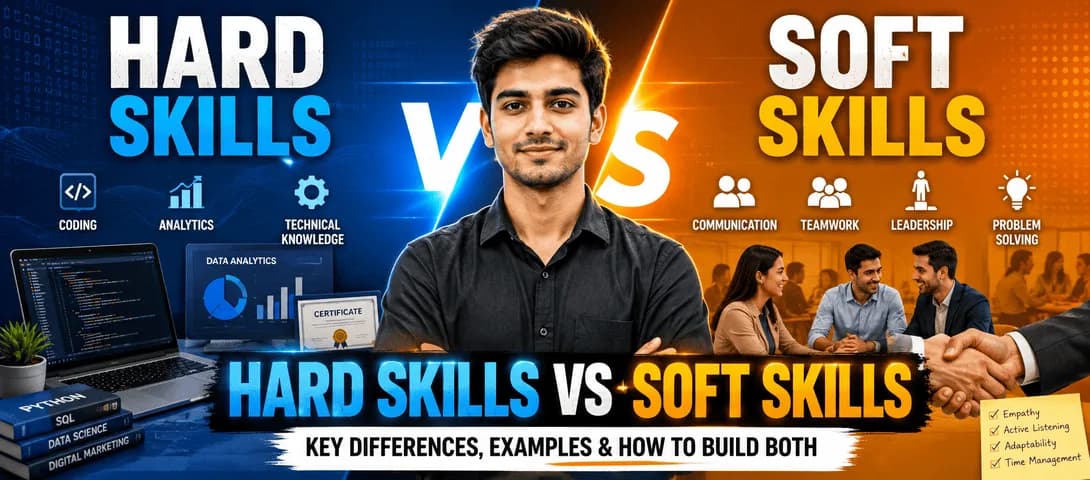
Hard skills vs soft skills describes the difference between teachable, measurable abilities like coding or SEO and personal traits like communication and teamwork. Hard skills get you shortlisted, while soft skills help you succeed and lead. This guide explains the difference with examples, resume tips, a comparison table, and how to build both for career growth.
Introduction
Hard skills vs soft skills is one of the most important distinctions in any career, because employers hire for both and few candidates truly master the balance. Hard skills are the teachable, measurable abilities you can prove, like coding, accounting, or digital marketing, while soft skills are the personal qualities that shape how you work, like communication, teamwork, and adaptability. Understanding this difference helps you build a stronger resume, interview with confidence, and grow faster once you are hired. This guide breaks down the definitions, gives real examples for each, compares them side by side, and shows you how to develop both.
Hard Skills vs Soft Skills Definition and Key Difference
The simplest hard skills vs soft skills definition is this: hard skills are specific, job related abilities you learn through training, education, or practice, while soft skills are the interpersonal and behavioral traits that determine how you apply them. The core hard skills vs soft skills difference is measurability. You can test, certify, and quantify hard skills, such as typing speed or fluency in a programming language, but soft skills like empathy or leadership are judged through behavior over time. Both matter, and the strongest professionals combine technical ability with the people skills that make that ability useful.
Hard Skills Examples and Where to Learn Them
Technical and Coding Hard Skills
Hard skills are usually tied to a specific role, tool, or industry, and they are the abilities most often listed as requirements in a job posting. Technical fields offer some of the clearest examples, and demand for full stack development keeps growing as companies build web and mobile products. Alongside programming, employers value data analysis, cloud computing, and database management as measurable, teachable abilities.
Marketing and Analytical Hard Skills
Marketing roles reward learnable hard skills too. Employers look for measurable abilities such as SEO, keyword research, and analytics, along with performance marketing that proves a clear return on ad spend. These skills are easy to demonstrate with results, which is exactly what makes them valuable on a resume.
Soft Skills Examples and Why They Matter
Soft skills are the human abilities that shape how you collaborate, communicate, and solve problems, and they transfer across almost every job. Unlike hard skills, they are rarely taught in a single course, and they grow through experience, feedback, and self awareness.
Common Soft Skills Employers Want
Communication and active listening
Teamwork and collaboration
Adaptability and flexibility
Time management and organisation
Emotional intelligence and empathy
Problem solving and critical thinking
Leadership and decision making
Employers value these highly because a technically brilliant employee who cannot communicate or collaborate often struggles, while someone with strong soft skills lifts an entire team.
Hard and Soft Skills Comparison Table
The table below summarises the core differences at a glance, which makes it easy to explain the two in an interview or a classroom.
Aspect | Hard Skills | Soft Skills |
Definition | Job specific, teachable abilities | Personal and interpersonal traits |
How you learn them | Courses, training, certifications, practice | Experience, feedback, self awareness |
How they are measured | Tests, certificates, portfolios, results | Behavior and outcomes over time |
Examples | Coding, SEO, data analysis, accounting | Communication, teamwork, leadership |
On a resume | Listed in a dedicated skills section | Shown through experience and results |
Hard Skills vs Soft Skills on a Resume
Knowing how to present hard skills vs soft skills on a resume can be the difference between an interview and a rejection. List hard skills clearly in a dedicated skills section and prove them with certifications, tools, and results, since these are what applicant tracking systems scan for. Weave soft skills into your experience descriptions by showing outcomes, for example leading a team or resolving a client issue, rather than simply naming them. The table below gives hard skills vs soft skills on resume examples you can adapt.
Skill Type | How to List It | Example on a Resume |
Hard skill | Name the skill plus proof | SEO, grew organic traffic by a clear percentage |
Soft skill | Show it inside an achievement | Led a team of five to deliver ahead of schedule |
Hard and Soft Skills vs Technical and Transferable Skills
People often ask how hard skills vs soft skills vs technical skills relate, and where transferable skills fit in. Technical skills are a subset of hard skills tied to specific tools and systems, such as cybersecurity and cloud computing, so all technical skills are hard skills, but not every hard skill is purely technical. Transferable skills are abilities that move with you across roles and industries, and they can be either hard or soft, such as project management or clear writing. Understanding hard skills vs soft skills vs transferable skills helps you frame your value for a new field even when your job title changes.
Skill Category | What It Means | Example |
Hard skills | Teachable, measurable job abilities | Programming, accounting, SEO |
Soft skills | Personal and interpersonal traits | Communication, empathy, teamwork |
Technical skills | Hard skills tied to tools and systems | Cloud computing, data analysis |
Transferable skills | Abilities that move across roles | Leadership, writing, problem solving |
Balancing Hard Skills and Soft Skills in Your Career
A common debate is hard skills vs soft skills which is more important, and the honest answer is that you need both, in the right order for your stage. Early in a career, hard skills often open the door because they are easy to verify and match to a job description. As you move into senior and leadership roles, soft skills like communication, judgment, and influence increasingly decide how far you go. Large scale workforce research, including the World Economic Forum Future of Jobs Report, consistently finds that employers now prioritise a blend of analytical hard skills and human centred soft skills rather than either on its own. The professionals who advance fastest keep sharpening technical ability while deliberately building the people skills that multiply it.
Hard and Soft Skills in Nursing and Other Fields
The balance looks different in every profession. Hard skills vs soft skills nursing examples show this clearly: a nurse needs hard skills such as administering medication, using medical equipment, and reading charts, alongside soft skills such as empathy, communication, and staying calm under pressure. The same pattern holds in teaching, engineering, sales, and hospitality, where technical competence keeps you safe and effective while soft skills build the trust that makes the work succeed.
How to Develop Both Hard Skills and Soft Skills
You can grow both deliberately rather than leaving it to chance. The goal is steady progress on technical ability while consistently strengthening the people skills that make it useful.
Ways to Build Hard Skills
Focused learning is the fastest route. On CourseUnbox you can build in demand hard skills such as social media marketing and content creation, then prove them through real projects and certifications.
Take focused courses and earn recognised certifications
Complete real or sample projects to build a portfolio
Practise regularly with the actual tools of your field
Ways to Build Soft Skills
Ask for feedback often and act on it
Take on team, mentoring, or leadership responsibilities
Practise communication in real and sometimes uncomfortable situations
Printable Hard and Soft Skills List, Worksheet, and PDF
If you prefer to study offline or teach this topic, a simple hard skills vs soft skills list, a hard skills vs soft skills worksheet, and a printable hard skills vs soft skills pdf make it easy to review the difference. A hard skills vs soft skills worksheet pdf works well in classrooms and training sessions, and short hard skills vs soft skills youtube explainers can reinforce the ideas visually.
Resources help you review the difference, but building the hard skills themselves takes practice. Learners in India often begin with a recognised program such as the best digital marketing institute in Noida, and those aiming at modern search study specialised topics like AEO vs SEO vs GEO so their skills match where hiring is heading.
Conclusion and Next Steps
Hard skills vs soft skills is not really a competition, it is a partnership. Hard skills get you noticed and prove you can do the job, while soft skills help you thrive, collaborate, and lead once you are there. Build a resume that showcases both, keep learning technical abilities that match where the market is going, and grow the human skills that make those abilities count. If you are ready to build the hard skills that employers pay for, explore the technology and digital marketing courses on CourseUnbox and start turning new skills into real career growth.
Sources and Further Reading
The guidance in this article reflects widely recognised workforce research on skills demand and hiring. For deeper data on how the balance of hard skills and soft skills is shifting, these authoritative sources are worth reviewing.
World Economic Forum Future of Jobs Report, for global data on the fastest growing hard skills and soft skills.
LinkedIn workplace learning and skills research, for trends in the skills employers and recruiters value most.
SHRM research on soft skills in hiring, for employer perspectives on why soft skills influence hiring decisions.
.
About the Author
Jugal Chauhan
Jugal Chauhan is a digital marketing strategist and tech educator with a passion for making complex topics accessible. He writes about marketing, technology, and professional growth to help learners and businesses thrive in the digital age.
Learn more about us →