Get a counselling call
What Is SEO Writing: The Complete 2026 Beginner Guide
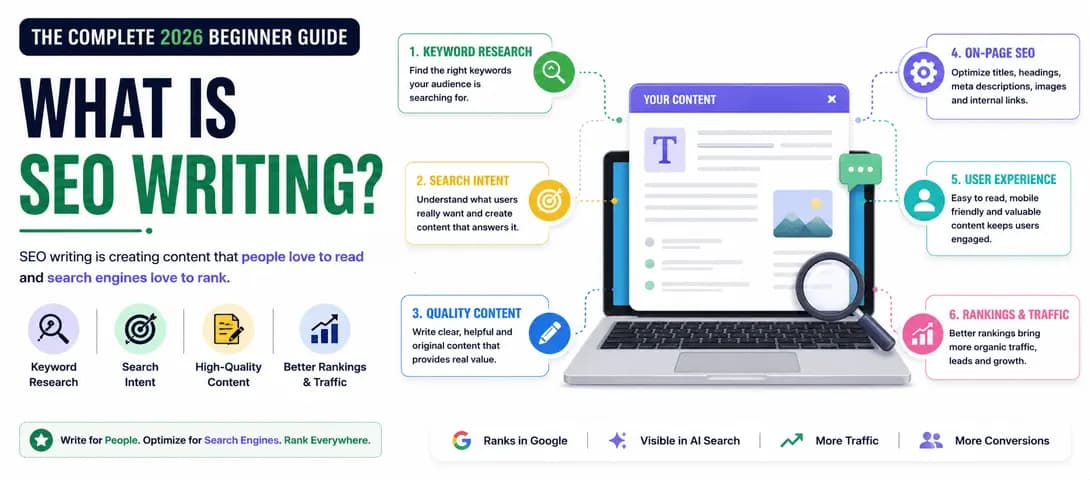
SEO writing is the process of creating content that ranks in search engines and AI tools while genuinely helping readers. It blends keyword research, search intent, and on-page SEO to earn organic traffic. This guide explains what SEO writing is, how it works, and how to do it step by step in 2026
SEO writing is the practice of creating content that ranks in search engines and AI tools while genuinely helping the person reading it. It blends keyword research, search intent, and on-page SEO to turn a blank page into a page that earns organic traffic month after month, long after you hit publish. If you have ever wondered what SEO writing is, and why some articles sit comfortably on page one while others disappear on page four with eleven impressions and zero clicks, this guide breaks it all down in plain language.
By the end you will understand what SEO writing actually involves, how it differs from ordinary content writing, the exact steps to write search engine optimized content, and how to build a real career from this skill. This is the same foundation we teach inside the content creation course at Course Unbox and the AI digital marketing course, written openly so you can learn it whether you enroll or not.
SEO Writing Explained in Simple Terms
SEO writing means writing content in a way that both search engines and real people can understand, trust, and act on. Search engine optimized content is created around a specific search term, structured so Google can read it easily, and written so a human finishes it and thinks, that was exactly what I needed.
Here is the simplest way to picture it. Imagine someone types how to write SEO content into Google. Behind that search is a goal. They want a clear, practical answer. Good SEO writing identifies that goal, answers it fully, uses the words the searcher and Google both expect, and formats everything so it is easy to scan. That is the whole craft in one sentence. Everything else, from keyword optimization to internal links, exists to serve those two audiences at once.
SEO writing is not keyword stuffing, and it stopped working that way years ago. Modern search engines understand context and meaning, not just repeated phrases. So the job today is closer to teaching than tricking. You take a topic you understand, and you explain it better and more completely than the pages already ranking.
Why SEO Writing Matters for Organic Traffic and Business Growth
Organic traffic is the traffic you do not pay for every time someone clicks. A well written article can rank for months or years and keep pulling in readers, leads, and customers without an ongoing ad budget. That compounding return is exactly why businesses invest in content writing for SEO instead of relying only on paid ads.
There is a quality angle too. Not all traffic is equal. Search engine optimized content attracts people who are actively looking for what you offer, which means higher intent and better conversions. A page may bring in fewer visitors than a viral post, yet those visitors are far more likely to buy, sign up, or enquire, because they searched for the exact thing you wrote about.
For anyone building a digital career, this matters even more. SEO writing sits at the centre of nearly every online role, from blogging to marketing to product content. If you are exploring where these skills lead, our guide to what a digital marketing job involves shows how content and search skills fit into real hiring today.
SEO Writing, SEO Copywriting, and Content Writing for SEO Compared
People use these terms loosely, so let us clear up the difference, because it changes how you write. Content writing for SEO usually refers to informational pieces like blog posts, guides, and how to articles that teach and build topical authority. SEO copywriting leans toward persuasion, such as a service page or product description written to drive an action. General content writing covers everything else you publish, where search is not always the main goal.
Aspect | Content Writing for SEO | SEO Copywriting | General Content Writing |
Primary goal | Rank for informational searches and build topical authority | Drive a specific action while still ranking | Communicate, engage, or entertain |
Typical content | Blog posts, guides, how to articles, FAQs | Service pages, product descriptions, landing pages | Brand stories, newsletters, social posts |
Main focus | Teaching and informing the reader | Persuading the reader to convert | Message and audience connection |
Search intent | Informational | Commercial and transactional | Not always search driven |
Role of keywords | Guides topic and structure, used naturally | Targets buying intent terms, balanced with persuasion | Optional, not the main priority |
Success metric | Organic traffic and rankings | Conversions, leads, and sales | Engagement, shares, and brand recall |
Best used for | Blogs and knowledge hubs | Money pages and product pages | Brand building, social, and email |
In practice, strong writers move between all three. A skilled SEO writer can look at a set of keywords, work out what the searcher truly wants, and write it clearly whether the goal is information or a sale. That flexibility is what separates a competent writer from a valuable one, and it is a core reason SEO writing pairs so naturally with the wider skill set covered in our social media marketing course guide.
The Core Elements of Search Engine Optimized Content
Every strong piece of SEO content shares the same building blocks. Master these and the rest becomes detail.
Keyword research comes first. You identify the primary keyword the page will target, plus the related and semantic terms that surround it. Each page should focus on one primary keyword so search engines clearly understand what it is about.
Search intent optimization comes next, and it is the part beginners skip. Before writing, you check what already ranks for your term. If the top results are step by step tutorials, a definition alone will not compete. Matching intent means giving searchers the format and depth they already expect.
On-page SEO ties it together. This includes your title, headings, the first paragraph, image alt text, internal links, and natural keyword optimization throughout the body. Good on-page SEO content makes it obvious to both readers and crawlers what the page covers and how it is organised.
Structure and readability keep people on the page. Short paragraphs, descriptive headings, and a direct answer near the top all reduce the effort of reading, which quietly improves your rankings through better engagement.
Authority and links round it out. Internal links connect your page to related content on your own site, while credible external references support your claims. Off-page signals like backlinks build trust from outside, and you can go deeper in our guide to off-page techniques in SEO and the specific tactic of SEO social bookmarking.
How to Write SEO Content Step by Step
Here is a repeatable process you can use for every article. We teach a longer version of this inside our structured SEO course, but this short version is enough to start writing today.
Step one, choose one primary keyword. Pick a term with real search demand that matches something you can genuinely help with. Note a handful of related and long tail phrases to weave in later.
Step two, study the current top results. Open the pages already ranking, read them fully, and list their strengths and gaps. Your job is to cover what they cover, then add the insight, examples, or clarity they miss. That added value is what Google now calls information gain, and it is often the single biggest reason one page outranks another.
Step three, build an outline around search intent. Decide the sections a reader needs to fully solve their problem, and order them logically from basic to advanced. Include the questions people also ask, so your page answers the whole topic, not a slice of it.
Step four, write for a human first. Start with a strong, clear opening that answers the query quickly. Use plain language, concrete examples, and your own experience. Place your keyword naturally in the introduction, in at least one heading, and across the body, without ever forcing it.
Step five, optimise on the page. Add a compelling title, a clear meta description, descriptive image alt text, and internal links to related content. Keep the keyword density natural, roughly 0.8 to 1.5 percent, so the term appears often enough to be clear but never repetitive.
Step six, review, publish, and update. Proofread for clarity, check facts, and publish. Then revisit the page every ninety days or so to refresh data and keep it competitive, since search results and reader expectations keep moving.
On-Page SEO Content Checklist for Higher Google Rankings
Use this quick checklist before you publish any piece of SEO writing. Place the primary keyword in the title, the first hundred words, at least one heading, the body, the image alt text, and the conclusion. Keep keyword optimization natural and never stuffed. Match search intent to the format that already ranks. Use descriptive, scannable headings instead of vague labels. Put a direct answer to the main query near the top, ideally in forty to sixty words, since that is what earns featured snippets. Add internal links to related pages, and one or two credible external references where they genuinely help. Finally, write a clear title and meta description that earn clicks without misleading anyone.
These on-page fundamentals map closely to real Google ranking factors, and they are the same signals covered in Google Search Central guidance on creating helpful content, which remains one of the most useful free resources for any SEO writer.
Writing for AI Search, AEO, and Google AI Overviews
Search in 2026 is no longer only about blue links. A large share of searches now end with an AI generated answer at the top of the page, and many people ask questions directly inside ChatGPT, Gemini, Perplexity, and Google AI Overviews. This has created two newer disciplines that sit on top of classic SEO writing.
Answer Engine Optimization, often shortened to AEO, is about structuring content so a search engine can lift a clean, direct answer from your page and show it in a snippet or AI summary. Generative Engine Optimization, or GEO, is about writing content that large language models trust enough to cite when they generate answers.
The good news is that the fundamentals overlap. To perform well in AI search, answer questions clearly and early, use descriptive headings, back claims with facts and sources, and demonstrate real experience. Content that reads like a genuine expert explaining a topic tends to get both featured snippets and AI citations, while thin, generic content gets ignored by both. To see how these AI first tactics play out across a full marketing stack, our guide to AI digital marketing strategies for beginners puts them in context.
Common SEO Writing Mistakes That Hurt Rankings
A few avoidable mistakes hold back most new writers. The first is writing for search engines instead of people, which produces stiff, keyword heavy text that no one enjoys and Google no longer rewards. The second is ignoring search intent and answering a different question than the one being asked. The third is thin content that repeats what every other page says without adding anything new.
Other frequent errors include stuffing every related keyword into a single paragraph instead of distributing them naturally, skipping internal links, neglecting image alt text, and publishing once then never updating. Fixing these is often faster than writing new content, and it can lift pages that are stuck just outside the top results.
Tools and Skills Every SEO Content Writer Needs
You do not need dozens of tools to start, but a few make the work far easier. Keyword research tools such as Semrush, Ahrefs, and Google Keyword Planner help you find real demand and gauge difficulty. Google Search Console shows which terms your pages already appear for, so you can improve them. Google Trends and simple competitor analysis reveal what topics are rising and what the leaders are missing.
The skills matter more than the tools, though. Strong SEO writers combine clear writing, research discipline, an understanding of search intent, basic on-page SEO knowledge, and the judgement to know when a keyword fits and when it does not. These are learnable skills, not talents you are born with, and they transfer across almost every online field, from marketing to full stack development where clear technical writing is increasingly valued.
How to Learn SEO Writing and Build a Career From It
SEO writing is one of the most accessible entry points into a digital career, because you can learn it without a technical background and practise it with nothing more than a laptop and a topic you understand. The demand is steady too, since every business that wants to be found online needs someone who can write search optimized content that actually ranks.
Career wise, the path opens quickly. SEO writing feeds directly into content strategy, digital marketing, and specialist SEO roles, and pay grows fast once you can prove results rather than just years of experience. You can see current numbers in our breakdown of digital marketing salary in India for 2026. If you prefer a guided route with live projects and placement support, learners in and around Ghaziabad often start with our practical SEO course in Ghaziabad, which covers on-page, off-page, technical, and local SEO through real work rather than theory.
Whatever route you choose, the fastest way to improve is simple. Pick a keyword, study what ranks, write something more helpful, publish it, and measure what happens. Repeat that loop enough times and you will not just understand what SEO writing is. You will be genuinely good at it.
Final Thoughts and Your Next Step
SEO writing is the skill of creating content that search engines and AI tools want to show, and that real people want to read. It starts with understanding the searcher, builds on solid keyword research and on-page SEO, and rewards writers who add real experience and clarity instead of chasing algorithms. Master it, and you own a skill that keeps paying you back through organic traffic long after the work is done.
If you are ready to turn this from theory into a career, learn it properly with people who do it every day. Explore the hands on programs at Course Unbox, browse more free guides on the Course Unbox blog, or talk to a mentor about the right path for you. Your first ranking article is closer than you think. Start writing.
About the Author
Jugal Chauhan
Jugal Chauhan is a digital marketing strategist and tech educator with a passion for making complex topics accessible. He writes about marketing, technology, and professional growth to help learners and businesses thrive in the digital age.
Learn more about us →