Get a counselling call
What Skills Are Needed for Full Stack Development? A 2026 Guide
Full-stack development requires front-end skills (HTML, CSS, JavaScript and a framework such as React) and back-end skills (a server language such as Node.js, Python or Java, plus a database like MySQL or MongoDB). In 2026, employers also expect Git, REST APIs, basic cloud and DevOps, testing, and the ability to build with AI coding tools. Course Unbox groups these into twelve skill areas.
If you have searched for the skills required to become a full-stack developer, you have probably found long lists that mix beginner basics with advanced tools and never say what to learn first. This guide fixes that. It gives you the full skill map that modern hiring actually rewards, the order to learn it in, how long each stage takes, and how the skills connect to full-stack developer roles and salaries in India.
What is full-stack development?
Full-stack development means building both sides of a web application. The front end, also called the client side, is everything a user sees and clicks: the layout, the buttons, the forms. The back end, also called the server side, is everything behind the scenes: the server, the database, the logic that decides what happens when a user acts.
A full-stack developer can work on both. That is what makes the role valuable. One person can take a feature from an idea in the browser all the way to data stored on a server, which is why startups and product teams hire full-stack developers first. That breadth is also why a clear starting point matters, and why our guide to full stack development for beginners opens with the fundamentals rather than the tools.
The full skill list for full-stack development in 2026
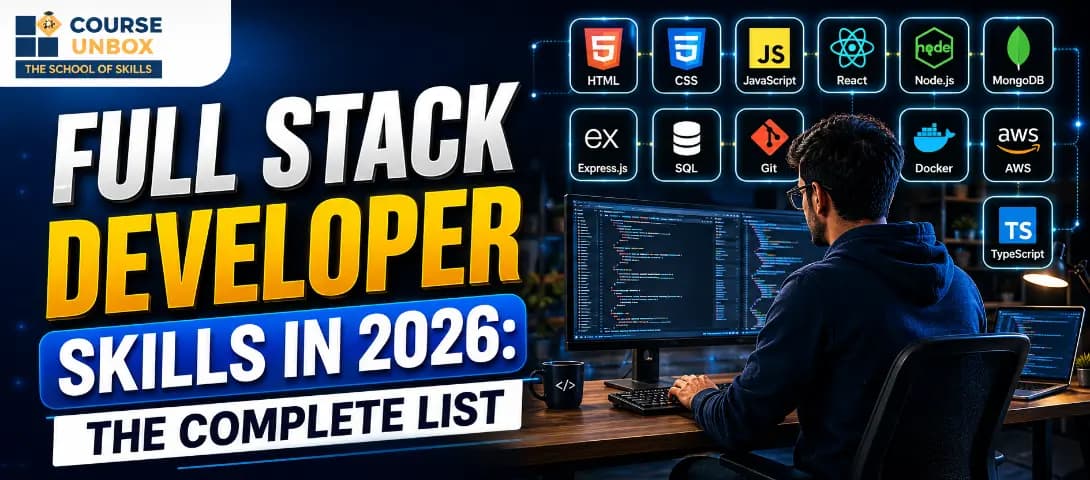
Here is the complete set of skills a job-ready full-stack developer needs today. This is the table-stakes list every strong candidate covers, plus the modern additions such as TypeScript, cloud, DevOps and AI-assisted development that separate a 2026 developer from an outdated one.
Skill area | What to learn | Why it matters |
1. HTML and CSS | HTML5, CSS3, Flexbox, Grid, responsive design | Structures and styles every interface a user sees |
2. JavaScript and TypeScript | Modern JavaScript (ES6+), the DOM, async code, then TypeScript | The language of the browser; TypeScript adds the type safety employers ask for |
3. Front-end framework | React with Next.js, or Angular or Vue | Builds interactive, large-scale user interfaces |
4. Back-end language and framework | Node.js with Express, Python with Django or FastAPI, or Java with Spring Boot | Runs server logic, business rules and request handling |
5. Databases | SQL (MySQL or PostgreSQL) and NoSQL (MongoDB) | Stores, relates and retrieves application data |
6. APIs | REST, JSON, HTTP, the basics of GraphQL | Connects the front end, back end and outside services |
7. Version control | Git, with GitHub or GitLab | Tracks changes and lets you work on any real team |
8. Web architecture and security | Client-server model, authentication, HTTPS, common OWASP risks | Keeps the systems you build correct and safe |
9. Cloud and DevOps | One cloud platform (AWS, Azure or GCP), Docker, basic CI/CD | Deploys and runs apps the way modern teams do |
10. Testing and debugging | Unit testing, browser dev tools, reading error traces | Ships code that works and fixes it quickly |
11. AI-assisted development | GitHub Copilot or Cursor, writing prompts, reviewing AI output | Teams expect you to build faster with AI while owning the design |
12. Soft skills | Communication, problem-solving, time management | Full-stack developers coordinate across the whole product |
Front-end skills
The front end is where most people start, because you see results immediately. Learn HTML for structure and CSS for layout and style, then JavaScript to make pages respond to the user. Once the basics feel natural, add a framework. React is the safest first choice in India because it appears in the most job listings, and Next.js builds on it for faster, production-ready sites. Learn TypeScript early rather than late; it is now a default expectation on serious front-end teams.
Back-end skills
The back end is where the application actually thinks. You need one server language and one framework to start. Node.js with Express keeps you in JavaScript, which is the fastest path if you came through the front end first. Python with Django or FastAPI is strong for fintech and data-heavy products. Java with Spring Boot dominates IT services and banking. You also need at least one relational database such as MySQL or PostgreSQL and one document database such as MongoDB, because real products use both.
The skills that connect the stack
Between the two ends sit the skills that make you employable rather than just able to code. Git is not optional; every team uses it from day one. REST APIs are how the front end and back end talk. A working knowledge of one cloud platform, Docker and a simple deployment pipeline shows you can ship, not just build on your laptop. Add basic security habits and testing, and you have covered the ground that most beginner portfolios miss.
AI-assisted development: the 2026 skill most guides still skip
In 2026, teams expect developers to work with AI coding tools such as GitHub Copilot and Cursor. The value is no longer in typing every line yourself. It is in describing the problem clearly, reviewing what the tool produces, and knowing enough about architecture, debugging and security to catch what the AI gets wrong. Learning to build faster with AI while still owning the design decisions is now a genuine hiring signal.
The order to learn full-stack skills
A skill list is only useful if you know the sequence. Learning back-end frameworks before you understand JavaScript, or chasing cloud tools before you can build a page, is how people stall. Below is the order we teach, with realistic timeframes for someone studying consistently. For the week-by-week version, see the full stack developer roadmap for 2026.
Stage | Focus | Typical time |
Stage 1 | HTML, CSS and responsive layouts | About 4 to 6 weeks |
Stage 2 | JavaScript, then TypeScript | About 6 to 8 weeks |
Stage 3 | React and Next.js | About 6 to 8 weeks |
Stage 4 | Node.js or your chosen back end, plus one database | About 8 to 10 weeks |
Stage 5 | Git and REST APIs, learned alongside Stages 2 to 4 | Ongoing from the start |
Stage 6 | Cloud deployment, Docker, testing, AI tools and one full project | About 6 to 8 weeks |
The stages overlap in practice, which is why most learners reach a job-ready level in roughly 6 to 9 months rather than the sum of every stage. What decides the outcome is not speed but finished, deployed projects you can show an employer.
Which stack should you choose?
You do not need to learn every language. You need one coherent stack, learned deeply. The four common choices in India, and where each one leads, are below. This also answers the frequent questions about Java full-stack and Python full-stack roles. For the exact topics and tools we cover in each stack, see the full stack developer course syllabus.
Stack | Technologies | Best for |
MERN | MongoDB, Express, React, Node.js | Startups and product companies; JavaScript across the whole app |
MEAN | MongoDB, Express, Angular, Node.js | Enterprise apps that favour Angular |
Java full stack | Spring Boot with React or Angular, and MySQL | IT services, banking and large MNCs, which hire in high volume |
Python full stack | Django or FastAPI with React, and PostgreSQL | Fintech, analytics and AI-adjacent products |
The older LAMP stack, which stands for Linux, Apache, MySQL and PHP, still runs a large share of the web, so PHP skills remain useful for maintenance and agency work. New product hiring in India leans toward MERN and Java full stack. Pick one, build with it, and add a second language only once the first feels natural.
What full-stack skills are worth in India
The skills above are in demand, and the pay reflects it. In 2026, full-stack developer freshers in India typically earn about 3.5 to 6 lakh per year, and those with a strong React and Node.js portfolio can negotiate higher, especially at product companies and startups. Developers who can work confidently with a modern stack and AI coding tools are seeing the strongest offers. For a full breakdown by experience level, city and stack, read our Full Stack Developer salary in India 2026 guide. If you are weighing the return on a course, you can also check the full stack development course fees before you decide.
Learn every skill on this list, in the right order
Course Unbox runs a mentor-led, job-oriented Full Stack Development program taught live by working practitioners, with real projects and placement support. It is built beginner to advanced, so you can start with no prior experience, whether you learn online or in person at our full-stack developer institute in Noida.
How to build these skills so employers notice
Knowing the list is step one. Employers hire proof. Three things turn skills into offers. First, build and deploy real projects, not tutorials, and put them on a live URL. Second, keep everything on GitHub so your commit history shows how you work. Third, learn in a structured order with feedback, because self-teaching without review is where most people pick up habits they later have to unlearn. If you want the full step-by-step path, read how to become a full stack developer in India.
About the Author
Jugal Chauhan
Jugal Chauhan is a digital marketing strategist and tech educator with a passion for making complex topics accessible. He writes about marketing, technology, and professional growth to help learners and businesses thrive in the digital age.
Learn more about us →