Get a counselling call
Performance Marketing vs Growth Marketing, the Real Difference in 2026
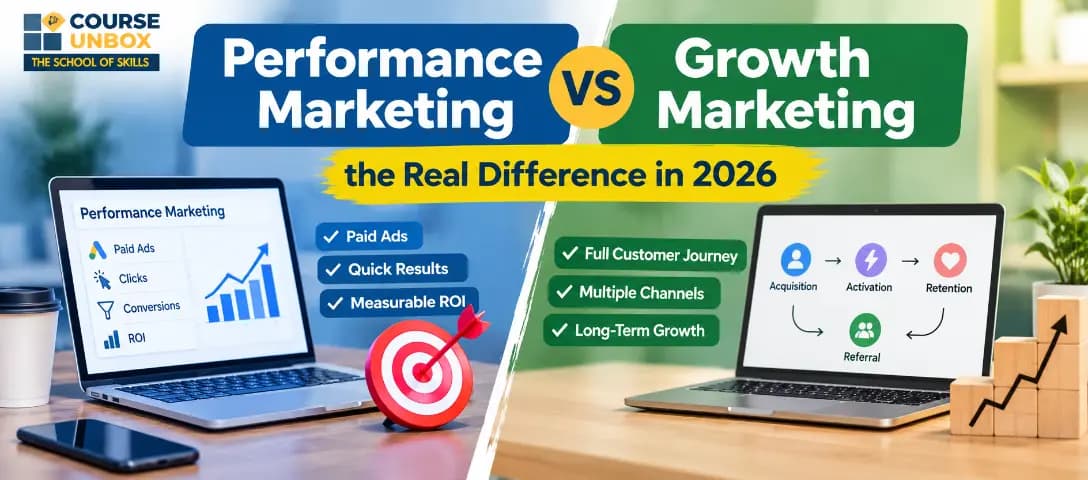
Performance marketing is a results driven, mostly paid approach focused on measurable short term actions such as clicks, leads, and sales, where you pay for outcomes and optimise closely for metrics like ROAS and CPA. Growth marketing is a broader, data driven discipline that works the entire customer lifecycle, from awareness and acquisition through activation, retention, and referral, using experiments across paid and organic channels, optimising for sustainable long term growth and lifetime value. The simplest way to hold the two apart is this. Performance marketing is one of the tools growth marketing uses. Most businesses should not choose one forever. They should pick the right emphasis for their stage and run both together, with performance marketing driving immediate demand and growth marketing compounding it over time.
What is performance marketing
Performance marketing is a data driven approach in which you pay for measurable results rather than for exposure. Instead of buying a billboard and hoping, you run campaigns tied to a specific, trackable action, a click, a lead, an install, a sale, and you can see, often within a day or two, exactly what each rupee returned.
It is overwhelmingly a paid media discipline. The core channels are paid search, run through the Google Ads ecosystem, paid social on platforms like Meta ads and LinkedIn, display and native advertising, and affiliate marketing. On the pricing side it uses models like cost per click (CPC), cost per acquisition (CPA), and cost per lead (CPL). The defining feature is accountability. Every campaign has a number attached, and the job is to move that number.
Performance marketing tends to concentrate on the lower end of the funnel, the moments closest to a conversion, where intent is highest and the return is easiest to attribute. A performance marketer spends the day on targeting, bids, creative testing, landing page conversion rates, and the constant optimisation loop of launch, measure, cut what loses, and scale what wins.
Its great strength is speed and clarity. You can switch a campaign on today and have meaningful data by the weekend, and you can prove the return to a finance team that wants to see it. Its limits are the flip side of that strength. It rents demand rather than building it, the moment you stop paying the traffic usually stops, and it says little about whether the customers you bought will stay.
What is growth marketing
Growth marketing is a broader, experiment led discipline aimed at sustainable, compounding growth across the entire customer lifecycle, not just the moment of purchase. Where performance marketing asks how to get a conversion as cheaply as possible right now, growth marketing asks how to build a system that acquires, activates, keeps, and multiplies customers over time.
The usual mental model is the full funnel, often summarised as the AAARRR or pirate framework. Those stages are awareness, acquisition, activation, retention, revenue, and referral. A growth marketer works every one of those stages, not just acquisition. That means the toolkit runs far wider than paid ads. It includes content and SEO, email and lifecycle messaging, conversion rate optimisation (CRO), onboarding and product experience tweaks, referral and loyalty programs, and, yes, paid performance campaigns as one input among many.
The method is experimentation. Growth marketing borrows the scientific habit of forming a hypothesis, running a controlled test, reading the result, and either killing the idea or scaling it. A growth team might run dozens of small experiments a quarter across the funnel, compounding a series of modest wins into a meaningfully better machine.
A quick but important distinction. Growth marketing is not the same as growth hacking. Growth hacking usually means fast, cheap, often trend driven experiments chasing a quick spike. Growth marketing is the more patient, sustainable, data disciplined cousin, less about a viral trick and more about a durable system.
Its strength is durability and depth. Organic channels and retention keep paying off long after the work is done, and lifetime value tends to rise. Its cost is time and patience. Results compound rather than arrive overnight, and it demands more analysis, tooling, and cross team work than simply buying clicks.
The core difference in one line
Here is the cleanest way to hold the two apart, and the framing most comparison articles only hint at. Performance marketing is a tactic. Growth marketing is a strategy that can include that tactic.
Performance marketing is a specialised engine for converting existing demand efficiently. Growth marketing is the whole operating system for creating, converting, and keeping demand across the lifecycle, and paid performance campaigns are one of the levers it pulls. This is why the growth marketing vs performance marketing debate is slightly miscast as a rivalry. They sit at different altitudes. One is a discipline you execute. The other is a strategy you design, within which that discipline often lives.
That does not make performance marketing lesser. For a business with real demand to capture, a sharp performance program can be the single highest return activity it runs. It simply answers a narrower question.
Performance vs growth marketing, full comparison
Here is the whole picture at a glance. Read each dimension as performance marketing first, then growth marketing.
Primary goal. Performance marketing targets measurable short term actions like clicks, leads, and sales. Growth marketing targets sustainable, compounding long term growth.
Scope. Performance marketing is a tactic and channel discipline. Growth marketing is a full strategy and operating system.
Funnel focus. Performance marketing works the bottom of the funnel, the conversion. Growth marketing works the full funnel, from awareness to referral.
Time horizon. Performance marketing is short term with fast feedback. Growth marketing is long term and its results compound.
Core method. Performance marketing runs paid campaigns and optimisation loops. Growth marketing runs hypothesis driven experiments across channels.
Main channels. Performance marketing uses paid search, paid social, display, affiliate, and native. Growth marketing uses SEO, content, email and lifecycle, CRO, product, and referrals, plus paid.
Primary metrics. Performance marketing watches ROAS, CPA, CPC, CPL, CAC, and conversion rate. Growth marketing watches lifetime value, retention, activation rate, organic growth, referral rate, and the CAC to LTV ratio.
Spend model. Performance marketing pays for outcomes, per click, lead, or sale. Growth marketing mixes spend, investing in owned assets and testing.
What happens if you stop. Stop performance marketing and traffic and conversions usually stop. Stop growth marketing and organic and retention effects keep paying.
Team and skills. Performance marketing needs media buyers, PPC specialists, and creative testers. Growth marketing needs a cross functional mix of analytics, content, lifecycle, product, and paid.
Biggest strength. Performance marketing gives speed, clarity, and provable return. Growth marketing gives durability, rising lifetime value, and lower long run acquisition cost.
Biggest limitation. Performance marketing rents demand and stops when budget stops. Growth marketing is slower and needs patience, tooling, and cross team work.
Best suited to. Performance marketing suits capturing existing demand efficiently. Growth marketing suits building and compounding demand over time.
The seven real differences explained
The comparison above is the summary. Here is what actually sits behind the most important rows.
1. Goal, a number versus a system. Performance marketing optimises a specific, near term number, cost per acquisition, return on ad spend, conversion rate. Growth marketing optimises a system that produces growth across quarters, where any single metric is only a piece. This is the root difference from which the others flow.
2. Time horizon, this week versus this year. A performance campaign can be judged in days. A growth program is judged over months, because its compounding pieces, SEO authority, an improving onboarding flow, a retention lift, take time to mature and then keep paying.
3. Funnel focus, the bottom versus the whole. Performance marketing concentrates where intent is highest and attribution is cleanest, the conversion. Growth marketing deliberately works the stages performance ignores, awareness that creates future demand, activation that turns signups into users, retention that stops the leak, and referral that turns customers into a channel.
4. Channels, paid versus everything. Performance lives in paid auctions. Growth uses paid and organic, content, SEO, email, product, community, and referrals. Paid media appears in both, which is exactly why they overlap. In a growth program, performance marketing is the paid acquisition module.
5. Metrics, efficiency versus value. Performance asks how cheaply it bought an action, through CPA and ROAS. Growth asks how much a customer is worth over their life and how to raise it, through lifetime value and the CAC to LTV ratio. The same campaign can look great on CPA and poor on lifetime value, which is how businesses buy their way into unprofitable growth.
6. Team and mindset, specialist versus cross functional. A performance team is a focused unit of media buyers and optimisers. A growth team is cross functional by design, pulling in analytics, content, lifecycle, and often product and engineering, because the levers it needs live across the whole company.
7. What happens when you stop. Turn off a performance budget and the traffic it bought largely vanishes the same day. Turn off growth work and the organic rankings, the email list, and the improved retention you built keep working. One is a tap. The other is a reservoir.
The metrics each one lives by
Because the performance marketing vs growth marketing distinction is ultimately about what you optimise, it helps to define the core metrics precisely. These also tell you which discipline a team is really practising, whatever they call themselves.
Performance marketing metrics.
CPC, cost per click. Total ad spend divided by clicks. What each visit costs.
CPA or CPL, cost per acquisition or lead. Spend divided by conversions, or by leads. What each outcome costs.
ROAS, return on ad spend. Revenue from ads divided by ad spend. Four rupees back on one rupee spent is a ROAS of four to one.
Conversion rate. Conversions divided by clicks, or by visits. How well the funnel turns traffic into action.
CAC, customer acquisition cost. Total acquisition cost divided by new customers. Shared with growth, but performance drives it down channel by channel.
Growth marketing metrics.
Lifetime value, LTV. Average revenue per customer times gross margin times average lifespan. The number growth exists to raise.
The CAC to LTV ratio. The health check. A rough rule of thumb is that lifetime value should be at least three times acquisition cost.
Activation rate. Users who reach the aha moment divided by signups. The bridge between acquisition and retention.
Retention and churn. Customers kept, or lost, over a period. Small retention gains compound enormously.
Referral rate. How many new customers each existing one brings.
Organic growth. Traffic, signups, and revenue that arrive without paid spend, the clearest sign the system is compounding.
A performance marketer who watches only ROAS can scale a campaign that is quietly buying low value customers. A growth marketer who ignores CPA can fund experiments that never pay back. Mature teams watch both sides.
A worked example, one company running both
Abstract definitions only get you so far, so take a real situation. A direct to consumer skincare brand, two years old, with ten lakh rupees a month to spend, wants to grow without torching its margin. Here is how the two disciplines divide the work, and why it needs both.
The performance marketing job, say 60 percent of budget, six lakh rupees. Run Google Ads on high intent search terms, something like “vitamin C serum for oily skin”, and Meta ads to lookalike audiences. If you are weighing which platform to lead with, that is a decision worth understanding on its own, covered in Google Ads vs Meta Ads. Target a CPA under six hundred rupees and a blended ROAS above three to one. Test five creatives a week, cut the losers, scale the winners, and tighten the landing page conversion rate. This buys demand now and pays the bills this quarter. Its weakness is that the day the budget pauses, most of these sales stop.
The growth marketing job, the other 40 percent, plus cross functional time. Build an SEO content hub answering the skin concern questions buyers search before they are ready to buy, which creates future demand the brand will not have to rent. Fix the post purchase email flow so first time buyers become repeat buyers, a retention win that raises lifetime value and, in turn, lets performance bid higher profitably. Run a referral program. Split test the onboarding of the subscription offer to lift activation. None of this spikes this week’s revenue. All of it compounds.
Why both. The performance engine gives the growth program the cash and the data to work with. The growth program raises lifetime value and builds owned channels, which makes the performance engine more profitable and less fragile. Cut performance and near term revenue falls off a cliff. Cut growth and acquisition cost slowly rises until paid acquisition stops making money. The budget split is not all one way either. It is a dial you turn as the business matures.
Which should you choose
If you must weight one over the other right now, decide on three factors.
Business stage. A brand new company with no demand and no data often starts with performance marketing on one or two channels, typically Google Ads search, because it is the fastest way to buy traffic, learn what converts, and validate the offer. As the business matures and retention and brand start to matter more than raw acquisition, the emphasis shifts toward growth marketing.
Budget and runway. With a small budget and a need for near term sales, concentrated performance marketing usually wins. It is cost effective, fast, and provable. With more runway and a tolerance for delayed payoff, growth marketing’s compounding owned assets become the better long term investment.
Goal. If the goal is measurable conversions this quarter, that is a performance marketing brief. If the goal is to lower acquisition cost and raise lifetime value over the next year, that is a growth marketing brief. Name the goal honestly and the choice usually names itself.
A simple rule of thumb. Early and cash focused, lean performance. Established and durability focused, lean growth. And never treat the dial as permanent.
How to run both together
For most businesses the honest answer to growth marketing vs performance marketing is both, in the right proportion. Here is how they connect rather than compete.
Growth marketing is the strategy layer and performance marketing is one of its strongest channels. Performance delivers the immediate, trackable acquisition. Growth uses the customers and data that performance brings to improve activation, retention, and referral, which lifts lifetime value, which in turn lets performance bid more aggressively and profitably. It is a loop, not a tug of war.
In practice, let the performance team own paid acquisition and its efficiency metrics, let the growth function own the full funnel system and the lifetime value metrics, and make sure they share dashboards so no one optimises a cheap CPA that buys worthless customers. The failure mode is siloing, performance scaling bad fit traffic while growth never sees the lifetime value data to stop it.
How AI is reshaping both in 2026
AI is changing the daily work of both disciplines, and a 2026 comparison that ignored it would be incomplete.
In performance marketing, AI now runs much of the machinery that used to be manual, automated bidding, broad match targeting guided by machine learning, dynamic creative, and budget allocation across channels. That shifts the human job from pulling levers toward strategy, creative direction, measurement integrity, and feeding the algorithms clean conversion data. The marketers who do well treat AI bidding as a tool to steer, not a black box to trust blindly.
In growth marketing, AI speeds up the experiment loop, faster content production, quicker analysis of test results, AI assisted SEO and personalisation, and lifecycle messaging tuned to behaviour. It does not remove the need for a hypothesis and a clean read of the data. It removes the grunt work between them.
The common thread. AI is making both disciplines faster and more automated, which raises the value of the humans who can set the right goal, judge the output, and keep the measurement honest.
Common myths and mistakes
Growth marketing is just a trendy name for performance marketing. No. Growth is broader and works the whole funnel. Performance is one paid slice of it.
Growth marketing is the same as growth hacking. No. Growth hacking chases quick, cheap spikes. Growth marketing builds a sustainable, tested system.
You have to pick one. Rarely true. The useful question is the ratio for your stage, not an exclusive choice.
Performance marketing always has better return. Only in the short term, and only if you ignore lifetime value. A great CPA that buys low value customers is a slow loss.
Growth marketing cannot be measured. It is heavily measured, just on different, longer horizon metrics like lifetime value, retention, and activation rather than this week’s ROAS.
About the Author
Jugal Chauhan
Jugal Chauhan is a digital marketing strategist and tech educator with a passion for making complex topics accessible. He writes about marketing, technology, and professional growth to help learners and businesses thrive in the digital age.
Learn more about us →