Get a counselling call
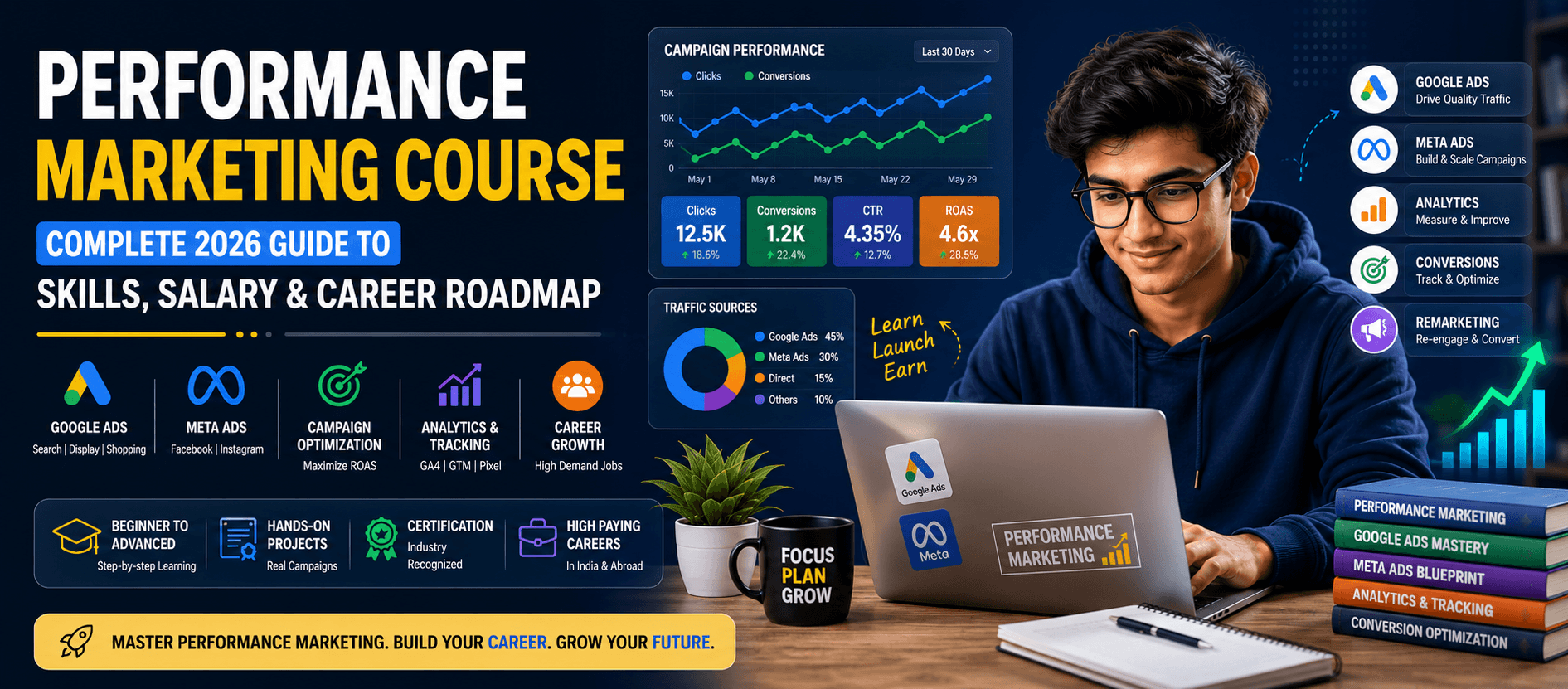
Performance Marketing Course: Complete 2026 Guide to Skills, Salary & Career Roadmap
Thinking about a career that pays for results, not just effort? A performance marketing course teaches you how to turn ad budgets into measurable revenue using Google Ads, Meta Ads, GA4, and AI tools. This guide breaks down what performance marketing actually is, how it works, the skills and tools you'll need, and a realistic salary range in India and abroad. You'll also get a module-by-module curriculum breakdown, a comparison with traditional digital marketing, common beginner mistakes, and the 2026 trends shaping the industry — from AI-powered bidding to first-party data tracking. Whether you're a fresher, a career-switcher, or a business owner who wants to stop wasting ad spend, this guide — and the Course Unbox Performance Marketing Course — will show you exactly where to start.
Every day, brands burn lakhs of rupees on ads that go nowhere. Clicks come in, but sales don't. The problem usually isn't the budget — it's the lack of a skilled performance marketer behind the campaign.
That's exactly the gap a good performance marketing course is built to close.
Unlike traditional marketing, where you pay for reach and hope for results, performance marketing ties every rupee spent to a measurable outcome — a click, a lead, a sale. It's data-driven, accountable, and one of the fastest-growing career paths in India's digital economy right now.
In this guide, we'll walk through what performance marketing really means, how it works behind the scenes, the exact skills and tools you need, realistic salary numbers in India and abroad, and how a structured performance marketing training program — like the one at Course Unbox — can take you from zero to job-ready in a few months.
What is Performance Marketing?
Performance marketing is a form of digital advertising where advertisers pay only when a specific, measurable action happens — a click, a lead, an app install, or a sale — instead of paying upfront for impressions or airtime.
It runs primarily across platforms like Google Ads, Meta Ads (Facebook and Instagram), LinkedIn Ads, and programmatic display networks, all tied together with tracking tools like Google Analytics 4 (GA4), Google Tag Manager, and Meta Pixel.
In simple words: if traditional advertising is a billboard, performance marketing is a vending machine. You put money in, and you can see exactly what came out.
This is also why performance marketing has become the backbone of how startups, D2C brands, and even large enterprises spend their marketing budgets — it removes guesswork and replaces it with data.
How Performance Marketing Works
Every performance marketing campaign follows a similar underlying loop, even if the platform changes:
Define the goal – lead generation, sales, app installs, or brand sign-ups.
Set up tracking first – conversion tracking through GA4, Meta Pixel, or Conversions API, so every action can be attributed correctly.
Build the campaign – audience targeting, ad creatives, bidding strategy, and budget allocation across Search Ads, Display Ads, Shopping Ads, or Video Ads.
Launch and monitor – track CTR, CPA, and ROAS in real time.
Optimize continuously – pause underperforming ad sets, scale winning creatives, adjust bids, and refine the landing page.
Retarget and remarket – bring back users who didn't convert the first time using remarketing audiences.
This cycle repeats constantly. A performance marketer's real job isn't "running ads" — it's reading data and making fast, informed decisions that improve ROAS week over week.
Benefits of Learning Performance Marketing
High earning potential – performance marketers are among the highest-paid entry-level digital marketing roles.
Job security – every business with an online presence needs someone to manage paid ads.
Freelance-friendly – you can manage client ad accounts remotely, from anywhere.
Fast entry, no degree required – skills matter more than a specific degree background.
AI is amplifying the role, not replacing it – tools like ChatGPT and Gemini now assist with ad copy and audience insights, making skilled marketers even more valuable, not less.
Transferable across industries – e-commerce, ed-tech, real estate, SaaS, and healthcare all need performance marketers.
Performance Marketing vs Digital Marketing
People often confuse performance marketing with the broader term "digital marketing." Here's the difference laid out clearly:
Parameter | Digital Marketing | Performance Marketing |
|---|---|---|
Scope | Broad umbrella: SEO, social media, content, email, PR | Narrow, paid-and-measurable subset of digital marketing |
Payment Model | Often flat fee or retainer-based | Pay-per-click, pay-per-lead, pay-per-conversion |
Measurability | Harder to attribute directly to revenue | Directly tied to CPA, ROAS, and conversions |
Timeframe for Results | Long-term (SEO, branding) | Short to mid-term (campaigns show data within days) |
Core Skill Focus | Content, branding, strategy | Google Ads, Meta Ads, analytics, conversion optimization |
Career Speed | Steady growth | Faster growth due to visible, provable results |
If you want a deeper breakdown, Course Unbox has a dedicated page comparing performance marketing vs digital marketing in more detail.
Skills You Will Learn
A solid performance marketing certification program should cover:
Google Ads (Search, Display, Shopping, YouTube, Performance Max)
Meta Ads Manager (Facebook & Instagram campaigns)
Conversion tracking (GA4, GTM, Meta Pixel, Conversions API)
Landing page optimization and A/B testing
Full-funnel strategy (TOFU/MOFU/BOFU) and remarketing
Creative strategy — hooks, ad angles, UGC-style creatives
AI-assisted campaign workflows
Reporting and dashboarding (Looker Studio, GA4)
Budget pacing and scaling strategy
If you want to check exactly which skills recruiters look for, this skills required for performance marketing page breaks it down role by role.
Course Curriculum
Here's what a well-structured, 12-module performance marketing training roadmap typically looks like — this mirrors the curriculum followed at Course Unbox:
Module | Focus Area |
|---|---|
1 | Performance Marketing Foundations & Unit Economics (CAC, ROAS, LTV, CPA) |
2 | Google Ads — Search, Display, Shopping, YouTube & Performance Max |
3 | Meta Ads — Facebook & Instagram campaign management |
4 | Conversion Tracking & Attribution (GTM, GA4, Meta Pixel/CAPI) |
5 | Landing Pages & Conversion Rate Optimization |
6 | Full-Funnel Strategy & Retargeting |
7 | Other Paid Channels — LinkedIn Ads, programmatic, app-install |
8 | Creative Strategy for Performance |
9 | AI in Performance Marketing (predictive bidding, AI reporting) |
10 | Analytics, Reporting & Optimization |
11 | Advanced Scaling & Media Buying |
12 | Freelancing, Career Prep, Capstone Project + Paid Internship |
You can view the complete breakdown on the Performance Marketing Syllabus page.
Tools Covered
Category | Tools |
|---|---|
Paid Ads Platforms | Google Ads, Meta Ads Manager, LinkedIn Campaign Manager |
Analytics & Tracking | GA4, Google Tag Manager, Meta Pixel, Search Console |
AI Tools | ChatGPT, Gemini, Claude, Perplexity, Midjourney |
Reporting | Looker Studio |
Landing Pages/CRO | Website builders, A/B testing tools |
Creative | Canva, Figma |
Marketing Automation | HubSpot, Mailchimp |
SEO/Competitive Research | SEMrush |
A dedicated deep-dive into ad platforms is available on the Google Ads course and Meta Ads course pages if you want to specialize further.
Projects Included
A practical online performance marketing course should have you build, not just watch tutorials:
A live Google Ads campaign running on a real budget
A live Meta Ads campaign with creative testing
A complete conversion tracking setup with verified events
An A/B-tested landing page tied to an active campaign
A full-funnel media plan with retargeting flows
An AI-assisted campaign workflow
A live performance dashboard and client-ready report
A capstone project managing a real ad budget, followed by a paid internship
Eligibility
Good news — performance marketing doesn't gatekeep by degree or background.
Any graduate, undergraduate, or working professional can apply
No coding background required
Basic comfort with numbers and spreadsheets helps but isn't mandatory
Students, career-switchers, freelancers, and business owners are all common enrollees
Who Should Join This Course
Freshers who want a job-ready, practical digital skill
Career switchers from finance, operations, or non-marketing backgrounds
Business owners who want to run their own ads instead of relying on agencies
Freelancers looking to add a high-paying service to their portfolio
Existing marketers who want to specialize and increase their salary
Not sure if this is the right starting point for you? Course Unbox has a specific guide for performance marketing for beginners that walks through this in more detail.
Career Opportunities
After a solid performance marketing classes program, common entry points include:
Performance Marketing Executive
Paid Media Analyst / Media Buyer
PPC Specialist
Google Ads Specialist
Meta Ads Specialist
Growth Marketing Associate
Digital Marketing Executive (Paid Media focus)
Explore the full breakdown of roles on the performance marketing jobs page.
Freelancing Opportunities
Performance marketing is one of the most freelance-friendly digital skills:
Manage ad accounts for small businesses and D2C brands
Offer landing page + ad campaign packages
Work with agencies as a contract media buyer
Build a personal brand around a niche (e.g., real estate ads, e-commerce ads)
Many students use their capstone project as their first freelance case study or portfolio piece.
Remote Jobs
Because campaigns are managed entirely through cloud dashboards, performance marketing is naturally remote-friendly. Companies across e-commerce, ed-tech, SaaS, and agencies regularly hire remote paid-media specialists, media buyers, and growth marketers — making this one of the more location-flexible digital careers available today.
Performance Marketing Salary in India
Salaries vary by city, company size, and portfolio strength, but here's a general, realistic range seen across the industry:
Experience Level | Typical Annual Salary Range (India) |
|---|---|
Fresher / Entry-Level | ₹2.5 LPA – ₹4.5 LPA |
1–3 Years Experience | ₹4.5 LPA – ₹8 LPA |
3–6 Years Experience | ₹8 LPA – ₹15 LPA |
Senior / Team Lead | ₹15 LPA – ₹25+ LPA |
Freelance (per project/month) | Varies widely based on ad spend managed and niche |
For a deeper, city-wise breakdown, see the performance marketing salary in India page.
Performance Marketing Salary Abroad
Internationally, especially in the US, UK, UAE, and Southeast Asia, performance marketers with strong portfolios and platform certifications can expect noticeably higher compensation than the Indian market, particularly in agency and D2C e-commerce roles. Remote roles for Indian performance marketers working with international clients or agencies are also increasingly common, often paying in USD or AED, which significantly boosts effective earnings compared to local-only roles.
Future Scope & 2026 Trends
Performance marketing isn't slowing down — it's evolving. Key trends shaping 2026:
AI-driven campaign management – Performance Max and AI bidding are handling more of the manual optimization work
First-party data & privacy-first tracking – as cookies phase out, server-side tracking (Conversions API, GTM) is becoming essential
Creative-led growth – with automation handling bidding, creative testing is now the biggest lever for performance
AI-generated ad creatives – tools like ChatGPT, Gemini, and Midjourney are becoming standard in the workflow
Blended/MER reporting – marketers are expected to report performance across the full marketing mix, not just platform-level ROAS
Rise of retail media and app-install ecosystems – new ad inventory beyond Google and Meta is opening up
Marketers who combine core platform skills with AI fluency will have a clear advantage over those who don't.
Why Choose Course Unbox
Course Unbox's Performance Marketing Course is built specifically to close the gap between "knowing the theory" and "actually running profitable campaigns."
Live projects on real brands, not simulated dummy accounts
AI-integrated curriculum covering ChatGPT, Gemini, Claude, and Midjourney alongside Google and Meta Ads
100% placement assistance and dedicated career guidance
Founder-led mentorship from Jugal Chauhan, who brings 12+ years of hands-on experience across brands like Bata India and Airtel
Flexible batches — full-time weekday or weekend options
A capstone project + paid internship managing real ad accounts before you graduate
Strong placement outcomes, with alumni working at companies like Google, Meta, Swiggy, Zomato, Paytm, and PhonePe
If you're comparing options, Course Unbox also has an honest breakdown on the best performance marketing institute in Noida page, and a direct Course Unbox vs Kraftshala comparison if you want to weigh your options before enrolling.
Expert Tips
Track before you spend – never launch a campaign without conversion tracking fully verified.
Test creatives, not just copy – in 2026, the creative is often the single biggest performance lever.
Don't chase CTR alone – a high CTR with low conversions is a landing page problem, not an ad problem.
Learn to read blended ROAS, not just platform-reported ROAS — platforms tend to over-report their own contribution.
Build a portfolio from day one – document every campaign you run, even practice ones.
Common Beginner Mistakes
Launching ads without setting up GA4 or Meta Pixel tracking first
Targeting audiences that are too broad or too narrow
Ignoring landing page speed and mobile experience
Judging a campaign's success within the first 24–48 hours (most algorithms need a learning period)
Not separating branded and non-branded keywords in Google Ads
Treating Google Ads and Meta Ads with the same strategy, when each platform behaves differently
Key Takeaways
Performance marketing ties ad spend directly to measurable outcomes like leads and sales.
It's a faster, more accountable career path than traditional digital marketing roles.
Core skills include Google Ads, Meta Ads, GA4/GTM tracking, CRO, and now, AI-assisted workflows.
Salaries scale quickly with proven ROAS results and a strong portfolio.
A structured, project-based performance marketing course — like the one at Course Unbox — significantly shortens the path from learning to earning.
Conclusion
Performance marketing rewards people who can prove their results — not just describe their efforts. That's what makes it one of the most meritocratic, fast-growing careers in digital marketing today.
If you're ready to move from watching tutorials to actually running live campaigns with real budgets, real brands, and real mentorship, the Course Unbox Performance Marketing Course is built exactly for that jump — from beginner to job-ready performance marketer, backed by placement support and a paid internship.
About the Author
Jugal Chauhan
Jugal Chauhan is a digital marketing strategist and tech educator with a passion for making complex topics accessible. He writes about marketing, technology, and professional growth to help learners and businesses thrive in the digital age.
Learn more about us →