Get a counselling call
How to Rank on Google First Page - Complete SEO Guide | SEO Expert
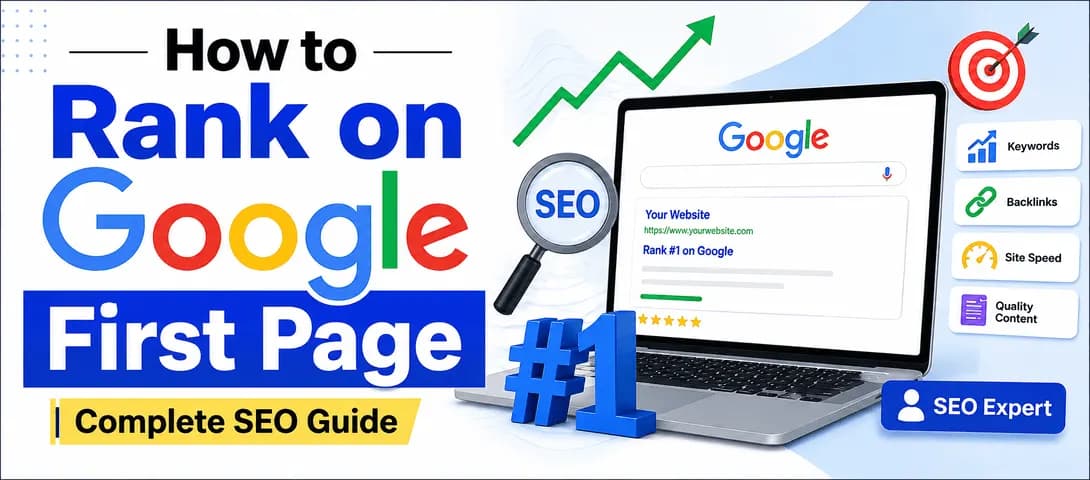
To rank a website on Google first page, match search intent with genuinely helpful content, then strengthen on-page SEO, technical speed, Core Web Vitals, quality backlinks, and E-E-A-T trust signals. Structure every page so Google and AI search engines can extract a clean answer. Learning how to rank website on Google first page is a repeatable system, not luck.
The reason the first page matters so much is simple. The large majority of clicks go to page one, and most people never look at page two because they assume the best answers are already in front of them. As AI Overviews expand, a growing share of searches now end without a click, because the answer is served directly on the results page. This makes two things true at once. Being on page one is more valuable than ever, and simply being present is no longer enough. You have to earn the specific position, snippet, or citation that captures attention.
It also helps to separate organic rankings from paid ads. Ads can put you at the top today for a price, but the moment your budget stops, you disappear. Organic first page ranking is earned through SEO and compounds over time, sending free traffic month after month. Many businesses run both, using Google Ads for immediate visibility while building organic rankings for long term growth. This guide focuses on the organic side, which is where lasting value lives.
The Core Framework to Rank Website on Google First Page
Before the tactics, hold the big picture in mind. Every method that helps you rank website on Google first page falls into one of five buckets, and Google weighs them together rather than in isolation. When people ask how to improve Google search rankings, the honest answer is that you rarely fix one thing. You strengthen all five until your page becomes the clearly better result. These priorities mirror the best practices in Google's official SEO Starter Guide, and they shape the way we teach ranking across our career-focused digital skills programs.
Pillar | What it answers for Google | What you actually do |
Relevance | Does this page match what the searcher wants? | Keyword and intent research, precise topic targeting |
Content quality | Is this the most helpful answer available? | Depth, originality, first-hand experience, clarity |
Technical health | Can Google crawl, render, and load this fast? | Speed, mobile usability, indexing, Core Web Vitals |
Authority | Do other trusted sources vouch for this site? | Backlinks, brand mentions, citations, E-E-A-T |
Extractability | Can search and AI engines lift and cite it? | Structure, direct answers, schema, clean formatting |
Keep this table in view as you read on. Each section below strengthens one or more of these pillars, and together they form a system rather than a checklist of disconnected hacks.
Google Ranking Factors That Decide the First Page
Google uses hundreds of signals, but a handful carry most of the weight. Understanding the major Google ranking factors keeps you focused on what actually moves the needle instead of chasing myths. The signals that matter most in 2026 are content relevance and depth, real expertise and trust, quality backlinks, technical performance, mobile usability, and how easily your content can be understood and cited.
Content relevance comes first. If your page does not answer the query the searcher had in mind, no amount of technical polish will save it. After relevance comes helpfulness and originality, because Google's helpful content systems are built to reward pages written for people and to filter out thin, mass produced text. Trust and authority follow, expressed through backlinks from respected sites and through clear signals about who created the content and why they are credible. Finally, technical factors such as speed and crawlability act as gatekeepers, and the web performance best practices published by Google's own engineers set the bar here. They rarely lift a weak page to the top, but they can quietly hold a strong page back if ignored.
Search Intent and Keyword Research as Your Foundation
Everything starts with choosing the right keyword and understanding the intent behind it. Search intent is the goal a person has when they type a query. It can be informational, where they want to learn, commercial, where they are comparing options, transactional, where they are ready to act, or navigational, where they want a specific site. Matching intent is the single biggest reason pages either rank or fail. A page that sells a product will not rank for a query where people want a free tutorial, no matter how good the page is.
Good keyword research starts by listing the topics your audience cares about, then expanding each into the real phrases they search, including long tail variations that are longer, more specific, and easier to rank for. Beginners should target these long tail terms first, because they carry clear intent and far less competition. To judge a keyword, look at its search volume, its difficulty, and the type of pages already ranking. If the first page is full of deep guides, a thin post will not break in. Learning how to rank keywords on Google is really about learning to read that first page and then produce something clearly more complete and more useful.
Group your keywords into clusters around a single core topic, then build one strong pillar page supported by focused cluster pages. This topical structure tells Google you cover the subject thoroughly, which builds the authority needed to rank for competitive head terms. It is the same content architecture approach we apply across the Course Unbox blog, where clusters of related guides reinforce one another.
On-Page SEO Techniques to Rank Higher on Google
On-page SEO is everything you control directly on the page, and it is where most quick wins hide. Strong on-page SEO for higher rankings starts with the title tag. Write a clear, compelling title of roughly fifty to sixty characters that includes your primary keyword near the front and gives a real reason to click. The meta description will not rank you on its own, but a sharp description improves click through, and click through influences how Google views your result over time.
Use one clear H1 that states the topic, then descriptive H2 and H3 headings that guide the reader and include natural keyword variations. Place your primary keyword in the first hundred words, then let related and semantic terms appear naturally throughout, without forcing them. Keep your URL short and readable with the keyword inside it. Add descriptive alt text to every image so search engines and visually impaired users both understand it. These small details compound, and mastering them is a core part of any serious SEO training, including the practical modules inside our on-page and technical SEO training.
One warning that saves many sites. Do not over optimize. Repeating an exact phrase dozens of times looks like manipulation and can hurt you. Aim for a natural keyword density, use synonyms and related concepts, and write for a human reader first. Google is far better at understanding meaning than matching exact strings, so relevance beats repetition every time.
Creating Helpful Content That Earns the Top Spot
Content is where first page rankings are won or lost. Google's systems are tuned to reward content that is genuinely helpful, original, and satisfying, and to suppress content that exists only to rank. To earn the top spot, your page has to be the most complete and useful answer a searcher can find, not merely a rephrased version of what already ranks.
Start by covering the full question, including the follow up questions people ask next. Add value that competitors miss, such as real examples, first hand experience, original observations, step by step instructions, and honest tradeoffs. Write in plain language, break ideas into scannable sections, and lead each section with a clear answer before you expand on it. Freshness matters too. Updating and improving an existing page often outperforms publishing a brand new one, because it builds on signals the page has already earned.
If content creation is where you want to grow, structured practice makes the difference between writing that ranks and writing that disappears. Our content creation program focuses on exactly this blend of research, structure, and storytelling that modern search rewards.
Technical SEO and Core Web Vitals for Faster Pages
Technical SEO makes sure Google can find, understand, and serve your pages quickly. If a page cannot be crawled or takes too long to load, even brilliant content will struggle. The essentials are straightforward. Submit an XML sitemap through Google Search Console, keep a clean robots file that does not block important pages, use HTTPS, set correct canonical tags to avoid duplicate content, and make sure every page you want to rank is actually indexed.
Speed and stability are measured through Core Web Vitals, which look at how fast the main content loads, how quickly the page responds to interaction, and how much the layout shifts while loading. Compress images, reduce heavy scripts, enable caching, and choose reliable hosting to keep these metrics healthy. You can follow the detailed guidance on optimizing these metrics to benchmark your pages against the recommended thresholds. Mobile usability is non negotiable, since Google evaluates the mobile version of your site first. The deeper technical audit skills, from crawl analysis to structured data, are covered thoroughly in our career focused SEO course guide.
Internal Linking and Site Architecture That Lift Rankings
Internal linking is one of the most underused ways to improve Google search rankings. When you link from one relevant page to another using descriptive anchor text, you help Google understand how your pages relate, and you pass authority from strong pages to the ones you want to lift. A clear site architecture, where a pillar page links down to cluster pages and they link back up, concentrates topical authority where it matters most.
Practical rules make this easy. Link from high authority pages to new or important pages, use anchor text that describes the destination rather than generic phrases, and avoid burying key pages many clicks deep. A logical structure also improves the user experience, keeps visitors moving through your site, and increases the time they spend engaging with your content. Building this kind of well structured, fast, and crawlable site is a skill that overlaps with development, which is why many marketers benefit from understanding how full stack development shapes site performance and structure.
Off-Page SEO and Backlinks for Authority and Trust
Off-page SEO covers everything you do beyond your own website to build authority, and backlinks remain its centerpiece. A backlink is a link from another website to yours, and Google treats each relevant, high quality link as a vote of confidence. A handful of editorial links from respected, on topic sites will move you further than hundreds of low value directory or spam links, which can actually harm you.
Earn links by creating genuinely link worthy assets such as original research, useful tools, and definitive guides, then reaching out to publications and creators who serve your audience. Guest posting on reputable sites, digital PR, being quoted as an expert, and earning natural brand mentions all build the authority that first page rankings require. Supporting tactics such as directory submissions, local citations, and SEO social bookmarking help search engines discover and index your content faster, even when they do not directly lift rankings on their own. For a complete, current playbook, our guide to off-page techniques in SEO walks through backlinks, authority building, and AI search visibility in detail.
E-E-A-T Signals That Make Google Trust Your Website
E-E-A-T stands for Experience, Expertise, Authoritativeness, and Trust, and it describes the qualities Google's human quality raters look for. While E-E-A-T is not a single score, the signals behind it strongly influence which pages Google feels safe promoting, especially for topics that affect money, health, or major decisions. Demonstrating real experience and expertise is now one of the clearest ways to separate your content from generic, mass produced text, a distinction Google spells out in its guidance on helpful, people-first content.
Show who wrote the content with a named author and a credible bio, cite trustworthy sources, keep your facts accurate and current, and be transparent about your business with a real address, contact details, and clear policies. First hand experience is powerful, so share what you have actually done, tested, or observed. At Course Unbox, our content is created by working practitioners with more than a decade of hands on industry experience, and you can learn more about our team and approach on our About Course Unbox page. These trust signals matter to Google, and they matter even more to AI search engines that must decide which sources are safe to cite.
Optimizing for AI Overviews, Featured Snippets, and AI Search
The biggest shift in how to get a website on the first page of Google is that the first page is no longer only about blue links. AI Overviews, featured snippets, and answers pulled into tools like ChatGPT, Gemini, and Perplexity now sit at the top of attention. Optimizing for these surfaces is known as answer engine optimization, or AEO, and generative engine optimization, or GEO, and they are quickly becoming as important as classic SEO.
The tactics reward clarity. Answer the core question directly in the first forty to sixty words of a section so it can be lifted cleanly. Use descriptive headings, short scannable paragraphs, lists where they help, and comparison tables that machines can extract. Add structured data such as Article and FAQ schema, built with the vocabulary from Schema.org, so engines understand your content. Include specific facts, numbers, and named sources, because AI systems prefer content they can attribute confidently. Being genuinely present across the wider web, through helpful answers, credible mentions, and consistent expertise, increases the chance that AI engines cite you. These emerging skills, alongside the fundamentals, sit at the center of our AI digital marketing strategies and are a defining part of the modern search landscape.
Measuring Progress and Increasing Organic Traffic
You cannot improve what you do not measure. The free foundation for tracking how to increase organic traffic is Google Search Console, which shows the queries you appear for, your average positions, impressions, clicks, and any indexing problems. Pair it with an analytics tool to understand what visitors do after they arrive, and with a rank tracker to watch your target keywords over time.
Read the data as a story. If a page earns impressions but few clicks, your title and description need work. If it ranks on page two, it is often one content upgrade or a few internal links away from breaking into page one, which makes these near miss pages your highest priority. Track the questions you appear for, watch which pages Google favors, and keep refining. Steady measurement turns SEO from guesswork into a controllable growth channel, and it is the habit that separates marketers who guess from those who compound results, a discipline we reinforce throughout our performance marketing training.
A Realistic Timeline to Reach Google First Page
Be wary of anyone promising the first page in a day. It occasionally happens on trusted sites for low competition terms, but it is the exception, not the plan. For most websites, meaningful first page rankings take three to twelve months of consistent work in a competitive niche. Established domains with existing authority move faster, while brand new sites need patience while they earn trust.
The timeline shortens when you focus. Start with long tail keywords you can realistically win, publish helpful content on a steady schedule, fix technical issues early, and build a few relevant links each month. As pages start ranking, the authority they build makes the next pages rank faster. SEO rewards compounding effort, so the honest expectation is momentum that accelerates, not an overnight jump. Understanding this realistic curve is also why structured learning pays off, whether you pursue SEO, social media marketing, or a developer path like the one in our full stack developer roadmap.
Common Mistakes That Keep Websites Off the First Page
Most sites that stay stuck repeat the same avoidable errors. The first is keyword stuffing and writing for search engines instead of people, which now triggers suppression rather than rankings. The second is ignoring search intent, publishing a page that does not match what searchers actually want. The third is thin, generic content that adds nothing new to a crowded first page.
Other frequent mistakes include neglecting technical health, so pages load slowly or fail to get indexed, chasing large volumes of low quality backlinks that carry risk, targeting keywords far above the site's current authority, and publishing once then never updating. Expecting instant results and giving up before content matures is perhaps the most common failure of all. Avoid these, stay consistent, and you remove most of the barriers between your website and the first page of Google.
Turn This Knowledge Into a Career Ready Skill
Reading about how to rank website on Google first page is a great start. Doing it on real projects, with mentorship from working practitioners, is what makes it stick. The Course Unbox AI DigitalMarketing Course is a six month, beginner to advanced, live online program covering SEO, AEO, GEO, performance marketing, social media, and hands on AI tools, with live projects, certification, and placement support backed by more than five hundred hiring partners. As a Google Partner and Meta Business Partner, we teach the exact strategies in this guide, applied to live websites, with transparent course fees and EMI options.
→ Explore the AI Digital Marketing Course
Bringing It All Together
Ranking on Google's first page in 2026 is no longer a mystery, and it is not reserved for big brands with huge budgets. It is a system. Understand search intent, do sharp keyword research, publish genuinely helpful content, tighten your on-page and technical SEO, earn trusted backlinks, build clear E-E-A-T, and optimize for the AI surfaces that now shape the first page. Measure everything, stay consistent, and let your authority compound. Do this, and first page ranking stops being a hope and becomes a predictable outcome.
If you are ready to build these skills for a real career, book a free counselling session with our team, and if you are a company looking for job ready talent, visit our hire from us page. The first page is within reach. Start today, stay consistent, and let your rankings grow.
About the Author
Jugal Chauhan
Jugal Chauhan is a digital marketing strategist and tech educator with a passion for making complex topics accessible. He writes about marketing, technology, and professional growth to help learners and businesses thrive in the digital age.
Learn more about us →