Get a counselling call
Full Stack Developer Roadmap 2026: 14-Module Journey from HTML to AI-Powered Capstone
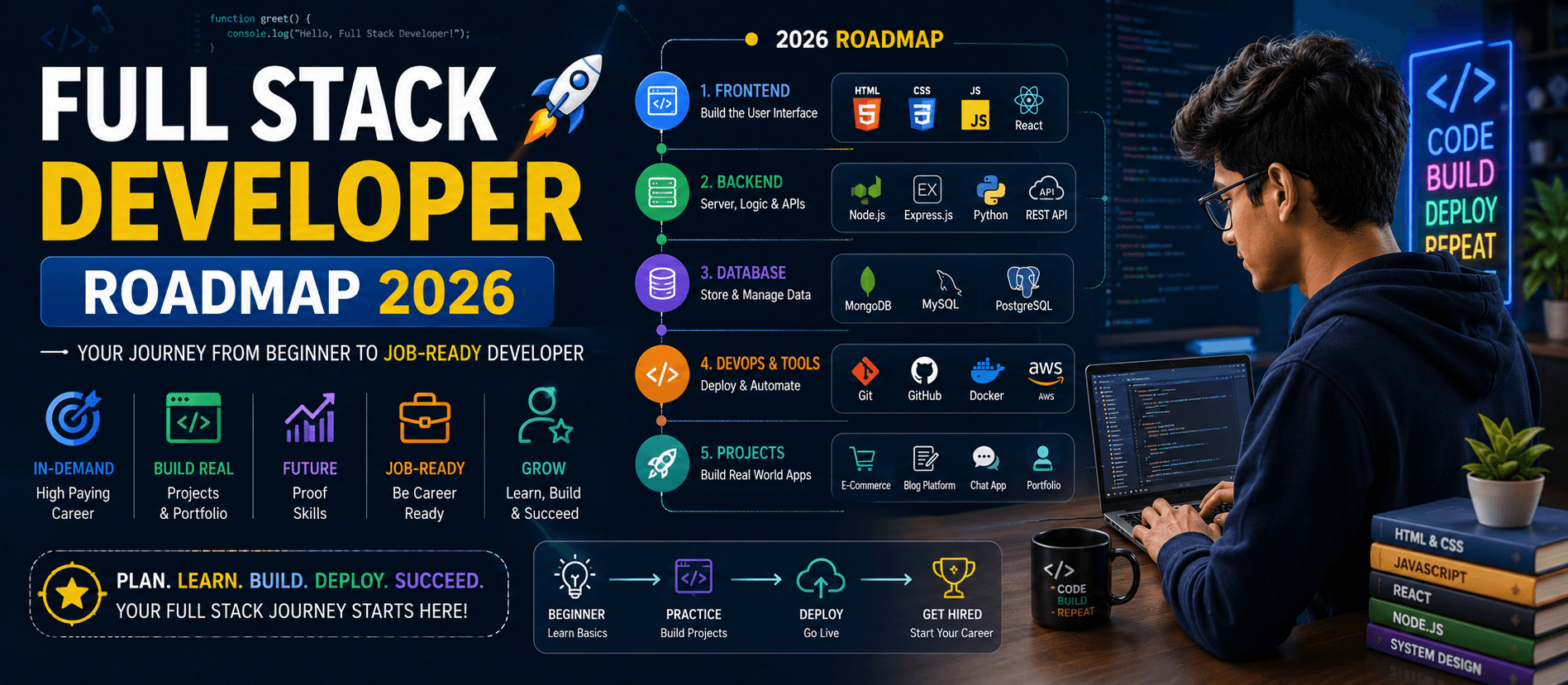
Not sure where to start with full stack development? Follow this 14-module roadmap — from HTML/CSS foundations to AI-powered capstone projects — and become job-ready in 6 months with Course Unbox.
The biggest strength of this structure is that every module builds on the previous one — there's no random jumping around. That's exactly why even complete beginners can build confidence step by step.
Phase-Wise Breakdown
Phase 1: Foundation (Modules 1-3)
Here you learn the basic building blocks of the web — HTML, CSS, and JavaScript. Don't skip this phase, even if it feels "too easy." Most developers who struggle later do so because their foundation was weak.
By the end of this phase, you should be able to build a fully responsive static webpage from scratch, and understand how JavaScript makes a page interactive — form validation, dynamic content updates, and simple animations without relying on any framework.
Phase 2: Frontend Mastery (Modules 4-5)
React.js is the most in-demand frontend library in the industry. Here you learn to build real components, manage state, and create professional-grade UI.
This phase also introduces performance thinking — why unnecessary re-renders happen, how memoization works, and how state management tools like Redux or Zustand keep large applications predictable as they grow.
Recruiters don't just check "does the app work" — they check "does the developer understand why it works." This phase is where that understanding starts forming.
Phase 3: Backend & Data (Modules 6-8)
Node.js, Express, and MongoDB together form the backend half of the MERN stack. In this phase, you learn how a server is built, how data is stored, and how APIs are secured.
You'll also learn how middleware works behind the scenes, how authentication tokens (JWT) keep user sessions secure, and how to design REST APIs that other developers can actually work with cleanly.
Phase 4: Modern Stack & AI (Modules 9-12)
This phase is what separates 2026's full stack developers from traditional ones. TypeScript, Next.js, and AI tools integration — these three now show up as requirements in almost every job description.
Next.js specifically teaches you server-side rendering and static site generation — concepts that directly impact how well a website ranks on Google, which makes this module especially valuable if you also care about SEO-driven projects.
Phase 5: Production-Ready (Modules 13-14)
Writing code isn't enough — you also need to know how to deploy it, keep it live, and get it in front of real users. The capstone project and paid internship give you real-world exposure that shows up both on your resume and in interviews.
A project sitting only on your laptop has zero value to a recruiter. A deployed, live project with a working link is proof you can ship — and shipping is what companies actually pay for.
What Makes This Roadmap Different?
Most online courses only teach "syntax" — click this button, write this function, done. But in a real job, you get asked things like: "Why is this API call failing?", "Why is this component re-rendering repeatedly?", "Why is this database query slow?"
That's why Course Unbox's curriculum focuses on "why and how," not just "what" — internal engine mechanics, runtime behavior, and real debugging scenarios. This approach also directly helps with interview preparation.
The Role of Real Projects
Every module comes with practical assignments and real brand projects, so theory doesn't stay limited to notes. By the time you reach Module 14, you already have a working portfolio you can show recruiters at placement time.
These aren't cloned to-do-list apps either — they're built around real business use cases, which means you also learn how to think from a client's or product owner's perspective, not just a coder's.
Placement Outcomes
About the Author
Jugal Chauhan
Jugal Chauhan is a digital marketing strategist and tech educator with a passion for making complex topics accessible. He writes about marketing, technology, and professional growth to help learners and businesses thrive in the digital age.
Learn more about us →