Get a counselling call
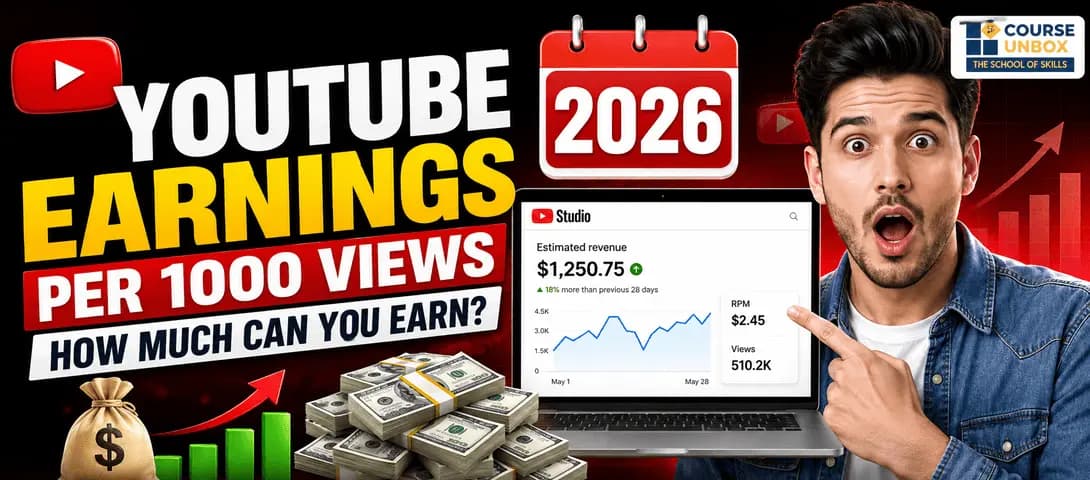
YouTube Earnings Per 1000 Views: What Creators Really Make
YouTube pays creators a share of ad revenue, not a fixed rate per view. Right now, most channels earn about 1 to 20 US dollars per 1,000 long-form views, and 2 to 5 dollars is the most common range. High-value niches like finance and software can reach 20 to 40 dollars. In India, earnings usually run 50 to 200 rupees per 1,000 views, rising to 500 rupees or more in premium niches. Shorts pay far less, often under one cent per 1,000 views. This guide breaks the numbers down by niche, country, and view count, and shows you how to estimate your own income.
Views | Typical global (USD) | India typical (INR) |
1,000 | 2 to 5 | 50 to 200 |
10,000 | 20 to 50 | 1,000 to 2,000 |
100,000 | 200 to 500 | 10,000 to 20,000 |
1 million (10 lakh) | 2,000 to 5,000 | 1,00,000 to 2,00,000 |
10 million (1 crore) | 20,000 to 50,000 | 10,00,000 to 20,00,000 |
CPM vs RPM: the two numbers that decide your pay
Two metrics explain almost every earnings question on YouTube, and mixing them up is the most common mistake creators make. CPM, or cost per mille, is what an advertiser pays for 1,000 ad impressions. It is the price on the advertiser side, before YouTube takes its cut. RPM, or revenue per mille, is what you actually keep per 1,000 video views after YouTube takes its share and after non-monetized views are counted in. RPM is the number that matches your bank balance, so it is the one this guide uses throughout. A creator can have a 15 dollar CPM and a 6 dollar RPM at the same time, because not every view shows an ad and YouTube keeps a portion. YouTube explains the metric in its official Help pages.
How YouTube splits the money
YouTube shares ad revenue with creators on a fixed split you cannot negotiate. For long-form videos over 60 seconds, creators keep 55 percent of the ad revenue their videos generate and YouTube keeps 45 percent. This 55/45 split has been the base of the creator economy for years.
For Shorts, the model is different. Ad money from the Shorts feed goes into a single pool. Music licensing costs are removed first, then the pool is divided among creators based on each creator's share of engaged Shorts views. From that allocation, creators keep 45 percent and YouTube keeps 55 percent. The lower share is one reason Shorts earn so much less per view than long-form videos. Fan features pay a better rate. Channel Memberships, Super Chat, Super Thanks, and Super Stickers return about 70 percent to the creator, because these are direct payments rather than ad sales.
YouTube earnings per 1000 views by niche
Your niche is the single biggest lever on your RPM, because YouTube advertising runs on an auction. Advertisers in industries with valuable customers, such as finance and software, bid far more than advertisers in gaming or entertainment. That is why two channels with identical view counts can earn wildly different amounts. The table below shows typical creator-reported RPM ranges. Treat them as planning ranges, not guarantees, because your own audience location and watch time move the number.
Niche | Typical RPM (USD per 1,000 views) |
Finance, investing, insurance | 12 to 40 |
Real estate | 8 to 25 |
Software, SaaS, tech reviews | 6 to 20 |
Business, digital marketing | 5 to 18 |
Education and tutorials | 4 to 12 |
Health, fitness, wellness | 4 to 12 |
Food, travel, lifestyle | 2 to 8 |
Gaming, entertainment, vlogs | 1 to 5 |
Music | 0.5 to 2 |
Shorts (any niche) | 0.01 to 0.07 |
A Business Insider creator survey reported real RPMs from 1.61 to 29.30 dollars per 1,000 views, an entertainment creator at the low end and a personal finance creator at the high end.
YouTube pay by view milestone
Once you know your RPM, scaling to any view count is simple multiplication. The table below models three long-form scenarios in dollars, a low RPM of 2, a common RPM of 5, and a high-niche RPM of 15, alongside a typical India range in rupees.
Views | RPM 2 (USD) | RPM 5 (USD) | RPM 15 (USD) | India typical (INR) |
1,000 | 2 | 5 | 15 | 50 to 200 |
10,000 | 20 | 50 | 150 | 1,000 to 2,000 |
100,000 | 200 | 500 | 1,500 | 10,000 to 20,000 |
1,000,000 | 2,000 | 5,000 | 15,000 | 1,00,000 to 2,00,000 |
10,000,000 | 20,000 | 50,000 | 1,50,000 | 10,00,000 to 20,00,000 |
So a general channel at a 5 dollar RPM makes about 5,000 dollars from 1 million views, while a finance channel at a 15 dollar RPM makes roughly 15,000 dollars from the same views.
YouTube income per 1000 views in India
India has one of the largest creator bases in the world, but average RPMs are lower than in the United States, the United Kingdom, or Australia. The reason is advertiser demand: brands generally pay less to reach viewers in India than to reach viewers in high-income markets, so the same 1,000 views convert to fewer rupees. For general Indian content, earnings usually fall between 50 and 200 rupees per 1,000 views. Premium niches change the picture sharply. Finance, business, technology, and software channels aimed at Indian professionals can earn 500 to 1,000 rupees or more per 1,000 monetized views, because the advertisers chasing those viewers pay a premium. Two practical takeaways: topic selection matters more than raw views, and an audience that includes viewers in high-income countries lifts your blended RPM, so content with global appeal pays better per view than content that only reaches domestic audiences.
YouTube income by subscriber count
Subscribers do not pay you directly, but they usually track with monthly views, which do. As a rough India-based guide, here is what channels earn at different sizes. Actual income swings with niche and audience location.
Subscribers | Typical monthly views | Estimated monthly income (INR) |
10,000 | 50,000 to 1 lakh | 2,500 to 10,000 |
1,00,000 (1 lakh) | 2 to 5 lakh | 20,000 to 80,000 |
10,00,000 (10 lakh) and above | 10 lakh to 50 lakh and above | 1 lakh to 10 lakh and above |
Ranges are ad-revenue estimates for Indian audiences. Sponsorships and products can multiply these figures.
YouTube earnings by country
Where your viewers sit changes your pay more than almost anything else. Views from high-income, English-speaking markets attract higher ad bids. The table shows typical RPM bands by audience country.
Country | Typical RPM (USD) | Typical RPM (INR) |
United States | 4 to 8 | 350 to 700 |
United Kingdom | 3 to 7 | 300 to 600 |
Canada | 3 to 6 | 300 to 500 |
Australia | 3 to 6 | 250 to 450 |
India | 0.5 to 2.5 | 50 to 200 |
That is why channels with a global audience often earn more even with fewer views.
How much do YouTube Shorts pay per 1000 views
Shorts are a growth engine, not a primary income source. Because Shorts run on the pooled model described above, and because creators keep only 45 percent of that pool, Shorts RPMs are a fraction of long-form rates. In practice, Shorts pay roughly 0.01 to 0.07 dollars per 1,000 views, which works out to about 30 to 200 dollars per million views. Compare that with 2,000 to 15,000 dollars for a million long-form views and the gap is obvious. The smart play is to use Shorts for reach and subscriber growth, then move that audience to long-form videos where the real money lives. A viewer who discovers you on a Short and then watches your 12 minute video is worth many times more than the Short itself.
What decides your earnings per 1000 views
Several factors move your RPM up or down, often at the same time.
Niche and topic. The auction rate for your subject sets the ceiling. Finance and software sit at the top, music and kids content near the bottom.
Audience location. Views from the United States, Canada, the United Kingdom, and Australia pay several times more than views from many other regions.
Watch time and video length. Videos of eight minutes or more can carry mid-roll ads, which raises revenue per view.
Ad density and format. More ad slots and higher-value formats lift RPM, but too many ads hurt retention, so there is a balance.
Engagement. Likes, comments, and shares do not pay directly, yet they push the algorithm to recommend your video, which increases monetized views.
Seasonality. Advertiser budgets peak in the last quarter of the year, so October to December usually delivers the highest RPMs, while January is typically the lowest.
Monetized view rate. Not every view shows an ad. Ad blockers, made-for-kids limits, and advertiser-friendly guidelines all reduce the share of views that actually earn.
How to estimate your own earnings
You do not need a paid tool to get a realistic estimate. The formula is: estimated earnings = (views divided by 1,000) multiplied by your RPM. First, find your RPM in YouTube Studio, then Analytics, then the Revenue tab. If you are not monetized yet, pick a starting RPM from the niche table above. Then divide your views by 1,000 and multiply by that RPM.
Worked example, global. A tech review channel in the United States with an 8 dollar RPM and 250,000 monthly views earns 250 multiplied by 8, which is about 2,000 dollars a month from ads.
Worked example, India. A personal finance channel with a 400 rupee RPM and 300,000 monthly views earns 300 multiplied by 400, which is about 1,20,000 rupees a month from ads.
When YouTube starts paying you
You cannot earn ad revenue until you join the YouTube Partner Program. There are two entry points. Early access, for fan funding and Shopping, needs 500 subscribers, 3 valid public uploads in the last 90 days, and either 3,000 valid public watch hours in 12 months or 3 million valid public Shorts views in 90 days. Full monetization, for ad revenue, needs 1,000 subscribers plus either 4,000 valid public watch hours in 12 months or 10 million valid public Shorts views in 90 days, an active Google AdSense account, no active strikes, and 2-step verification. One change to plan for: from 1 February 2027, YouTube raises the ad-revenue bar to 8,000 watch hours or 20 million Shorts views, with the 1,000 subscriber requirement unchanged, per YouTube's own announcement. If you are close to the current bar, reaching it before that date is worth the push.
Taxes on YouTube income in India
YouTube income is taxable in India, whether it comes from ads, sponsorships, or Shorts. Link your PAN with your AdSense account so payments are processed correctly. Income is generally reported when you file your annual income tax return, either as income from other sources for casual creators or as business income for regular ones. If your channel earns from viewers in the United States, Google may withhold US tax on that portion unless you submit your tax information. Large creators may also cross the GST registration threshold, since ad revenue from a foreign platform can count as an export of services. Rules and rates change, and a wrong figure has real consequences, so treat this as an overview and confirm your position with a qualified chartered accountant.
Common mistakes that reduce your income
A few avoidable habits quietly cap what a channel earns.
Uploading reused or copyrighted content, which triggers limited or no monetization.
Ignoring video SEO, so strong videos never get discovered.
Posting only Shorts and no long-form videos, which starves the channel of real ad revenue.
Clickbait thumbnails that win the click but crush retention, which lowers RPM.
Never checking analytics, so you cannot see which videos and niches actually pay.
Depending on ads alone instead of adding sponsorships, affiliates, and products.
How to earn more than ads
Ad revenue is where most creators start, but it is rarely where the money peaks. Memberships and Super Thanks return about 70 percent to the creator. A single sponsorship can pay more than a month of ad revenue for a mid-size channel. Affiliate links earn a commission on every sale, which can dwarf ad income in review and tutorial niches. Your own products, courses, and services turn an audience into a business. To lift your pay per 1,000 views, choose higher-value topics, make longer videos, grow your share of high-income audiences, publish strong evergreen videos before the year-end advertiser surge, and diversify early. Strong marketing skills speed all of this up, and the Course Unbox Social Media Marketing course teaches how to build, grow, and monetize an audience across platforms. You can also read our guide on
About the Author
Jugal Chauhan
Jugal Chauhan is a digital marketing strategist and tech educator with a passion for making complex topics accessible. He writes about marketing, technology, and professional growth to help learners and businesses thrive in the digital age.
Learn more about us →