Get a counselling call
What Is PLC in Marketing? Product Life Cycle Explained
PLC in marketing stands for Product Life Cycle, the four stages a product moves through in the market: introduction, growth, maturity, and decline. Each stage needs a different marketing strategy. CourseUnbox breaks down every stage below, with a diagram, real examples, and how to apply it.
Key facts
PLC: stands for Product Life Cycle
Four stages: introduction, growth, maturity, decline
1965: popularised by Theodore Levitt in Harvard Business Review
Sales over time: what the PLC curve plots
If you have searched for what PLC means in marketing, here is the short version, then the depth. PLC is short for Product Life Cycle, one of the most used frameworks in marketing and business studies. It describes how a product is born, grows, matures, and eventually fades, and how a marketer should act at each point.
The idea was popularised by the Harvard Business School professor Theodore Levitt in a 1965 Harvard Business Review article titled Exploit the Product Life Cycle. Since then it has become a standard tool taught in every marketing course, because it turns a vague sense that products rise and fall into a practical guide for pricing, promotion, and planning.
What does PLC stand for in marketing?
PLC stands for Product Life Cycle. In marketing, the product life cycle is a model that maps a product's sales over time across a series of stages, from the day it launches to the day it leaves the market. The model rests on a simple premise: no product sells at the same level forever. Demand builds, peaks, and eventually falls, and the smart marketer plans for each phase rather than reacting to it.
It remains one of the most widely taught marketing concepts, and most versions use four stages. A longer five-stage version adds a development stage before launch, when the product is still being built and no sales exist yet. This guide uses the common four-stage model and notes the development stage where it matters.
The product life cycle diagram
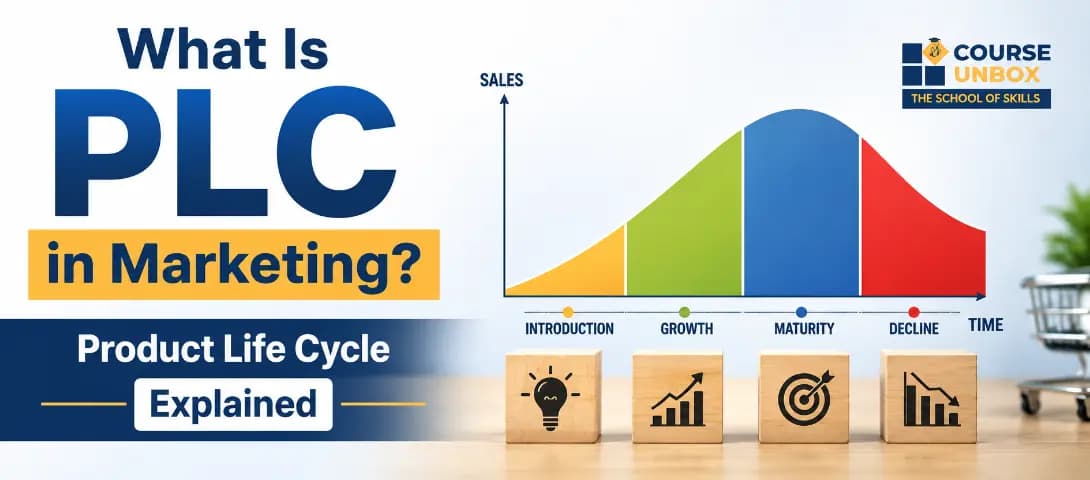
The product life cycle is almost always drawn as a curve of sales against time. Sales start low at launch, climb steeply through growth, flatten at maturity, and slide during decline. Profit does not track sales exactly: it is usually negative or thin during introduction because of launch and marketing costs, rises fastest in growth, peaks around late growth or early maturity as costs settle, and falls again in decline. The web version of this guide includes an interactive version of this curve.
The four stages of the product life cycle
Each stage of the PLC has its own sales pattern, level of competition, and marketing job to do. Here is what defines the four stages and how the marketing strategy shifts.
Stage 1: Introduction
The product launches. Sales are low, awareness is near zero, and costs per customer are high. There are few or no direct competitors yet.
Goal: build awareness and drive first trial.
Pricing: skimming for premium products, or penetration pricing to win share fast.
Promotion: heavy spend to explain the product and reach early adopters.
Distribution: often selective while demand is unproven.
Stage 2: Growth
Sales rise rapidly and profits climb as awareness spreads. Success attracts competitors, so differentiation starts to matter.
Goal: maximise market share while the market is expanding.
Pricing: hold or adjust as competition arrives.
Promotion: shift from awareness to building brand preference.
Distribution: widen channels to meet rising demand.
Stage 3: Maturity
Sales peak and then flatten. The market is crowded, growth slows, and price competition intensifies. This stage usually lasts the longest.
Goal: defend market share and protect profit.
Pricing: competitive, often with promotions or discounts.
Promotion: stress differentiation, loyalty, and new uses.
Distribution: intensive, with wide availability.
Stage 4: Decline
Sales and profits fall as tastes change or better options appear. Weaker players exit the market.
Goal: decide whether to harvest, divest, or revive the product.
Pricing: cut to clear stock, or hold for a loyal niche.
Promotion: reduced to the most efficient channels.
Distribution: narrowed to where the product still sells.
Product life cycle stages compared
The same four stages side by side, so you can see how sales, profit, competition, and the marketing mix change across the life of a product.
Stage | Sales | Profit | Competition | Pricing | Promotion focus |
Introduction | Low | Negative or thin | Few | Skimming or penetration | Build awareness and trial |
Growth | Rising fast | Rising | Growing | Hold or adjust | Build brand preference |
Maturity | Peak, then flat | High but pressured | Intense | Competitive, discounts | Differentiate and retain |
Decline | Falling | Falling | Shrinking | Cut or hold for niche | Minimal, efficient only |
Product life cycle examples
The model is easier to grasp with familiar products, and case studies such as Apple's product line show how one company manages several products across stages at once.
Introduction: a newly launched category such as consumer AI wearables, where brands are still explaining what the product does.
Growth: electric vehicles in many markets, where sales are climbing fast and new competitors keep arriving.
Maturity: smartphones and carbonated soft drinks, where nearly everyone already buys and brands fight over share.
Decline: DVDs and printed newspapers, where demand keeps falling as digital options replace them.
Why the product life cycle matters in marketing
The value of the PLC is that it tells you what to do, not just what is happening. The marketing mix that wins in introduction, heavy awareness spend and a launch price, would waste money in maturity, where retention and differentiation matter more, so a business must keep revising the marketing mix at each stage. Reading the stage correctly guides four decisions: how to price, where to spend promotion, how wide to distribute, and whether to keep investing or plan the product's exit.
It also helps a business balance risk. If every product a company sells is in decline at once, revenue is about to fall. A healthy portfolio keeps products spread across the stages, using the profits from mature products to fund the next introduction.
How to apply the PLC in digital marketing
Textbooks stop at the four stages. In practice, the stage decides which digital channels earn their budget. This is the part that turns the PLC from a diagram into a plan.
In introduction, the work is discovery: SEO foundations, explainer content, and paid social media marketing to reach early adopters. In growth, you scale performance marketing, optimise landing pages for conversion, and lean on reviews and social proof. In maturity, the money shifts to retention: email and loyalty, defending search rankings, and content that differentiates a crowded field. In decline, you harvest with the cheapest channels and decide whether to reposition the product or sunset it.
Learning to run that playbook across channels is the core of a digital marketing career. CourseUnbox teaches it hands on in its AI Digital Marketing programme, while its Content Creation course covers the creative side. You can browse all eight CourseUnbox programmes, or read our guide to digital marketing for content creators to see how these skills pay off.
PLC vs PLM: what is the difference?
The two are easy to mix up. PLC, the product life cycle, is the concept described here: the four market stages a product passes through. PLM, or product lifecycle management, is the broader business practice, and often the software, used to manage a product across its entire life, from design and engineering through to end of life. Put simply, PLC is the marketing model, while PLM is the operational system that manages products day to day.
Limits of the model
The PLC is a guide, not a law. Not every product follows the neat curve. Some fail at launch and never reach growth, some skip stages, and others revive after decline through a redesign or a new use. The length of each stage is also hard to predict, so the model is best used to ask good questions about a product rather than to forecast exact sales. Used that way, it remains one of the most useful frameworks a marketer has.
About the Author
Jugal Chauhan
Jugal Chauhan is a digital marketing strategist and tech educator with a passion for making complex topics accessible. He writes about marketing, technology, and professional growth to help learners and businesses thrive in the digital age.
Learn more about us →