Get a counselling call
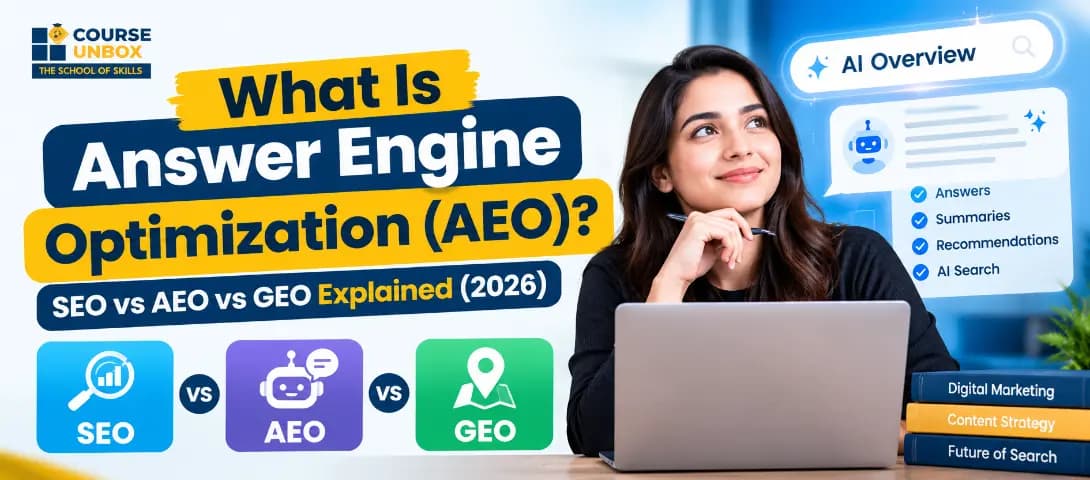
What Is Answer Engine Optimization (AEO)? SEO vs AEO vs GEO Explained (2026)
Answer Engine Optimization (AEO) is the practice of structuring your content so that answer engines like Google AI Overviews, ChatGPT, Gemini, and Perplexity pull a direct answer straight from your page and cite your brand as the source. AEO stands for Answer Engine Optimization. It differs from traditional SEO in one key way: SEO aims to rank your page and earn a click, while AEO aims to make your content the answer itself. This CourseUnbox guide breaks down AEO and GEO, how they differ from SEO, the 2026 data behind the shift, and a step-by-step system you can apply to any website today.
A few years ago the question was simple: how do I get my website onto page one of Google? Today that question has quietly changed. People increasingly ask ChatGPT, Gemini, Perplexity, and Google AI Overviews for a direct answer, and a huge share of them never click a link at all. Search has moved from a list of ten blue links to a single, spoken-or-written answer, and the brands that get named inside that answer are winning attention the rest never see.
That shift is exactly what AEO is built for. If you already understand the fundamentals of SEO, think of AEO as the next layer on top of it: instead of only trying to rank, you work to become the answer, and to be the source an AI cites when it responds. In this guide we start from the basics, define AEO and its full form, compare it clearly with SEO and GEO, look at the 2026 data that makes it urgent, and finish with a practical checklist, examples, and a way to measure results.
What AEO means and its full form
AEO, or Answer Engine Optimization, is a strategy for writing and structuring content so that search engines and AI assistants can lift it out and serve it directly as an answer. An answer engine is any system that returns a resolved response rather than a page of links: a Google featured snippet, a People Also Ask box, a voice assistant reply, or a full AI Overview. AEO is the discipline of making your content the response those systems trust and reuse.
In plain terms: when someone asks a question, an answer engine wants to return one clear, trustworthy, concise reply. The job of AEO is to make your page that reply. That is a different mindset from classic SEO, which optimises a page to climb the rankings and win a click. With AEO, the click is a bonus; the real prize is being the sentence the engine reads out or displays.
One line The full form of AEO is Answer Engine Optimization, and its goal is to make your content the direct answer inside featured snippets, People Also Ask, voice answers, and AI Overviews. |
A quick example. Someone asks, "What does AEO stand for?" A well-optimised page states the answer in its very first line, in a clean sentence a machine can quote without editing. A poorly optimised page buries the same fact three paragraphs down, wrapped in a story. Both may contain the answer, but only the first is written for an answer engine. That single habit, leading with the answer, is the heart of AEO.
Why AEO matters now, with 2026 data
The core reason is simple: search has shifted from links to answers, and the numbers behind that shift are no longer small. Consider the current picture:
Around 68% of Google searches now end without a click, up from roughly 45% a decade ago, according to the SparkToro and Similarweb zero-click study published in June 2026.
AI Overviews appear on 20% or more of searches, and on up to about 48% of tracked queries in some studies (SparkToro, June 2026; BrightEdge, February 2026).
When an AI Overview appears, about 83% of those searches end without a click (Bain & Company and Dynata, December 2024).
Google AI Mode has passed 1 billion monthly users (Google I/O, May 2026), and Similarweb’s clickstream data shows AI-first interfaces refer far fewer clicks to outside sites than classic search.
Visitors who arrive through AI search convert at 4.4 times the rate of traditional organic visitors (Semrush, 2025), so the traffic that does come through is far more valuable.
Put those together and the message is clear. If your content ranks but never appears in the AI answer, you lose the growing audience that will never scroll to a blue link. And because AI-sourced visitors convert so much better, being cited is not a vanity metric; it is a direct line to leads and sales.
There is also a timing advantage, especially in India. AI features are rolling out more slowly in some markets, which means the competition for AI citations is still thin. Brands that build clear, well-sourced, answer-shaped content now will be the trusted sources these engines lean on as adoption accelerates. Early movers get to define the answer before everyone else shows up.
How answer engines actually choose an answer
To optimise for answer engines, it helps to know roughly how they decide what to show. While the exact systems differ across Google, ChatGPT, Perplexity, and Gemini, the pattern is consistent:
They read the question, not just the keywords. Modern engines interpret intent, so they look for content that answers the real question a person is asking, in natural language.
They look for a clear, self-contained passage. A two to four sentence block that answers the question on its own is far easier to lift than an answer scattered across a page.
They weigh trust and authority. Signals like a named author, credible sources, consistent facts, and a recognised brand make an engine more comfortable repeating your content.
They parse structure and markup. Clean HTML and structured data from Google Search Central help machines understand which part of your page is the answer, which is the question, and how the entities relate.
They favour freshness. For fast-moving topics, recently updated pages are more likely to be selected than stale ones.
Notice that none of these is a trick. Every one rewards content that is clear, honest, well-organised, and genuinely useful. That is the good news about AEO: the work that pleases answer engines is the same work that helps real readers.
How AEO works, step by step
1. Understand real user intent
AEO works on the full question, not isolated keywords. Instead of "best web hosting," people now ask "which web hosting is best for a small business in India?" Your task is to identify the true intent behind that phrasing and answer it directly. When you match intent precisely, you become the obvious candidate for the answer slot, because you are solving the exact problem the searcher described.
2. Structure content so it can be lifted
Answer engines reward content with clear headings, short paragraphs, bullet points, and FAQs. The single most useful habit is to answer each question in two to four sentences that make complete sense even when pulled out of context. Write question-shaped headings, then answer them immediately underneath, before you add background or nuance. This turns your page into a set of ready-to-quote answers rather than one long essay a machine has to summarise.
3. Handle the technical layer
Schema markup and structured data make your page easy for machines to parse. Marking up your content with types from Schema.org tells engines exactly what each section is, which improves your chances of being chosen as the answer. Fast, clean, mobile-friendly pages matter too, because slow or messy pages are harder for AI crawlers to read and less likely to be cited.
SEO vs AEO vs GEO: full comparison table
This is where most articles get vague, so here is the full difference at a glance. The three disciplines are distinct but connected, and a strong strategy uses all three:
Aspect | SEO | AEO | GEO |
Full form | Search Engine Optimization | Answer Engine Optimization | Generative Engine Optimization |
Main goal | Rank your website higher in search results | Become the direct answer in snippets and answer boxes | Get cited as a source inside AI-generated answers |
Where you appear | Google and Bing organic blue links | Position Zero, People Also Ask, voice answers | AI Overviews, ChatGPT, Perplexity, Gemini |
Success metric | Rankings, organic clicks, traffic | Snippet capture, answer visibility | AI citations, brand mentions, share of voice |
Content focus | Keywords, backlinks, on-page signals | Precise, structured, question and answer format | Authoritative, quotable, well-sourced passages |
Core techniques | Titles, metas, internal links, page speed | Schema markup, concise answers, FAQs | Original data, clear entities, llms.txt |
Best for | Building long-term organic reach | Winning quick, direct-answer queries | Staying visible as search goes conversational |
The easy way to remember it: SEO gets you into the results, AEO makes you the direct answer, and GEO gets you cited inside an AI-generated answer. SEO is the foundation, since a page that cannot be found or trusted will not be quoted either. AEO builds on that foundation by shaping the answer. GEO extends it into the conversational, generative surfaces where more and more search now happens. Treat them as three layers of one strategy, not three competing choices.
What GEO is and how it differs from AEO
Quick answer GEO stands for Generative Engine Optimization. It is the practice of preparing your content so that generative AI tools like ChatGPT, Gemini, Perplexity, and Google AI Mode choose your brand as a source and cite it when they compose their answers. |
The difference between AEO and GEO is subtle but important. AEO focuses on the answer boxes a search engine shows itself, such as a featured snippet or a People Also Ask entry. GEO focuses on the answers an AI model writes by reading and blending many sources at once. With AEO you aim to become the answer; with GEO you aim to become the citation behind the answer. In practice they overlap heavily, and the same well-structured, trustworthy content tends to help both.
Three things move the needle most for GEO. First, publish original data or research, because unique facts are what models quote and competitors cannot copy. Second, back every claim with a credible, named source, since models prefer information they can verify. Third, keep your entities clear, meaning the names, places, products, and brands on your page should be unambiguous enough for a model to recognise and attribute correctly. Do these consistently and you become a source AI systems return to.
How to do AEO: a practical checklist
These steps apply to almost any website, whether you run a blog, a store, or a service business:
Find the real questions. Pull the exact wording people use from People Also Ask, Google autocomplete, and your own customer questions. Answer the questions people actually type, in their words.
Put a direct answer block on every page. Give a clean 40 to 60 word answer to the main question near the top, written so it can stand alone if lifted.
Write question-based headings. Phrase your H2s and H3s as real questions, for example "What is the difference between AEO and SEO?", then answer each one immediately.
Add schema markup. Use Article and FAQPage structured data so machines can parse your content. Ready-to-use JSON-LD is in the appendix of this guide.
Cite sources and add data. Quotable, sourced statistics are exactly what AI systems pick up and repeat, so include real numbers with named sources and dates.
Strengthen your E-E-A-T. Add a named author with genuine experience, clear sourcing, and an about section, so both readers and engines see a trustworthy authority.
Keep pages fast and mobile-friendly. Slow pages lose crawlers and readers alike, and speed is a ranking and citation advantage.
Update regularly. Answer engines favour fresh content, so refresh your key pages at least every quarter and note the update date.
AEO across different content types
AEO is not only for blog posts. The same answer-first thinking applies wherever people ask questions:
Guides and articles: open each section with a direct answer, then expand. This is the format engines quote most often.
Product and service pages: answer the real buying questions clearly, such as who it is for, what it costs to run, and how it compares, so AI can summarise your offer accurately.
FAQ pages: these are naturally answer-shaped, so add FAQPage schema and keep every answer tight and self-contained.
Course and learning pages: state outcomes and eligibility up front, so an engine can tell a searcher exactly what they will learn and who the course suits.
Local pages: answer "near me" and city-specific questions plainly, since voice and mobile searches lean heavily on direct answers.
How to measure AEO success
Classic SEO reporting focuses on rankings and clicks, but AEO needs a broader scorecard because much of the value happens without a click. Track these signals:
Featured snippet and answer-box wins for your target questions, which you can monitor in Google Search Console and rank trackers.
AI citations and mentions, meaning how often ChatGPT, Perplexity, Gemini, and AI Overviews name or link your brand for relevant queries.
Branded search growth, since being cited by AI often lifts the number of people searching for your name directly.
Impressions on question queries, which show whether you are surfacing for the conversational searches AEO targets.
Conversion quality of AI-sourced traffic, because those visitors tend to arrive with high intent and convert well.
Watching these together tells a truer story than clicks alone. A page can send fewer visits than before yet drive more leads, more brand searches, and more citations, which in the answer-engine era is exactly what winning looks like.
Benefits and common mistakes
Benefits
Appearing in Position Zero and AI Overviews multiplies brand visibility far beyond a normal ranking.
Your answer gets chosen for both voice and conversational queries, which classic SEO often misses.
Answering well and often builds your brand into a trusted authority that engines and readers return to.
AEO is still new, so early adopters gain a clear and lasting competitive advantage.
AI-sourced visitors convert at a much higher rate, so the traffic you do earn is worth more.
Common mistakes to avoid
Burying the answer. Put the direct answer first and the story afterwards.
Using statistics with no source, which damages both trust and your chances of being cited.
Stuffing keywords. AEO runs on intent and clarity, not keyword count.
Ignoring schema and structure, which can leave machines unable to read your page.
Writing for engines only. If a human finds the page thin, an engine eventually will too.
Learn this properly, with live projects AEO and GEO are most powerful when you understand the SEO foundation underneath them. To learn all three together, hands on, explore the CourseUnbox SEO Masters Course, or read more practical guides on our CourseUnbox blog, and start making your content ready for AI search. |
About the Author
Jugal Chauhan
Jugal Chauhan is a digital marketing strategist and tech educator with a passion for making complex topics accessible. He writes about marketing, technology, and professional growth to help learners and businesses thrive in the digital age.
Learn more about us →