Get a counselling call
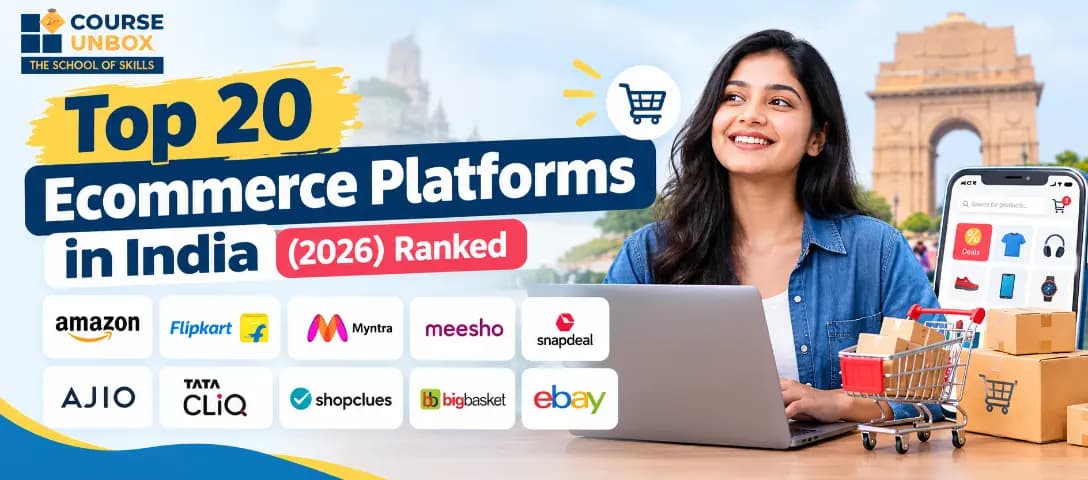
Top 20 Ecommerce Platforms in India in 2026
The biggest ecommerce platforms in India in 2026 are Amazon India, Flipkart and Meesho, followed by vertical leaders like Myntra, Nykaa and Ajio, the Reliance and Tata networks JioMart and Tata Neu, the B2B giants IndiaMART and Udaan, and the fast rising quick commerce apps Blinkit, Zepto and Swiggy Instamart. Flipkart still leads by sales value, Meesho now leads by order volume, and quick commerce is the fastest growing slice of the market. Below is the full top 20, ranked, with what each platform sells, who it suits, and how to pick one to sell on. If you plan to build your own store rather than sell on a marketplace, the store builder section near the end covers that too.
Ask any trader, D2C founder or student in India the same question and you get the same confusion. There are dozens of ecommerce sites in India, each one calls itself the best, and the labels overlap. Some are marketplaces where you buy and sell. Some are B2B portals for wholesale. Some are ten minute delivery apps. And some are software you use to build your own ecommerce website in India from scratch. They are all called ecommerce platforms, and they are not the same thing at all.
This guide fixes that. It ranks the top 20 ecommerce platforms in India for 2026, explains what each one actually is, and tells you which one fits if your goal is to shop, to sell, or to build. If selling is the goal, remember that getting found is half the battle, which is why ecommerce SEO optimisation decides how much of this traffic you actually win. The figures here are drawn from 2025 and 2026 industry reports and each one is labelled with its source and year, because in this market the numbers move fast and a lot of blogs quietly copy figures that are three years old.
How big is ecommerce in India in 2026
Before the list, the context, because the size of the opportunity is the reason this list matters.
India is now one of the largest and fastest growing ecommerce markets on earth. The market was worth roughly 125 billion dollars in 2024 and is widely projected to reach somewhere between 300 and 345 billion dollars by 2030, depending on which forecast you read (ClickPost 2026; Outlook Business; Invest India). India had around 270 million online shoppers in 2024, and that number keeps climbing as the next wave of buyers comes online from smaller towns rather than the metros.
Three forces are driving it. First, nearly everyone is online, with more than a billion internet users and mobile connections by the end of 2025. Second, paying is frictionless, because UPI has made digital payment the default even for a fifty rupee purchase. Third, delivery has reached deep into the country, so a shopper in a tier 2 or tier 3 town now gets the same catalogue a metro buyer does.
The clearest sign of how fast the market is changing is quick commerce. Ten minute grocery and essentials delivery went from a niche to a mainstream channel in about two years. By August 2026, the six largest quick commerce apps together handled around 9.5 million orders a day in India, with Blinkit on about 36.7 percent share, Zepto on about 26.2 percent and Swiggy Instamart on about 14.4 percent (Datum Intelligence, August 2026). That is a brand new layer of ecommerce that barely existed in 2021.
So when people ask whether ecommerce in India is still growing, the honest answer is that it is not only growing, it is adding entirely new categories every couple of years. That is the backdrop for every platform below.
What counts as an ecommerce platform
The phrase ecommerce platform gets used for four very different things, and knowing the difference is half the battle when you choose one.
The first type is the B2C marketplace, where businesses sell to consumers. Amazon India, Flipkart and Myntra are the obvious examples. You list your products, the marketplace brings the traffic, and you pay a commission on each sale.
The second type is the B2B portal, where businesses sell to other businesses, usually wholesale and in bulk. IndiaMART and Udaan are the leaders here, and they matter enormously for India's manufacturers, traders and exporters.
The third type is quick commerce, the ten minute delivery apps like Blinkit, Zepto and Swiggy Instamart. These started with groceries and are now expanding into electronics, beauty and general merchandise, which is why they belong on any serious list of ecommerce platforms in India.
The fourth type is the store builder, which is software you use to create your own ecommerce website rather than a place to list on. Shopify, WooCommerce and others sit here. They do not bring you traffic, but they give you a store you fully own. We cover these separately near the end, because they answer a different question.
Most of this list is about the first three types, the platforms where buyers and sellers already gather. If your real goal is to build ecommerce website in India under your own brand, skip ahead to the store builder section.
How we ranked the platforms
There is no single official ranking of ecommerce companies in India, so treat any numbered list, including this one, as a considered view rather than a league table. We weighed scale of sales and orders, number of active users, category leadership, how useful the platform is to Indian sellers, and current momentum in 2025 and 2026. We leaned on reports from the period rather than memory, and we labelled figures with their source. Where a platform is private and does not publish numbers, we say so instead of inventing one.
One honest note on the top of the list. Flipkart and Amazon India trade the top spot depending on what you measure. Flipkart tends to lead on gross sales value, while Meesho has been reported to lead on sheer order volume because of its low price, zero commission model that pulls huge numbers from smaller towns (Storyboard18; officechai, reporting festive and annual data). We have put Amazon first on overall scale and ecosystem, but a reasonable person could rank the top three in a different order, and we explain why under each one.
The top 20 ecommerce platforms in India at a glance
Here is the full list in one view before the detail. Founding years are drawn from the companies' own records and ClickPost's 2026 compilation.
Rank | Platform | Type | Best known for | Founded |
1 | Amazon India | B2C marketplace | Widest catalogue, Prime ecosystem | 2013 in India |
2 | Flipkart | B2C marketplace | Homegrown leader, electronics and Big Billion Days | 2007 |
3 | Meesho | B2C and social commerce | Low prices, zero commission, tier 2 and 3 reach | 2015 |
4 | Myntra | Fashion marketplace | Fashion and lifestyle leader | 2007 |
5 | JioMart | B2C and grocery | Reliance scale, groceries and daily needs | 2019 |
6 | Nykaa | Beauty marketplace | Beauty and personal care leader | 2012 |
7 | Ajio | Fashion marketplace | Reliance fashion, curated brands | 2016 |
8 | Tata Neu and Tata CLiQ | B2C super app | Tata brands, electronics and luxury | 2016 and 2022 |
9 | Snapdeal | Value marketplace | Value shopping, wide pincode reach | 2010 |
10 | IndiaMART | B2B portal | India's largest B2B marketplace | 1996 |
11 | Udaan | B2B marketplace | Wholesale and kirana supply | 2016 |
12 | Blinkit | Quick commerce | Ten minute delivery leader | 2013 |
13 | Zepto | Quick commerce | Fast growing ten minute delivery | 2021 |
14 | Swiggy Instamart | Quick commerce | Groceries via the Swiggy app | 2020 |
15 | BigBasket | Grocery | Full basket online grocery | 2011 |
16 | FirstCry | Vertical, kids | Baby and kids products leader | 2010 |
17 | Lenskart | Vertical, eyewear | Eyewear leader, online and offline | 2010 |
18 | Purplle | Beauty marketplace | Value beauty, strong in smaller towns | 2011 |
19 | Pepperfry | Vertical, furniture | Furniture and home leader | 2011 |
20 | ONDC | Open network | Government backed open ecommerce network | 2022 |
The top 20 ecommerce platforms in India, in detail
1. Amazon India
Amazon India is the most complete ecommerce platform in the country. It launched here in 2013 and has since built the widest catalogue, the deepest logistics, and a loyalty ecosystem through Prime that keeps more than 65 million subscribers coming back (ClickPost 2026). For buyers it is the default for electronics, home and almost anything else. For sellers it offers enormous reach, mature fulfilment through Fulfilment by Amazon, and advertising tools that have become a serious revenue line for the company, with India ad revenue reported at around 8,342 crore rupees in FY25.
If you are a seller who wants scale and professional tooling and can handle the competition and the fees, Amazon is the baseline you compare everything else against. It is not the cheapest place to sell, but it is the most capable.
2. Flipkart
Flipkart is the homegrown heavyweight and, by gross sales value, often the number one ecommerce site in India. Founded in 2007 and now part of the Walmart group, it is especially strong in electronics and large appliances, and its Big Billion Days festive sale is the biggest shopping event on the Indian calendar. Flipkart reported revenue of around 70,844 crore rupees in FY24, up about 26 percent year on year (ClickPost 2026), and it delivers to more than a thousand cities.
For sellers, Flipkart is the natural partner to Amazon. Many serious sellers list on both. Flipkart has also moved into quick commerce with Flipkart Minutes, which already handles over a million orders a day, a sign of how fast the lines between formats are blurring.
3. Meesho
Meesho is the most interesting story in Indian ecommerce right now. Founded in 2015, it built its growth on a zero commission model for sellers and rock bottom prices for buyers, aimed squarely at tier 2 and tier 3 India and at resellers who sell through WhatsApp and social media. That model has pushed its order volumes past the bigger names. Meesho has been reported as the fastest growing ecommerce platform in India and, by number of orders, has been placed ahead of Amazon and Flipkart in some periods (Bernstein via Inc42; officechai), even though those two still lead on the value of what is sold.
For a small seller or a first time seller, Meesho is often the easiest and cheapest on ramp in the whole market. For buyers it is the home of unbranded, affordable everyday products.
4. Myntra
Myntra is the clear leader in online fashion and lifestyle. Founded in 2007 and now part of the Flipkart group, it carries thousands of Indian and international brands and reported revenue of around 6,042 crore rupees in FY25, up about 18 percent, with a profit of 548 crore rupees (ClickPost 2026). Its strength is curation and brand experience, which is why fashion labels treat it as a must be present channel.
If you sell apparel, footwear, accessories or beauty with a brand identity, Myntra is where your category buyers already are.
5. JioMart
JioMart is Reliance Retail's ecommerce arm, launched in 2019, and it uses the sheer scale of Reliance to push groceries, electronics and daily essentials across the country. Its advantage is the physical network behind it, thousands of Reliance stores and kirana partnerships, which lets it reach places pure online players struggle to serve profitably.
For sellers and brands in groceries and fast moving consumer goods, JioMart is an important shelf, and its reach into smaller towns is its real edge.
6. Nykaa
Nykaa is India's beauty and personal care leader. Founded in 2012, it grew from an online store into a full omnichannel brand with more than a hundred physical stores and over 4,500 brands on its platform (ClickPost 2026). It also runs Nykaa Fashion as a separate vertical. Its content led approach, with tutorials and reviews, is a template many beauty sellers study.
If your products are beauty, skincare, wellness or cosmetics, Nykaa is the specialist platform where buyers arrive already in a buying mood.
7. Ajio
Ajio is Reliance's fashion marketplace, launched in 2016, and it has grown into one of the top fashion destinations in India alongside Myntra. It leans on curated collections, exclusive brand tie ups and aggressive pricing during sales. Backed by Reliance, it has the capital to keep acquiring customers and brands.
For a fashion brand, Ajio is the second big fashion channel to weigh after Myntra, and listing on both widens your reach considerably.
8. Tata Neu and Tata CLiQ
The Tata group plays ecommerce through two linked properties. Tata CLiQ, launched in 2016, is a B2C marketplace strong in electronics, fashion and genuine luxury through Tata CLiQ Luxury. Tata Neu, launched in 2022, is the group's super app that stitches together Tata brands and a loyalty currency called NeuCoins across retail, travel, groceries and more.
For brands that want to be inside the trusted Tata ecosystem, especially in electronics and premium categories, these are the platforms to consider.
9. Snapdeal
Snapdeal, founded in 2010, has repositioned itself as a value focused marketplace serving budget conscious buyers in smaller towns, rather than trying to beat Amazon and Flipkart head on. It claims coverage across the large majority of Indian pincodes (ClickPost 2026) and focuses on affordable fashion, home and general merchandise.
For sellers of value priced, unbranded or lightly branded goods, Snapdeal remains a useful additional channel, especially for non metro demand.
10. IndiaMART
IndiaMART is India's largest B2B ecommerce portal and one of the oldest, founded in 1996. It connects buyers and suppliers across industrial goods, machinery, raw materials, chemicals, textiles and almost every manufacturing category you can name. For India's millions of MSMEs, traders and exporters, IndiaMART is often the single most important source of business enquiries online.
If you run a manufacturing or wholesale business, especially in a cluster town, IndiaMART is usually the first ecommerce portal in India you should set up on, because the buyers there come to purchase in bulk.
11. Udaan
Udaan, founded in 2016, is the other major B2B platform, built for wholesale trade between manufacturers, wholesalers, retailers and kirana stores. It handles everything from staples and FMCG to electronics and apparel, and it bundles in logistics and credit to make bulk buying easier for small retailers.
For brands that sell into small shops, and for retailers who want to source stock online, Udaan is the wholesale marketplace to know alongside IndiaMART.
12. Blinkit
Blinkit, owned by Eternal, the parent of Zomato, is the clear leader in quick commerce, the ten minute delivery category. Originally founded in 2013 as Grofers, it rebranded and pivoted to instant delivery and now holds the largest share of India's quick commerce orders, around 36.7 percent of daily orders in August 2026 (Datum Intelligence). It is expanding well beyond groceries into electronics, beauty and general merchandise.
For brands in groceries, snacks, personal care and increasingly electronics, getting onto Blinkit is becoming as important as being on a traditional marketplace.
13. Zepto
Zepto, founded only in 2021, is the breakout quick commerce success, building a dark store network and taking around 26.2 percent of daily quick commerce orders by August 2026 (Datum Intelligence). Its speed and its focus on dense urban demand have made it a favourite in the metros and a serious rival to Blinkit.
For sellers chasing young, urban, convenience driven buyers, Zepto is one of the hottest shelves in Indian ecommerce right now.
14. Swiggy Instamart
Swiggy Instamart brings quick commerce to Swiggy's large food delivery audience. Launched in 2020, it held around 14.4 percent of daily quick commerce orders in August 2026 (Datum Intelligence) and benefits from being inside an app millions already open daily for food.
For FMCG and grocery brands, Instamart is the third major quick commerce channel to cover after Blinkit and Zepto.
15. BigBasket
BigBasket, founded in 2011 and now part of the Tata group, is the established name in full basket online grocery, the place for a planned weekly shop rather than a ten minute top up. It also runs its own quick delivery through BB Now. Its strength is range and reliability across a large grocery catalogue.
For grocery brands and private labels, BigBasket is a core channel, and its Tata backing gives it staying power as quick commerce reshapes the category.
16. FirstCry
FirstCry, founded in 2010, is the dominant vertical platform for baby and kids products, from clothing and toys to diapers and gear. It combines a large online marketplace with hundreds of physical stores, giving parents an omnichannel experience and brands a focused, high intent audience.
If you sell anything in the baby, kids or maternity space, FirstCry is the specialist platform where your exact buyers already shop.
17. Lenskart
Lenskart, founded in 2010, has become the leader in eyewear in India, blending a strong online platform with more than 1,400 stores (ClickPost 2026) and its own manufacturing. It is a textbook example of a vertical ecommerce brand that owns its category end to end.
Lenskart is less a marketplace for third party sellers and more a model worth studying for any founder building a single category D2C brand in India.
18. Purplle
Purplle, founded in 2011, is the value focused beauty marketplace, strong among younger buyers and in smaller towns, and a genuine challenger to Nykaa at the affordable end of beauty. It carries a wide range of brands and has built offline touchpoints as well.
For emerging and affordable beauty brands, Purplle is often a more accessible entry point than the premium beauty platforms.
19. Pepperfry
Pepperfry, founded in 2011, is the leading online platform for furniture and home products, a category that is hard to do well online because of size, logistics and the need to see before buying. It solved this with specialist delivery and a network of experience studios where shoppers can touch the products before ordering.
For furniture, decor and home brands, Pepperfry is the category specialist, and its model shows how vertical ecommerce handles bulky, considered purchases.
20. ONDC
ONDC, the Open Network for Digital Commerce, is not a company at all but a government backed network launched in 2022 that aims to do for ecommerce what UPI did for payments. Instead of every seller joining a closed marketplace, ONDC lets buyers and sellers on different apps transact across one open network. It had crossed 16 million monthly orders by May 2025 (ClickPost 2026) and is still early, but it could reshape the whole structure of Indian ecommerce.
For small sellers in particular, ONDC is worth watching closely, because its promise is lower fees and freedom from depending on any single marketplace.
Ecommerce platforms to build your own online store
Everything above is a place to list on. If instead you want to build ecommerce website in India under your own brand, where you own the customer and the data, you need a store builder, which is a different kind of ecommerce platform.
The main options Indian businesses use are Shopify, which is the most popular hosted store builder and the easiest to start with, WooCommerce, which is free and runs on WordPress and gives you full control, Magento, now Adobe Commerce, which suits larger and more complex stores, and Wix and other website builders for simple shops. Indian specific options and marketplaces like Dukaan and Instamojo also target small sellers who want a quick store or a payment link. A store only sells, though, once people can find it, and ranking a Shopify store has its own playbook, which our Shopify SEO optimisation course walks through step by step.
The trade off is simple. A marketplace brings you traffic but takes a commission and owns the relationship. Your own store keeps the margin and the customer data but you must bring your own traffic, which is where skills like SEO, performance marketing and content become essential. Most serious Indian sellers end up doing both, listing on the big marketplaces for reach and running their own store for margin and brand.
Which is the largest ecommerce company in India
This is one of the most searched questions about Indian ecommerce, and the honest answer is that it depends on what you count.
By gross sales value, Flipkart is usually described as the largest ecommerce company in India, driven by electronics and its festive sales. By order volume, Meesho has been reported ahead of both Flipkart and Amazon in some periods, because its very low prices generate a huge number of small orders from smaller towns. By overall ecosystem, reach and tooling, Amazon India is the most complete platform. And in the new quick commerce category, Blinkit is the biggest by daily orders.
So the biggest ecommerce company in India is Flipkart by value, Meesho by order count, Amazon by ecosystem, and Blinkit in quick commerce. Any blog that gives you a single flat answer is oversimplifying a market with several different leaders.
Best ecommerce platform for small business and new sellers
If you are a small business, a new D2C brand or a first time seller, the best ecommerce platform in India for you is usually not the biggest one. It is the one with the lowest barrier and the right audience for your product.
For the cheapest and simplest start, Meesho is hard to beat, because its zero commission model and reseller base let you sell with almost no upfront cost. For scale and professional tooling once you are ready, Amazon and Flipkart are the pair to be on. For a specific category, go to the vertical leader, Myntra or Ajio for fashion, Nykaa or Purplle for beauty, FirstCry for kids, Pepperfry for furniture. For wholesale and B2B, start with IndiaMART and Udaan. For groceries and FMCG, aim for the quick commerce apps and BigBasket. And for lower fees and independence, keep an eye on ONDC.
The practical answer for most small businesses is to start on one marketplace that fits your product, learn how listings, pricing, ads and ratings actually work, and only then expand to a second channel and, eventually, your own store. Trying to be everywhere on day one is the most common and most expensive mistake new sellers make.
Marketplace or your own store, how to choose
Here is the decision in plain terms. Choose a marketplace when you want reach fast, when you are testing products, or when your category has a strong vertical platform where buyers already gather. Accept that you will pay commission and that the platform, not you, owns the customer relationship.
Choose your own store, built on Shopify, WooCommerce or similar, when you have a real brand, when your margins can fund your own marketing, and when you want to own your customer data for repeat sales and email and WhatsApp follow up. Accept that you are responsible for bringing every visitor yourself.
For almost every growing Indian business the honest answer is both, in sequence. Use marketplaces to build demand and cash flow, then build your own store to protect margin and brand once you know what sells. What ties the two together, and what decides whether either one makes money, is skill. Listing is easy. Running profitable pricing, ads, SEO and analytics across these platforms is the actual job.
The skills behind selling on these platforms
A platform is only as good as the person running it. The sellers who win on Amazon, Flipkart, Meesho or their own store are not the ones with the most products. They are the ones who understand search and listing optimisation, who can run paid ads profitably, who read their analytics, and who use AI tools to produce listings, creatives and campaigns faster than their competitors.
That is exactly the gap a modern digital marketing education fills. Course Unbox runs a live and online AI digital marketing course built around these real skills, with hands on modules in marketplace and WhatsApp marketing, performance ads, SEO, analytics and AI workflows, so you learn to sell on these platforms rather than just list on them. If you want to go deeper on one area, it also offers a focused SEO course and specialised tracks in ecommerce SEO optimisation and Shopify SEO optimisation. For a wider view of where this whole field is heading, see our guide to the future of digital marketing in India.
Ready to sell, not just list? Course Unbox's AI digital marketing course teaches the marketplace, ads, SEO and analytics skills that turn an ecommerce listing into real sales.
Explore related Course Unbox programs. AI Digital Marketing, SEO, Ecommerce SEO, Shopify SEO, Content Creation, Cybersecurity and Domain Investing Mastery.
About the Author
Jugal Chauhan
Jugal Chauhan is a digital marketing strategist and tech educator with a passion for making complex topics accessible. He writes about marketing, technology, and professional growth to help learners and businesses thrive in the digital age.
Learn more about us →