Get a counselling call
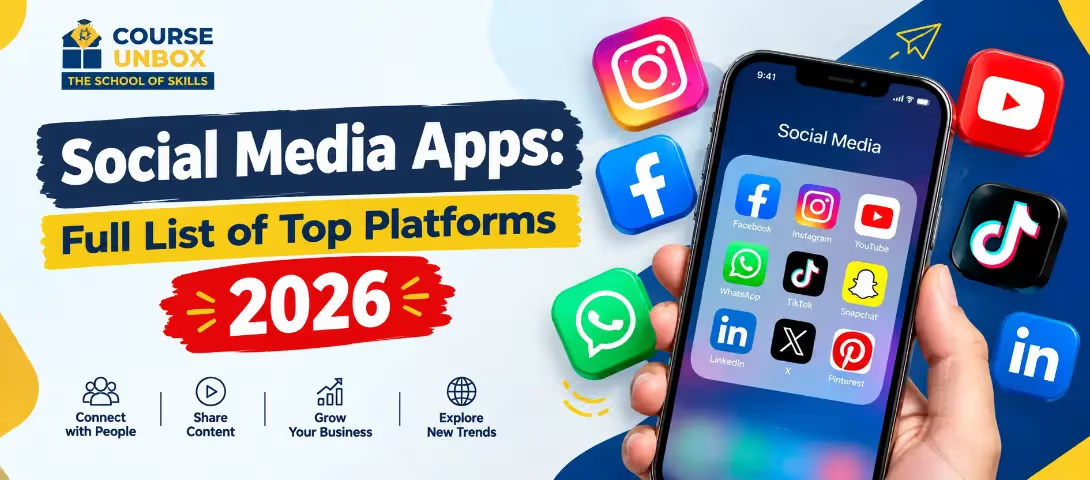
Social Media Apps: The Full List of Top Platforms 2026
The most popular social media apps in 2026 are Facebook with 3.05 billion monthly active users, YouTube with 2.49 billion, WhatsApp and Instagram with about 2 billion each, TikTok with 1.56 billion and WeChat with 1.34 billion, followed by Telegram, Snapchat, Reddit, X, Pinterest and LinkedIn. Below is the full list of the top social media platforms, ranked by users, with each app owner, category and what it is best for, so you can name any major platform and know exactly where it fits. User figures are based on DataReportal and company reports from early 2026 and change constantly.
If someone asks you to name a social media platform, you can reel off ten without thinking. But the full picture is bigger and more interesting than the handful most people name. There are global giants, regional powerhouses that lead one country, messaging apps that doubled as social networks, and fast rising newcomers. This CourseUnbox guide lists them all in one place, ranked and organised by type, so you never have to open ten tabs to compare them.
Top social media apps 2026, ranked by users
Here is the full list of the biggest social media apps and platforms in 2026, ranked by monthly active users. This is the quick reference for anyone searching for the top 10 social media platforms, the biggest or largest social media platform, the full set of social media platform names and app names, or simply the most popular social media apps and websites. Whether you call each one a social media website, a social networking website or an app, they are the same set of platforms below.
Rank | Social Media App | Monthly Active Users | Owner | Best For |
|---|---|---|---|---|
1 | 3.05 billion | Meta | Everything: friends, groups, marketplace, pages | |
2 | YouTube | 2.49 billion | Long video and how to content | |
3 | about 2 billion | Meta | Private and group messaging | |
4 | about 2 billion | Meta | Photos, reels, visual brands | |
5 | TikTok | 1.56 billion | ByteDance | Short video and discovery |
6 | 1.34 billion | Tencent | All in one super app (China) | |
7 | over 1 billion | Public, Advance is largest holder | Communities and discussion | |
8 | Telegram | around 1 billion | Telegram | Messaging, channels, communities |
9 | Snapchat | over 800 million | Snap Inc | Disappearing messages, young users |
10 | Kuaishou | over 685 million | Kuaishou | Short video (China) |
11 | X (Twitter) | 619 million | X Corp | Real time news and conversation |
12 | 605 million | Sina | Microblogging (China) | |
13 | 558 million | Tencent | Messaging (China) | |
14 | 498 million | Visual discovery and planning | ||
15 | about 310 million | Microsoft | Professional networking and jobs | |
16 | Threads | over 270 million | Meta | Text posts and conversation |
17 | Twitch | about 240 million | Amazon | Live streaming and gaming |
18 | LINE | 224 million | LY Corporation | Messaging (Japan, Thailand) |
19 | Discord | 154 million | Discord | Voice and community servers |
20 | Tumblr | 135 million | Automattic | Microblogging and fandoms |
Together these apps reach the large majority of the more than five billion social media users worldwide. The top of the list is dominated by Meta, which owns Facebook, WhatsApp, Instagram and Threads, and by a cluster of Chinese apps, namely WeChat, Kuaishou, Weibo and QQ, that are huge at home but little used elsewhere.
The top 15 social media apps, explained
1. Facebook
Facebook is still the biggest social media platform in the world, with about 3.05 billion monthly active users. Owned by Meta, it is the one app that does almost everything: profiles, friends, Groups, Marketplace, Pages, events and video through Reels and Watch. The user base skews older than it once did, but the sheer scale keeps it at number one. For most businesses it is still the single most important social media app, because almost every demographic in almost every country can be reached there, and the advertising tools are the most developed of any platform. Even people who say they have moved on from Facebook usually still use Messenger, Marketplace or a Facebook login somewhere in their week.
2. YouTube
YouTube, owned by Google, is the giant of online video with roughly 2.49 billion users. It is where the world watches long video, tutorials, music, podcasts and now short video through YouTube Shorts. For creators it is one of the few platforms that pays directly through ad revenue sharing, which is why so many treat it as a business rather than a hobby. It also works as the second largest search engine in the world, so a single video can keep earning views and traffic for years, long after a post on a feed based app has disappeared.
3. WhatsApp
WhatsApp, also owned by Meta, has about 2 billion users and is the default messaging app across much of the world, especially India, Latin America, Africa and Europe. It is built around private and group chats, voice and video calls, Status updates and, increasingly, business messaging and payments.
4. Instagram
Instagram, the third Meta app in the top four, has close to 2 billion users and is the home of visual content: photos, Stories, Reels and shopping. It is the default platform for lifestyle, fashion, food and creator brands, and Reels is how it competes with TikTok.
5. TikTok
TikTok, owned by China based ByteDance, reached 1.56 billion users by riding the short video wave it helped create. The recommendation feed is famous for pulling people in and surfacing content from accounts they do not follow, which makes it powerful for discovery and for turning unknown creators into stars.
6. WeChat
WeChat, from Tencent, has 1.34 billion users and is the classic super app. In China it is messaging, social feed, mobile payments, mini programs, shopping and official accounts all in one. Outside China the reach is mostly limited to the Chinese diaspora.
7. Reddit
Reddit is a network of communities called subreddits, covering every topic imaginable, and now counts over a billion monthly users. It rewards genuine discussion and niche expertise, which is why it ranks so often in Google and why marketers pay close attention to it.
8. Telegram
Telegram has grown to around a billion users on the strength of fast, secure messaging plus large public channels and communities. It sits somewhere between a messaging app and a broadcast platform, and is especially strong in Eastern Europe, the Middle East and Central Asia.
9. Snapchat
Snapchat, from Snap Inc, has over 800 million users and pioneered disappearing messages and augmented reality lenses. It remains popular with younger users and is built around the camera, Stories and Spotlight short video.
10. Kuaishou
Kuaishou is the main short video rival to Douyin, the Chinese version of TikTok, inside China, with over 685 million users. It is strong in smaller cities and rural areas and blends short video with live streaming and ecommerce.
11. X (Twitter)
X, formerly Twitter and now owned by X Corp, the company run by Elon Musk, has around 619 million users. It remains the home of real time news, public conversation and commentary, even as the user numbers and business have shifted since the rebrand.
12. Weibo
Weibo, often called the Twitter of China, has about 605 million users. It mixes microblogging with celebrity culture, trending topics and video, and is one of the main public conversation platforms inside China.
13. QQ
QQ, another Tencent product, is an older messaging platform with 558 million users. It is popular with younger Chinese users and gamers and offers chat, groups, games and a social feed.
14. Pinterest
Pinterest, with 498 million users, is less a social network and more a visual discovery and planning tool. People use it to save ideas for weddings, recipes, home decor, fashion and travel, which makes it a strong traffic source for brands in those niches.
15. LinkedIn
LinkedIn, owned by Microsoft, is the professional network, with around 310 million monthly active users. It is where people build careers, find jobs, publish professional content and where businesses do B2B marketing and recruiting.
Social media apps ranked 16 to 20
Just outside the top 15 sit five apps that are huge in their own lane:
Threads with over 270 million users, the Meta text first app launched in 2023, is positioned as a calmer alternative to X and is tightly linked to Instagram accounts.
Twitch with about 240 million, owned by Amazon, is the home of live streaming, especially gaming, with a strong creator and subscription economy.
LINE with 224 million is the leading messaging and social app in Japan and Thailand, bundling chat, payments, news and stickers.
Discord with 154 million is built around voice and text servers and started in gaming before spreading to communities of every kind.
Tumblr with 135 million, now owned by Automattic, remains a creative microblogging home for fandoms, art and niche subcultures.
New and decentralised social media apps
A newer wave of platforms is worth knowing, even though the user numbers are still small compared with the giants. Bluesky with over 35 million and Mastodon with around a million active users are decentralised networks built on open protocols, which means no single company fully controls them. They grew as people looked for alternatives to X, and they point to where a slice of social media may be heading: smaller, more open and more community run. For most users and brands these are still experiments rather than essentials, but they are the names to watch.
Social media apps by category and type
Not every social media app does the same job. Grouping them by category and type makes it far easier to choose the right one. Here are the main social media categories and the types of social networking sites, with examples of each.
Social networking: Facebook, LinkedIn. Built around connecting with people you know and sharing updates.
Photo and video sharing: Instagram, Pinterest, Snapchat. Built around visual content.
Short video: TikTok, Instagram Reels, YouTube Shorts, Kuaishou. Built around a fast, algorithm driven feed of short clips.
Long video and streaming: YouTube, Twitch. Built around longer video and live broadcasts.
Messaging and chat: WhatsApp, Telegram, WeChat, QQ, LINE, Discord. Built around private and group conversation, though several double as social networks.
Discussion and community: Reddit, Discord. Built around topic based communities rather than personal profiles.
Microblogging: X, Threads, Weibo, Tumblr, Bluesky, Mastodon. Built around short text posts and public conversation.
Visual discovery: Pinterest. Built around saving and finding ideas.
Super apps: WeChat. One app that bundles messaging, payments, shopping and more.
Many apps now blur these lines. Instagram does photos, video, messaging and shopping; YouTube does long and short video; WhatsApp is messaging with a social Status feed. That overlap is exactly why people search for the full list rather than relying on one category.
Regional social media apps that lead one country
A big reason the global list surprises people is that several of the largest apps are regional. If you only use Western apps, you may never have opened the ones that hundreds of millions of people use daily:
China: WeChat, Kuaishou, Weibo, QQ and Douyin lead, because global apps like Facebook, Instagram and YouTube are blocked.
Japan and Thailand: LINE is the default messaging and social app.
South Korea: KakaoTalk plays the LINE or WhatsApp role.
Russia and nearby countries: VK, also called VKontakte, and Telegram are especially strong.
This is why a worldwide ranking by users looks different from the list of apps popular in any single country. The biggest app in the world might not be the biggest app on your street.
India is a good example of this split. The most used social media apps in India are WhatsApp, Instagram, YouTube and Facebook, with fast growth in short video after the ban on TikTok pushed users to Instagram Reels, YouTube Shorts and home grown apps. So the Indian list looks similar to the global top of the table, but with its own order and its own local favourites underneath.
How many social media apps and users are there
There is no single official count of social media apps, because new ones launch constantly and the definition is fuzzy: is a messaging app a social media app, is a discussion forum one? What is clear is the scale of usage. More than five billion people now use social media worldwide, which is well over half of humanity and the large majority of everyone who is online.
The typical user is active on several platforms at once, which is why the user numbers above add up to far more than the total number of people. Someone in India might use WhatsApp, Instagram, YouTube and Facebook every day; someone in China might use WeChat, Douyin, Weibo and QQ. This guide lists the 20 biggest by users, but the full universe of social media apps runs into the hundreds once you include niche, regional and new platforms.
A few trends stand out in 2026. Short video, led by TikTok, Reels and Shorts, is now the format that pulls the most attention and is built into almost every major app. Messaging apps such as WhatsApp and Telegram keep turning into full platforms with channels, payments and communities. And a quiet move toward private groups and communities, on Discord, Reddit and group chats, is pulling some activity away from public feeds. The names at the top of the list change slowly, but how people actually use them is shifting fast. Learning to make content that performs on these apps is now a skill in itself, and a Content Creation Course Online covers the video, writing and design that each platform rewards.
How to choose the right social media app
If you are deciding where to spend your time, or where to put a brand, match the app to the goal rather than chasing the biggest number:
To reach the widest general audience: Facebook and YouTube.
For short visual content and discovery: Instagram and TikTok.
For messaging friends, family or customers: WhatsApp, Telegram or, in Asia, WeChat and LINE.
For professional networking, jobs and B2B: LinkedIn.
For community and deep discussion: Reddit and Discord.
For visual planning and ideas that drive website traffic: Pinterest.
For real time news and public conversation: X and Threads.
For live streaming and gaming: Twitch and YouTube.
Most people and brands end up using three or four apps that fit their audience, rather than trying to be everywhere at once.
For a brand or creator, two more things matter as much as audience size. The first is content format: if you make video, your time goes to YouTube, Instagram and TikTok; if you make long written content, LinkedIn and Reddit reward it more. The second is where your buyers already are. A B2B software company belongs on LinkedIn and X, a fashion label on Instagram and Pinterest, a mobile game on TikTok, Discord and YouTube. Picking the two apps where your audience and your format line up beats spreading thin across ten. If your goal is to turn these platforms into leads and sales, a structured Social Media Marketing Course Online teaches the strategy, paid ads and analytics behind each one.
Name a social media platform: the full answer
One of the most searched phrases around this topic is simply to name a social media platform, often from a word game or quiz. This is also the answer when people search for all social media apps, social media app names or just social media names: the full set of platforms gathered in one place. The easy answers are Facebook, Instagram and YouTube. But now you can go much further. A strong list of social media platforms, from biggest to smaller but notable, looks like this: Facebook, YouTube, WhatsApp, Instagram, TikTok, WeChat, Reddit, Telegram, Snapchat, X, Pinterest, LinkedIn, Threads, Twitch, Discord, Tumblr, plus regional names like Weibo, QQ, LINE, KakaoTalk and VK, and newer networks like Bluesky and Mastodon.
If the question is from a guessing game, the safest answers, the ones most people also say, are Facebook, Instagram, Twitter or X, Snapchat, TikTok and YouTube, because they are the most recognised worldwide. If you want a less obvious but still correct answer, Pinterest, Reddit, Discord and Telegram all qualify as social media platforms too. The point is that the category is broad: any app built around creating profiles, sharing content and connecting with other people counts, which is why the full list is so much longer than the handful that first come to mind.
Final word
The world of social media apps is far wider than the five or six names most people can list. In 2026 it is led by Facebook, YouTube, WhatsApp, Instagram, TikTok and WeChat, with a long tail of messaging apps, community platforms, regional giants and new networks behind them. Use the ranked list and the category breakdown above to see exactly where each app fits, pick the two or three that match what you actually want to do, and come back when the numbers shift, because on social media they always do.
User figures in this guide are based on DataReportal and company reports from early 2026 and are estimates that change over time. Last updated: 10 October 2026.
About the Author
Jugal Chauhan
Jugal Chauhan is a digital marketing strategist and tech educator with a passion for making complex topics accessible. He writes about marketing, technology, and professional growth to help learners and businesses thrive in the digital age.
Learn more about us →