Get a counselling call
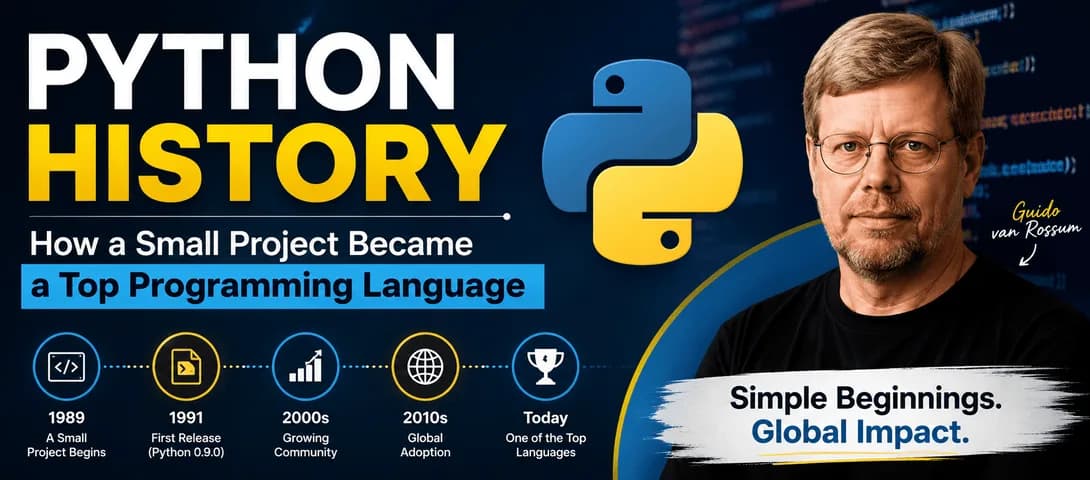
Python History: How a Small Project Became a Top Programming Language
Python is a high-level, general-purpose programming language created by Dutch programmer Guido van Rossum. He began developing it in December 1989 at CWI in the Netherlands and released the first version, Python 0.9.0, on 20 February 1991. He named it after the comedy troupe Monty Python's Flying Circus, and today Python is one of the world's most widely used languages
Key facts at a glance:
Creator: Guido van Rossum, at CWI in the Netherlands.
First released: 20 February 1991 (Python 0.9.0). Development began December 1989.
Named after: the comedy series Monty Python's Flying Circus, not the snake.
Based on: the ABC programming language.
Age: over 35 years old as of 2026.
Latest version: the Python 3.14 series, first released in October 2025.
Few programming languages have a backstory as charming, or as influential, as Python's. What began as a solo holiday project in a research lab in Amsterdam grew into the language that now runs behind websites, data pipelines, scientific research and modern artificial intelligence. Understanding the history of Python explains why the language feels so clean and readable, and why it has become the first language that so many developers, students and career changers choose to learn.
This guide walks through the full story: the person who built Python, the language it replaced, the exact dates each version arrived, the philosophy that guided its design, how it climbed to the top of the popularity charts, and the mark it left on the languages that came after it
Who created Python?
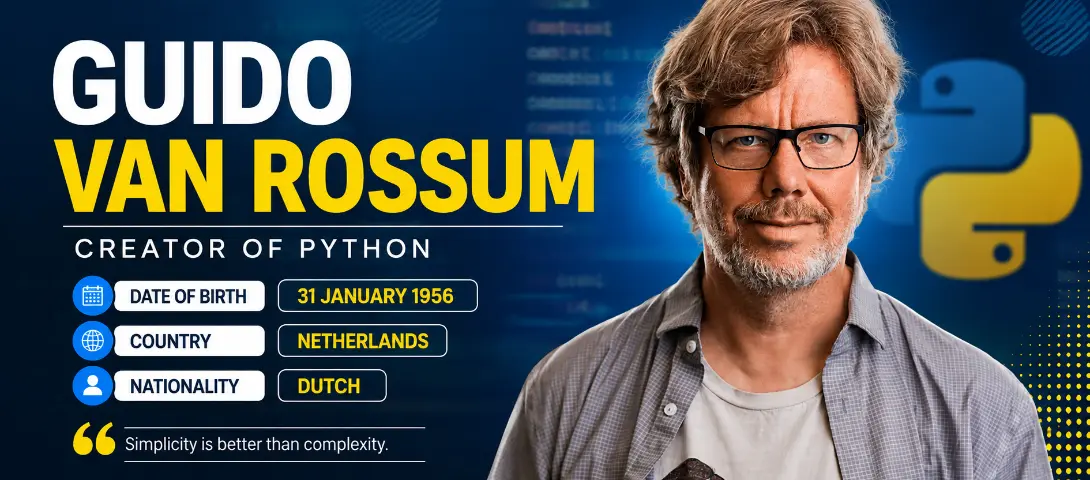
Python was created by Guido van Rossum, a programmer working at Centrum Wiskunde and Informatica (CWI), a national research institute for mathematics and computer science in the Netherlands. In December 1989 he started the project as a hobby to keep himself occupied over the Christmas holidays. He was looking for a challenge, and he wanted to build a language that was both easy to read and genuinely capable.
The idea did not appear from nowhere. Van Rossum had earlier helped create the ABC programming language, a teaching language designed to be simple and approachable. ABC had many features he admired, but it also had frustrating limitations and never caught on widely. Python was his answer. He kept the parts of ABC that worked, removed the friction that had held it back, and added the tools a practical language needs, including exception handling and the ability to interface with the Amoeba operating system he was working on at the time.
The result was a language that could express an idea in far fewer lines than C, C++ or Java, while still reading almost like plain English. That combination of power and clarity is the thread that runs through the entire history of Python
For nearly three decades, van Rossum led the project personally, holding a title the community gave him with affection: the Benevolent Dictator for Life. It meant he had the final word on the language's direction. On 12 July 2018 he stepped back from that role. Soon after, in early 2019, the core developers elected a five-member steering council to guide Python's future. The language is now stewarded by the Python Software Foundation and its community, so no single person owns Python today.
Why is it called Python?
The name has nothing to do with the snake. Guido van Rossum was a fan of the British comedy series Monty Python's Flying Circus, and he wanted a name that was short, memorable and a little bit mischievous. So he named his new language Python. The community has embraced that playful spirit ever since, and you will still find Monty Python references scattered through Python tutorials and documentation
When was Python created and released?
Python was released on 20 February 1991 as Python 0.9.0, but the timeline is easy to muddle because three different dates get quoted. Separating them clears up almost every question people ask about Python's age:
Late 1980s: Python was conceived as an idea while van Rossum worked at CWI.
December 1989: He wrote the first lines of code and formally began development.
20 February 1991: The first public version, Python 0.9.0, was shared with the world.
Measured from that first public release, Python is over 35 years old as of 2026, which makes it older than Java, JavaScript and PHP. That longevity matters. A language that has survived and grown for more than three decades has proven it can adapt, and that stability is one reason companies trust it for long-lived systems
Python version history timeline
Each major version marked a turning point in the story. The table below summarises the releases that shaped the language most.
Version | Release date | What it introduced |
Python 0.9.0 | 20 February 1991 | First public release, with exception handling, functions, and core types such as lists, strings and dictionaries. |
Python 1.0 | January 1994 | Functional tools including lambda, map, filter and reduce. |
Python 2.0 | 16 October 2000 | List comprehensions, a cycle-detecting garbage collector, and Unicode support. |
Python 3.0 | 3 December 2008 | A major redesign, nicknamed Python 3000, that is not fully backward compatible with Python 2. |
Python 2.7.18 | April 2020 | The final Python 2 release, closing the 2.x line after the language was retired on 1 January 2020. |
The single most important event in that timeline is the arrival of Python 3.0 in December 2008. It was a deliberate break with the past. Van Rossum and the core team chose to fix long-standing design flaws even though it meant breaking compatibility with Python 2. For years the community
ran both versions side by side, and a conversion tool called 2to3 helped move old code across. The transition finally completed when Python 2 was retired on 1 January 2020, with a last release, 2.7.18, following in April 2020. Since then, Python 3 is the version everyone uses, and it receives a new feature release roughly once a year
Python 2 versus Python 3: what actually changed
Many people arrive at Python's history trying to understand why there were two incompatible versions for so long. The short answer is that Python 3 corrected decisions that could not be fixed without breaking old code. The most visible change was how text works: Python 3 treats text as Unicode by default, which made handling the world's languages far cleaner. The print statement became a print function, integer division behaved more predictably, and many rough edges in the standard library were tidied up. None of this was possible without breaking backward compatibility, which is exactly why the community needed more than a decade to move across. If you are learning Python now, you only need Python 3
Why was Python created?
Van Rossum built Python around a simple conviction: code is read far more often than it is written, so clarity should come first. Every design decision flowed from that belief. Python uses indentation instead of curly braces to mark blocks of code, which forces a clean visual structure. It favours plain, obvious syntax over clever shortcuts. The goal was a language a person could read almost like prose and understand at a glance.
Those principles were later distilled into a short set of guiding aphorisms known as the Zen of Python, written by Tim Peters. Lines such as "readability counts" and "there should be one obvious way to do it" capture the mindset that has guided the language from the beginning. You can still read them today by typing import this into any Python interpreter.
Accessibility was part of the mission too. During his later work at CNRI in the United States, van Rossum launched an initiative called Computer Programming for Everybody, aimed at making programming approachable for far more people. Python was the natural vehicle for that vision, and it is a large part of why the language became the default choice for teaching beginners around the world
How Python became popular
Python's rise was gradual, then sudden. In the mid 1990s it spread quietly, helped by its inclusion in Linux distributions and by its open-source licence, which invited a global community to extend it. Developers wrote libraries, shared them freely, and slowly the language moved from small scripting tasks into serious software. In 1994 the community even gained its own discussion forum, comp.lang.python, which helped turn scattered users into a movement.
The web era gave Python its first big lift. Frameworks such as Django and Flask made it a strong choice for building websites and web applications, and its readability made teams more productive. But the real explosion came with data. Libraries such as NumPy and pandas, and later machine-learning frameworks such as TensorFlow and PyTorch, made Python the default language for working with data and building intelligent systems
That data science and artificial intelligence wave pulled millions of new developers toward Python, from academic researchers to finance analysts to students. Today it consistently ranks at or near the top of every major measure of programming-language popularity, and demand for Python skills in the job market continues to climb.
The effect is especially strong for newcomers. Because Python is gentle to learn yet used by the biggest technology companies in the world, it has become the language most training programmes teach first. A beginner who learns Python is not learning a toy. They are learning the same tool that professionals use to build real products, which is a rare and valuable head start in a technology career
How has Python influenced later programming languages?
Python did not just succeed on its own terms. It changed what programmers expect from a modern language. Three of its ideas in particular echoed through the languages that followed.
Readability as a feature. The idea that clean, indentation-based syntax is worth designing for influenced newer languages such as Go, Swift and CoffeeScript, which all put developer experience and clarity near the centre of their design.
An interactive-first workflow. Python's read-evaluate-print loop and its notebook culture set a pattern that later data-focused languages, including Julia, followed closely. Trying an idea instantly, one line at a time, became a normal expectation.
A batteries-included standard library. Python shipped with a rich set of built-in tools, so a beginner could do useful work on day one. That generosity reset the baseline for what a language is expected to provide out of the box.
Perhaps its deepest influence is cultural. Python became the connective glue of scientific computing and machine learning, the language that ties other tools together. That role shaped how entire ecosystems are built, well beyond Python itself
What Python is used for today
The same qualities that shaped Python's history make it enormously useful right now. Its readability lowers the cost of maintaining large systems, and its vast library ecosystem means there is usually a ready-made tool for the job. The most common uses today include:
Data science and analytics, using pandas, NumPy and visualisation libraries to turn raw data into insight.
Artificial intelligence and machine learning, with frameworks such as TensorFlow, PyTorch and scikit-learn powering everything from recommendation engines to language models.
Web development, building fast, reliable back ends with Django and Flask.
Automation and scripting, handling repetitive tasks, file processing and system administration.
Scientific and academic computing, where it has become a standard tool for research across many fields.
For anyone starting out in technology, Python remains one of the most valuable first languages to learn, precisely because it opens doors into so many different careers at once
Key milestones at a glance
1989: Guido van Rossum begins building Python at CWI in the Netherlands.
1991: Python 0.9.0, the first public version, is released.
1994: Python 1.0 arrives, along with the comp.lang.python community.
2000: Python 2.0 adds list comprehensions and Unicode support.
2008: Python 3.0 introduces a clean but incompatible redesign.
2018: Van Rossum steps down as Benevolent Dictator for Life.
2020: Python 2 is retired, leaving Python 3 as the standard
Learn Python the practical way with CourseUnbox
Reading about Python is a great start, but writing it is where the career begins. At CourseUnbox we teach Python through hands-on projects, live guidance and job-focused training, so you finish with skills you can actually use in data science, web development and automation roles rather than just theory on a page.
Ready to start learning Python? Talk to our team on WhatsApp or call us at +91 8923660886, or explore our practical computer and coding courses to find the right track for you.
About the Author
Jugal Chauhan
Jugal Chauhan is a digital marketing strategist and tech educator with a passion for making complex topics accessible. He writes about marketing, technology, and professional growth to help learners and businesses thrive in the digital age.
Learn more about us →