Get a counselling call
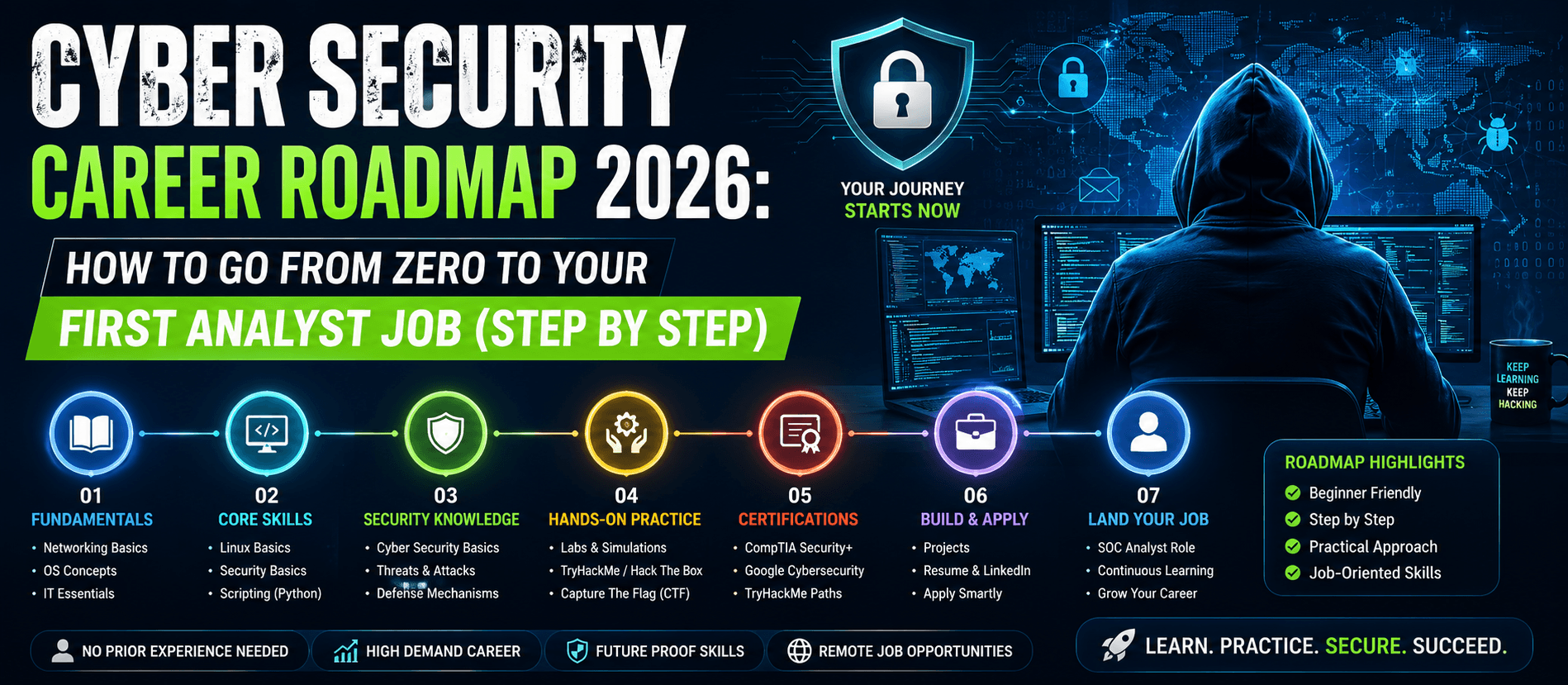
Cyber Security Career Roadmap 2026: How to Go From Zero to Your First Analyst Job (Step by Step)
A realistic, step-by-step cyber security roadmap for 2026 — what to learn first, which certifications matter, and how hiring actually works.
Cyber Security Career Roadmap 2026: How to Go From Zero to Your First Analyst Job (Step by Step)
Most "cyber security roadmap" content online is either a generic list of buzzwords with no order — "learn networking, learn hacking, learn cloud, get certified, get a job" — or a hyper-technical syllabus that assumes you already know what a SOC is. Neither actually helps someone starting from zero decide what to do this month.
This guide is built around one question: if you had three to six months and wanted your first real cyber security job — not just a certificate — what would you actually do, in what order, and how would you know you're ready to apply? We'll walk through the field itself, the specific skills that get checked in interviews, a month-by-month roadmap, which certifications are worth the money at each stage, realistic salary expectations, the exact job titles to target, the tools to prioritize, the mistakes that quietly stall most beginners, and where the field is heading so you're not training for a version of the job that's already outdated.
What is Cyber Security?
Quick Answer: Cyber security is the discipline of defending systems, networks, and data against unauthorized access, misuse, or damage — spanning prevention, real-time monitoring, and response after an incident occurs.
The field is often reduced to "hacking" in popular imagination, but the honest picture is closer to a spectrum. On one end sits offensive security — ethical hacking and penetration testing, where professionals simulate attacks with permission to find weaknesses first. On the other end sits defensive security — SOC analysts, incident responders, and security engineers who monitor systems, detect threats, and shut down active attacks. In between sits governance, risk, and compliance work, which focuses on policy, audits, and regulatory alignment rather than hands-on technical exploitation.
NIST's Cybersecurity Framework organizes almost all of this work around five functions — Identify, Protect, Detect, Respond, Recover — and understanding which function a given job role sits under is often more useful for career planning than memorizing tool names. If you're specifically deciding between the offensive and defensive tracks, our detailed comparison of ethical hacking vs cyber security is worth reading before you commit to a specialization.
Why Cyber Security Matters in 2026
Three things make the current hiring environment genuinely different from even two or three years ago.
AI has entered both offense and defense. Attackers use AI to generate convincing phishing content and automate reconnaissance at a scale manual attackers never could. Defensive teams increasingly rely on AI-assisted log analysis and anomaly detection to keep pace, which means "I understand how to work alongside AI security tools" has become a real, checkable skill in interviews — not a buzzword.
Cloud misconfiguration has overtaken classic network intrusion as a leading breach cause for many organizations, simply because so much infrastructure now runs on AWS or Azure by default. A roadmap that doesn't include cloud security fundamentals is preparing you for a smaller slice of the job market than it used to be.
Compliance-driven hiring has grown. As data protection expectations tighten across sectors, companies need people who can translate regulatory requirements into actual technical controls — which has expanded demand for GRC roles that many self-taught learners overlook entirely because they don't sound as exciting as "penetration tester."
Types of Cyber Security
Before building a roadmap, it helps to see the field as a set of parallel tracks rather than one linear path:
Track | Focus Area | Entry Friendliness | Typical First Job |
|---|---|---|---|
SOC / Blue Team | Real-time monitoring & detection | High | SOC Analyst L1 |
Offensive Security | Simulated attacks, exploitation | Moderate | Junior Penetration Tester |
Cloud Security | AWS/Azure configuration & auditing | Moderate–Low | Cloud Security Associate |
GRC | Policy, audits, regulatory alignment | High (non-coders welcome) | Compliance/GRC Analyst |
Digital Forensics | Post-incident investigation | Moderate | Forensics Associate |
Application Security | Web/app vulnerability testing | Moderate | AppSec Analyst |
Notice that SOC and GRC are the two friendliest entry points for someone without a strong coding background — this is the track most beginners should seriously consider first, even if penetration testing feels more "exciting" on paper.
Essential Cyber Security Skills
Recruiters checking candidates for entry-level roles in 2026 are generally looking for this stack, roughly in order of how often it's actually tested in interviews:
Networking fundamentals — TCP/IP, DNS, ports, common protocols, subnetting logic
Linux command-line comfort — most security tooling assumes you're not intimidated by a terminal
Basic Python scripting — enough to automate a scan or parse a log file, not full software development
Log analysis and SIEM familiarity — critical for SOC roles specifically
Vulnerability assessment basics — understanding how scanners work and how to read their output
Web application security fundamentals, anchored around the OWASP Top 10
Cloud security basics — IAM permissions, storage configuration, common cloud misconfigurations
Clear incident documentation and report writing — consistently underrated by beginners, consistently valued by hiring managers
For a full skill-to-role mapping — which exact skills matter for SOC vs penetration testing vs GRC — our detailed cyber security skills required guide breaks this down role by role.
Cyber Security Career Roadmap
Here's a realistic month-by-month structure for someone starting from zero.
Months 1–2: Foundations. Networking fundamentals and Linux essentials, in parallel with beginning Python. This stage feels slow because there's no "hacking" yet — but skipping it is the single most common reason self-taught learners plateau by month four.
Month 2–3: Core security concepts. The CIA triad, common attack types, and an introduction to the five-phase ethical hacking methodology — reconnaissance, scanning, enumeration, exploitation, reporting. This is also the point to start following structured content rather than random YouTube videos, since concepts here build directly on each other.
Month 3–4: Hands-on lab practice. Set up a home lab with Kali Linux and intentionally vulnerable practice machines. Start doing beginner-friendly CTF (Capture The Flag) challenges. This is where your resume starts having something real to show — write-ups, scan reports, and small automation scripts.
Month 4–5: Pick a specialization track. Based on what genuinely held your attention in the previous stages — SOC/blue team, offensive security, or cloud security/GRC — start going deeper into one track's specific tools (SIEM platforms for SOC, Burp Suite and Metasploit for offensive security, AWS/Azure security consoles for cloud).
Month 5–6: Certification and portfolio consolidation. Sit for an entry-level certification aligned to your track (typically CompTIA Security+ as a broad foundation, or CEH if you've committed to the offensive track). In parallel, consolidate your lab write-ups, CTF rankings, and any scripts into a portfolio you can actually walk an interviewer through.
Month 6 onward: Structured, targeted applications. Apply specifically to entry-level titles matching your track — SOC Analyst L1, Junior Penetration Tester, GRC/Compliance Analyst — rather than generic "cyber security jobs." Bring your lab reports and portfolio into every interview; in this field, demonstrated evidence consistently outweighs a polished resume alone.
If you want this exact path mapped out visually with additional milestones, our dedicated cyber security roadmap page covers it in more depth, and if your specific goal is the SOC analyst track, our guide on how to become a cyber security analyst walks through the hiring process end to end.
Cyber Security Certifications
Quick comparison for roadmap planning:
Certification | Best Stage to Take It | Track | Notes |
|---|---|---|---|
CompTIA Security+ | Month 5–6, first cert | Foundational / any track | Broadly recognized entry-level filter |
CEH | Month 6–8 | Offensive security | Assumes some prior hacking methodology knowledge |
CySA+ | Month 6–8 | SOC / Blue team | Strong fit if you're on the detection track |
OSCP | Year 1–2 | Offensive security (advanced) | Heavily hands-on, respected but demanding |
CISSP | 3+ years experience | Management / senior track | Requires professional experience to fully certify |
A common early-roadmap question is whether to start with CEH or Security+ — the honest answer depends on whether you're prioritizing broad foundational credibility (Security+) or committing early to the offensive track (CEH). Our detailed CEH vs CompTIA Security+ comparison walks through this decision with more nuance than a generic "it depends."
Key takeaway: certifications open the door to interviews; your lab portfolio and CTF track record are what get you through them.
Cyber Security Salary in India
Compensation in cyber security tracks closely with specialization and demonstrated skill rather than years of experience alone. Entry-level SOC analyst roles typically sit at the more modest end of the security salary range, while penetration testers, cloud security engineers, and application security specialists command noticeably higher pay as they build a track record — with the biggest jumps generally tied to a recognized certification plus a portfolio of real findings, rather than tenure by itself. Metro hubs — Bangalore, Delhi-NCR, Hyderabad, and Pune — remain the strongest markets given the concentration of product companies and MNC security teams.
For a detailed, current breakdown by exact role, experience band, and city, see our dedicated cyber security salary in India page.
Cyber Security Jobs
Here are the specific entry points this roadmap is designed to lead toward:
SOC Analyst (L1) — the most accessible first job on this roadmap; monitoring, alert triage, and escalation
Junior Penetration Tester — for those who specialized in the offensive track
GRC / Compliance Analyst — strong fit for non-coding backgrounds with strong documentation skills
Cloud Security Associate — for those who leaned into AWS/Azure security fundamentals
Digital Forensics Associate — for those drawn to post-incident investigation work
Incident Response Analyst — a natural next step after 1–2 years as a SOC analyst
Checklist before you start applying:
✅ You've completed at least one full lab-based project per specialization module
✅ You've solved a meaningful number of beginner-to-intermediate CTF challenges
✅ You hold (or have scheduled) at least one relevant certification
✅ You can walk through any line of your portfolio in a live interview without hesitation
✅ You've tailored your resume to a specific job title, not a generic "cyber security" label
For a deeper breakdown of responsibilities and hiring expectations by title, our full cyber security jobs guide covers each role individually.
Tools Every Cyber Security Professional Should Learn
Mapped to the roadmap stages above:
Foundation stage: Linux terminal, basic networking utilities Core security stage: Nmap (reconnaissance), Wireshark (packet analysis) Offensive track: Metasploit (exploitation), Burp Suite (web app testing, aligned with OWASP methodology) SOC/Blue team track: Splunk or another SIEM platform, log analysis workflows Cryptography basics (all tracks): OpenSSL, certificate and SSL/TLS handling Cloud track: AWS and Azure native security consoles All tracks: Python for automation and small custom tooling
Free supplementary references worth bookmarking as you go: Microsoft Learn's security modules, Cisco's security learning hub, and ISC²'s resources for those eyeing a longer-term CISSP path.
Common Mistakes Beginners Make
Trying to shortcut straight to "advanced hacking" content without networking fundamentals — this is the single biggest cause of stalled progress by month three or four.
Collecting certifications with no lab work behind them. Interviewers increasingly ask candidates to walk through a real finding, not just recite exam material.
Ignoring the SOC/GRC entry points because offensive security "sounds cooler," even when those tracks would get them hired faster.
Not specializing early enough, spreading thin across every track simultaneously instead of building depth in one.
Underinvesting in cloud security fundamentals, given how much of the real 2026 threat landscape now runs through cloud misconfiguration rather than classic network attacks.
Skipping CTFs entirely, missing the single most efficient way to build a demonstrable, interview-ready portfolio quickly.
Future of Cyber Security
For anyone planning a multi-year career rather than just a first job, three trends are worth building toward from the start:
AI-assisted SOC work is becoming the norm, not a specialty — meaning comfort using AI tools for alert triage and log summarization will increasingly separate competitive candidates from the rest.
Cloud security hiring will keep growing faster than traditional on-premise network security roles, as cloud migration continues across Indian enterprises.
AI system security — including prompt-injection defense and model supply-chain risk — is emerging as a genuinely new niche, and professionals who combine traditional security fundamentals with early AI-security exposure will be well positioned as this space matures.
Why Choose This Cyber Security Course
Course Unbox's Cybersecurity Mastery Program is built to mirror exactly the roadmap outlined above, rather than a generic, unordered list of topics:
A 12-module structure that follows the same logical progression — networking and Linux/Python foundations, ethical hacking methodology, penetration testing, network and web application security, cryptography, SOC/SIEM and incident response, cloud security, digital forensics, and a dedicated AI-in-cyber-security module
70% hands-on projects, so every stage of the roadmap above ends with a real deliverable — a threat assessment, a pentest report, a SIEM detection exercise, a cloud audit, a forensic investigation report
Certification prep built into the final module, covering CEH and CompTIA Security+ alongside portfolio and interview preparation
A capstone CTF-style project plus a paid internship, directly addressing the "portfolio and real evidence" step that this roadmap identifies as the biggest differentiator in hiring
Flexible full-time and weekend batches, so working professionals can follow this exact roadmap without quitting their current job
100% placement assistance, extending support past the curriculum into the actual job-search stage this guide covers
For a side-by-side look at how this compares with other options before you commit your time, see our comparison of Course Unbox vs Craw Security and our overview of the best cyber security institute in Noida.
Who Should Join
Beginners who want this exact month-by-month roadmap delivered as a structured, mentor-guided program instead of piecing it together from scattered free resources
IT, networking, or software professionals looking to pivot specifically into SOC, offensive security, or cloud security tracks
Non-coders interested in the GRC or SOC entry points, who assumed (incorrectly) that cyber security required a computer science background
Working professionals who need weekend-friendly batch timing to follow this roadmap alongside a current job
If you're still unsure whether you're "ready" to start this roadmap, our guide on cyber security for beginners directly addresses that hesitation.
Course Curriculum Highlights
The 12 modules map directly onto the roadmap stages covered in this guide:
Cyber Security & Networking Foundations
Linux & Python for Security
Ethical Hacking Fundamentals
System Hacking & Penetration Testing
Network Security
Web Application Security
Cryptography
SOC, SIEM & Incident Response
Cloud Security
Digital Forensics & Malware Basics
AI in Cyber Security
Certifications, Career Prep & Capstone + Paid Internship
For the full, detailed syllabus, visit the cyber security syllabus page, and for current program pricing, check the cyber security course fees page before you plan your timeline and budget together.
About the Author
Jugal Chauhan
Jugal Chauhan is a digital marketing strategist and tech educator with a passion for making complex topics accessible. He writes about marketing, technology, and professional growth to help learners and businesses thrive in the digital age.
Learn more about us →