Get a counselling call
Digital Marketing vs Traditional Marketing (2026): Differences, Types, Pros & Cons, and Which to Choose
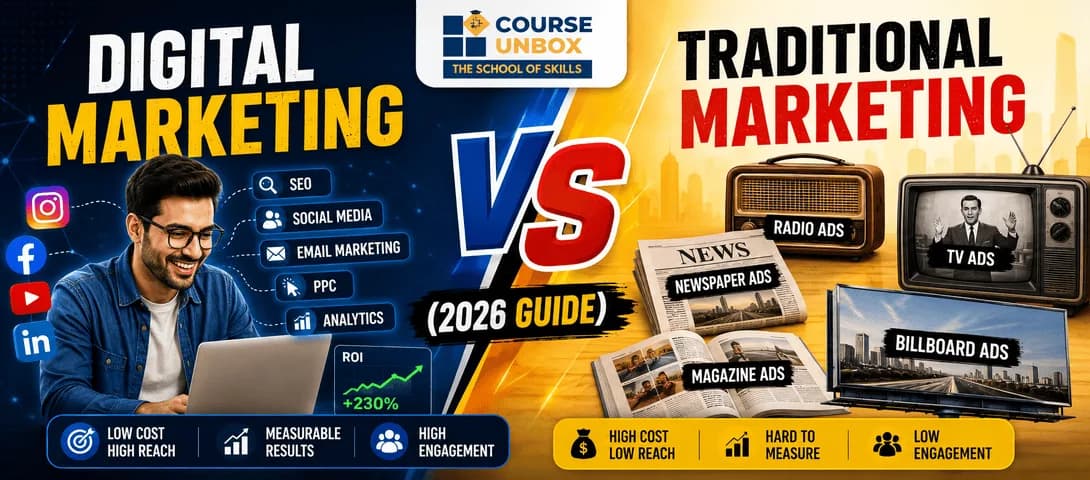
The core difference between digital marketing vs traditional marketing is the channel. Traditional marketing uses offline media — TV, radio, print, billboards, direct mail — for broad, tangible, high-trust reach. Digital marketing uses online channels — search, social, email, websites — for precise targeting, real-time analytics and flexible cost. Digital is more measurable and cost-efficient; traditional offers wider local reach and credibility. For most businesses, combining both (integrated marketing) works best.
Key takeaways
Traditional marketing uses offline channels (print, broadcast, outdoor, events) — tangible and credible, but costlier and harder to measure.
Digital marketing uses online channels (SEO, PPC, social, email) — cost-effective and measurable, but crowded and ever-changing.
The main differences come down to reach, cost, measurability, engagement and flexibility.
The best strategy depends on your goals, budget and audience — most businesses benefit from combining both.
“Digital marketing vs traditional marketing” is one of the most common questions in marketing today — often phrased as difference between traditional marketing and digital marketing, digital vs traditional marketing, digital versus traditional marketing, or simply traditional and digital marketing This guide compares the two head-to-head across channels, cost, reach, targeting, measurability and ROI — with their types, clear pros and cons, real examples, and a simple framework for choosing the right mix in 2026.
Digital marketing vs traditional marketing: quick comparison
Here's the difference between traditional and digital marketing at a glance, across the factors that matter most:
Factor | Traditional marketing | Digital marketing |
Channels | TV, radio, print, billboards, direct mail | Search, social, email, websites, apps |
Reach | Broad, mostly local/regional | Global, and precisely targetable |
Targeting | Limited (demographic/geographic) | Granular (interests, behaviour, intent) |
Cost & entry | Higher up-front, less flexible | Lower entry, scalable budgets |
Measurability | Hard to track precisely | Real-time analytics & attribution |
Engagement | Mostly one-way | Two-way, interactive |
Speed to launch/adjust | Slow (production lead times) | Fast (launch and optimise live) |
Longevity & trust | Tangible, memorable, high credibility | Often temporary; trust varies by channel |
Best for | Local awareness, mass reach, older audiences | Targeted acquisition, conversions, ROI tracking |
Want to master the digital side? Compare industry-recognised digital marketing courses on Course Unbox — SEO, PPC, social and analytics, filtered by fees, mode and placement support.
What is traditional marketing? (meaning)
Traditional marketing is the promotion of products and services through offline media channels. It broadcasts a message to a broad audience through established channels people already trust. It's often called conventional marketing, and it has been the backbone of advertising for decades. Its strengths are tangibility, broad local reach and credibility; its trade-offs are higher cost, slower turnaround and difficulty measuring results precisely.
What is digital marketing?
Digital marketing (sometimes called online marketing) is the promotion of brands and products through online channels and technologies. It emerged in the 1990s and has grown rapidly with social media and smartphones. Its defining advantage is data: marketers can target precisely and measure everything in real time. Its trade-offs are a crowded, fast-changing landscape and effects that can be short-lived without ongoing investment.
Types of traditional marketing (with examples)
Print marketing — newspapers, magazines, flyers, brochures, catalogues, business cards
Broadcast advertising — TV and radio commercials for mass awareness
Outdoor (OOH) advertising — billboards, hoardings, posters, transit and vehicle wraps
Direct mail — postcards, letters and promotional packages
Telemarketing — phone or SMS outreach, useful for follow-ups and offers
Events & sponsorships — trade shows, fairs and conferences with branded booths
Point-of-sale marketing — in-store displays, signage and packaging
Promotional merchandise — branded giveaways like pens, tote bags and T-shirts
Types of digital marketing (with examples)
Search engine optimisation (SEO) — ranking higher in search for steady, long-term traffic
Pay-per-click (PPC) — paid search and social ads where you pay per click
Social media marketing — organic and paid presence on Instagram, LinkedIn, YouTube, Facebook
Content marketing — blogs, videos, infographics and podcasts that build authority
Email marketing — targeted, cost-effective messages that nurture loyalty
Video marketing — YouTube, Reels and Shorts for high engagement
Influencer marketing — partnering with creators to reach ready-made communities
Affiliate marketing — performance-based partnerships that pay on results
Mobile marketing — SMS, app and location-based campaigns, strong for local
Display advertising — banners and retargeting that keep your brand top of mind
Key differences between traditional and digital marketing
1. Channel & reach
Traditional marketing reaches a broad, mostly local audience through offline media; digital marketing can reach a global audience and narrow it to very specific segments. This is the single biggest difference between the two.
2. Targeting & personalisation
Digital lets you target by interest, behaviour and intent, and personalise messages per user. Traditional targeting is limited to broad demographic or geographic assumptions.
3. Cost & flexibility
Digital campaigns can start on a small budget and scale; traditional campaigns carry higher fixed production and placement costs and are harder to adjust mid-flight.
4. Measurability & ROI
Digital offers real-time analytics and attribution, so ROI is visible and optimisable. Traditional results are harder to attribute, though brand lift is real.
5. Engagement & speed
Digital is interactive and can be launched or changed in hours; traditional is largely one-way with longer lead times — but its physical presence can be more memorable.
Pros and cons of each
Traditional — pros | Traditional — cons |
Broad, mass local reach | Higher up-front cost |
Tangible and memorable | Hard to measure precisely |
High credibility & trust | Limited targeting |
Effective for older/offline audiences | Slow to launch and adjust |
Digital — pros | Digital — cons |
Lower entry cost, scalable | Crowded, competitive space |
Precise targeting & personalisation | Effects can be short-lived |
Real-time analytics & ROI | Fast-changing platforms & rules |
Two-way, global engagement | Requires ongoing skill & upkeep |
Cost, ROI and what businesses actually choose
Digital generally offers a lower barrier to entry and clearer ROI, but traditional channels still influence buyers. Real-world data shows both matter:
In a 2024 small-business marketing survey, among businesses trying new tactics, roughly 40% doubled down on digital, 32% prioritised traditional, and 28% split investment across both.
On discovery, about 54% of customers find small businesses on social media and 44% via search engines — yet 34% still respond to flyers and 29% to direct mail.
The most-used digital channels were websites and social ads (60% each), SEO (50%) and email (46%); the top traditional tactics were business cards (50%), events (32%) and print ads (31%).
Source: VistaPrint 2024 Small Business Marketing Report (in partnership with Wix). Figures illustrate that digital leads on discovery while traditional retains real influence.
Real example: when brands use both
Guinness — traditional reach meets digital targeting. Guinness's television advertising is legendary — its 1999 “Surfer” spot is still cited among the best ads ever made. But rather than only running TV, the brand also produced social-first video shot specifically for Facebook and Instagram (not just repurposed TV cuts) and targeted it at defined audiences. The result paired the cultural weight and trust of traditional advertising with the reach and shareability of digital — a textbook case of the two working together rather than competing.
The lesson for smaller businesses is the same: a neighbourhood flyer can drive local awareness while a social ad captures and measures the leads it generates.
Which should you choose in 2026?
There's no universal winner — the right choice depends on your goals, budget and audience. A simple way to decide:
If your priority is… | Lean toward… |
Measurable ROI & precise targeting | Digital marketing |
Fast testing on a small budget | Digital marketing |
Broad local awareness / mass reach | Traditional marketing |
Reaching older or offline audiences | Traditional marketing |
Building tangible, long-term brand trust | Traditional marketing |
Most businesses, most of the time | A blend of both |
Can you combine digital and traditional marketing?
Yes — and usually you should. Using both together is called integrated marketing. Traditional channels build broad awareness and trust; digital channels then capture, target and convert that attention while measuring what works. A billboard that drives people to search your brand, or a TV spot reinforced by retargeting ads, is far stronger than either alone. For most brands in 2026, the real question isn't “digital or traditional” — it's finding the right mix.
About the Author
Jugal Chauhan
Jugal Chauhan is a digital marketing strategist and tech educator with a passion for making complex topics accessible. He writes about marketing, technology, and professional growth to help learners and businesses thrive in the digital age.
Learn more about us →