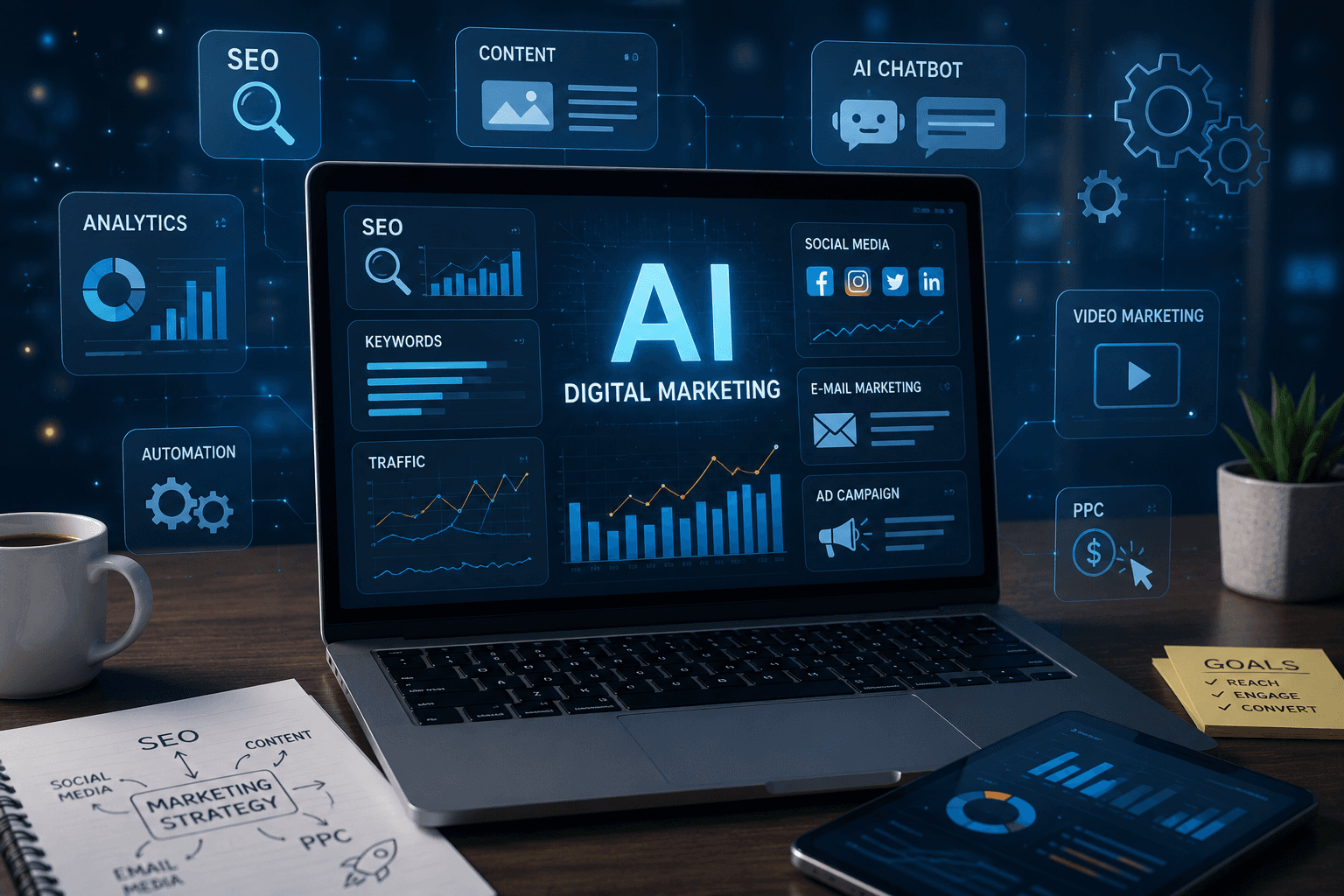
AI Digital Marketing Course: The Complete 2026 Guide to Skills, Curriculum, and Career Scope
AI Digital Marketing Course: The Complete 2026 Guide to Skills, Curriculum, and Career Scope
Search behavior has changed more in the last two years than in the previous ten. A meaningful share of people now get their answers directly inside Google's AI Overviews, or skip search engines altogether and ask ChatGPT, Gemini, Perplexity, or Claude instead. For marketers, this isn't a side trend to keep an eye on — it's a structural shift in how brands get discovered, and it's exactly why the phrase "AI digital marketing course" has gone from a niche search term to one of the most common questions students and career-switchers are typing into Google.
The problem is that most digital marketing courses haven't caught up. They were written for a 2022–2023 search landscape: keyword research, on-page SEO, Google Ads, social media calendars — with AI treated as an optional add-on module, usually a couple of sessions on "how to use ChatGPT for content ideas." That's not enough anymore. AI isn't a bonus skill sitting next to digital marketing; it's becoming the operating layer underneath every channel.
This guide walks through what an AI digital marketing course should actually teach, why the new disciplines of AEO (Answer Engine Optimization) and GEO (Generative Engine Optimization) matter, what tools and skills employers are hiring for right now, what salaries and career paths look like in India, and how to evaluate a course before you enroll.
Table of Contents
What Is AI Digital Marketing?
Why AI Digital Marketing Matters More in 2026 Than Ever Before
Traditional Digital Marketing vs AI Digital Marketing
Core Skills an AI Digital Marketing Course Must Teach
Understanding AEO and GEO: The New Frontier of Search
A Complete AI Digital Marketing Curriculum, Module by Module
AI Tools Every Modern Marketer Should Know
Career Scope and Salary in India (2026 Data)
Who Should Learn AI Digital Marketing
How to Choose the Right AI Digital Marketing Course
Common Mistakes Beginners Make
Expert Tips to Get the Most Out of Your Learning
Case Study: How AI-Assisted SEO Changed a Real Campaign
Your 6-Month Roadmap to Becoming an AI-Ready Digital Marketer
Conclusion and Next Steps
What Is AI Digital Marketing?
AI digital marketing is the practice of promoting brands, products, and services across search, social, paid, content, and email channels while using artificial intelligence tools to research, create, optimize, automate, and report on that work faster and more accurately than manual methods allow.
It's important to be precise about what this does and doesn't mean. AI digital marketing is not a replacement for marketing fundamentals — it's an amplifier built on top of them. A marketer who doesn't understand audience segmentation, funnel logic, or conversion tracking will not become effective just by learning to prompt ChatGPT well. The core discipline is unchanged: understand the customer, build the right message, put it in front of the right audience, measure what happens, and improve it. What's changed is the toolkit and the destinations where that message needs to show up.
There are two layers to AI digital marketing today:
Using AI as a tool — for research, ideation, content drafting, ad copy variations, audience insights, automation workflows, and reporting.
Marketing for AI-driven discovery — optimizing content and brand presence so that it gets surfaced, cited, and recommended inside AI Overviews, ChatGPT answers, Gemini responses, and other generative search experiences, not just traditional search engine result pages.
Most courses only teach the first layer. The second layer — often called AEO and GEO — is where the real skill gap sits in the current job market, and it's the piece most 2023-era syllabi never got around to updating.
Why AI Digital Marketing Matters More in 2026 Than Ever Before
A few shifts explain why this isn't hype:
AI Overviews now appear across a significant share of Google searches. Roughly a quarter of search queries currently trigger an AI-generated summary at the top of the results page, pushing traditional organic listings further down and changing what "ranking #1" even means.
The majority of marketers already use AI tools daily. Industry surveys consistently show that somewhere around nine in ten marketing professionals now use AI tools as part of their regular workflow — for research, drafting, or campaign optimization. Not using them is quickly becoming the exception, not the norm.
Brands cited inside AI answers see outsized visibility. When a brand or article gets referenced directly inside an AI Overview or a ChatGPT response, it captures attention in a zero-competition moment — there's no scrolling past nine other results.
Hiring has already caught up. Job postings for "digital marketer with AI skills" or "AI-integrated marketing specialist" increasingly command a pay premium over generic digital marketing roles, because employers know these skills translate directly into measurable ROI.
The tools themselves have matured. ChatGPT, Gemini, and Claude went from novelty chatbots to genuine research and drafting collaborators capable of handling briefs, outlines, competitive analysis, and even campaign structuring — provided the marketer knows how to direct them.
None of this means classic SEO, paid ads, or social media strategy are obsolete. It means the skill set has widened. A digital marketer in 2026 needs to be fluent in both worlds — the traditional search results page and the AI-generated answer layer sitting above it.
Traditional Digital Marketing vs AI Digital Marketing
Here's a direct comparison to make the distinction concrete:
AspectTraditional Digital MarketingAI Digital MarketingPrimary goalRank on Google's ten blue linksRank on Google + get cited in AI Overviews, ChatGPT, Gemini, PerplexityKeyword researchManual tools, volume-focusedAI-assisted, intent- and entity-focusedContent creationEntirely manual draftingAI-assisted drafting with human editing, fact-checking, and E-E-A-T signalsSEO focusOn-page, technical, backlinksOn-page, technical, backlinks + schema markup, entity SEO, llms.txt, structured dataAd campaignsManual bid managementAI-assisted bidding, creative testing, and audience predictionReportingManual dashboard buildingAI-assisted anomaly detection and auto-generated insightsNew skill required—Prompt engineering, AEO, GEO, AI workflow automationCareer ceilingModerate, plateaus without specializationHigher, especially for AEO/GEO and AI-automation specialists
The point isn't that AI digital marketing throws out the old playbook. It layers a new set of disciplines — and a new destination for visibility — on top of a foundation that hasn't actually changed.
Core Skills an AI Digital Marketing Course Must Teach
A genuinely useful AI digital marketing course should build competence across four skill clusters. If a curriculum is missing an entire cluster, it's incomplete, no matter how polished the marketing around it looks.
1. Marketing Fundamentals (Non-Negotiable)
Customer journey mapping and buyer personas
Go-to-market strategy and positioning
Goal-setting frameworks (KPIs, OKRs, North Star metrics)
Funnel design: awareness, consideration, conversion, retention
2. Channel Execution
Search Engine Optimization (technical, on-page, off-page, local)
Search Engine Marketing (Google Ads: Search, Display, Shopping, YouTube)
Paid social (Meta Ads, LinkedIn Ads) and organic social strategy
Content marketing and copywriting frameworks
Email marketing and lifecycle automation
E-commerce and marketplace marketing (Shopify, Amazon)
3. AI-Native Skills (Where Most Courses Fall Short)
Prompt engineering for marketing use cases
Using ChatGPT, Gemini, and Claude for research, ideation, and drafting
AI image and video generation tools (Midjourney, Canva AI)
AI workflow automation (Zapier, n8n) to remove repetitive manual work
AI ethics, copyright, and data privacy in marketing use
4. AI Search Optimization (The New Discipline)
Answer Engine Optimization (AEO): featured snippets, People Also Ask, AI Overviews
Generative Engine Optimization (GEO): getting cited by ChatGPT, Perplexity, Gemini, Claude
Schema and structured data implementation
Entity SEO and topical authority building
E-E-A-T (Experience, Expertise, Authoritativeness, Trustworthiness) signal building
That fourth cluster is the one worth paying closest attention to when you're comparing courses, because it's the part of the curriculum most institutes haven't built yet — often because their own trainers haven't kept up with it either.
Understanding AEO and GEO: The New Frontier of Search
Because these terms get thrown around loosely, here's a clear breakdown of what each actually means and how they differ.
Answer Engine Optimization (AEO)
AEO is the practice of structuring content so it gets pulled directly into answer-style search features — featured snippets, "People Also Ask" boxes, and Google's AI Overviews. It's an extension of classic SEO, but with a sharper focus on:
Answering questions directly and concisely near the top of a page
Using clear heading hierarchies that map to real user questions
Structuring content in scannable formats (lists, tables, short paragraphs)
Implementing FAQ, HowTo, and Article schema markup correctly
Generative Engine Optimization (GEO)
GEO goes a step further. It's the discipline of optimizing content so that large language models — ChatGPT, Gemini, Claude, Perplexity — choose to cite it when generating an answer to a user's question, even when the user never visits a traditional search engine at all. GEO relies on:
Strong entity association (making sure your brand and topic are clearly, consistently defined across the web)
Demonstrable E-E-A-T signals (author credentials, original data, verifiable expertise)
Structured, fact-dense content that's easy for an LLM to extract and summarize accurately
Presence across authoritative third-party sources, not just your own website
Technical accessibility, including considerations like an
llms.txtfile that signals how AI crawlers should treat your content
AEO vs GEO vs Traditional SEO — Quick Comparison
FactorTraditional SEOAEOGEOTarget surfaceOrganic search resultsFeatured snippets, PAA, AI OverviewsChatGPT, Gemini, Claude, Perplexity answersRanking signalBacklinks, keywords, technical healthStructured, direct answers + schemaEntity trust, E-E-A-T, citation-worthinessContent styleLong-form, keyword-optimizedConcise, question-answer formatFact-dense, authoritative, well-sourcedMeasurementRankings, organic trafficSnippet ownership, AIO appearanceCitation tracking, AI referral trafficMaturity of disciplineEstablished (20+ years)Emerging, actively evolvingVery new, still being defined
Why this matters practically: a marketer who only knows traditional SEO can get a page to rank #3 on Google and still get zero visibility if an AI Overview above it answers the query completely and doesn't cite the page at all. Learning AEO and GEO isn't optional specialization anymore — it's becoming a baseline literacy requirement, the same way mobile optimization became non-negotiable a decade ago.
A Complete AI Digital Marketing Curriculum, Module by Module
Based on how the discipline has actually evolved, here's what a comprehensive, job-ready curriculum should cover. This structure reflects the kind of end-to-end program that takes a genuine beginner to a portfolio-ready, employable marketer — not a highlights reel of buzzwords.
Module 1 — Digital Marketing Foundations & Strategy
Marketing principles, the modern customer journey, mapping every digital channel, building a real go-to-market strategy, buyer personas, and KPI setting. Output: a complete strategy document for a live brand.
Module 2 — Website & Landing Page Development (No-Code + CRO)
Building sites without coding using tools like WordPress and Elementor or Webflow, UX and mobile optimization, landing page anatomy, and conversion rate optimization fundamentals using tools like Hotjar.
Module 3 — Search Engine Optimization (SEO)
How search actually works, keyword research, on-page and technical SEO, off-page link building, local SEO, content structure, and internal linking, using tools like Search Console, SEMrush or Ahrefs, and Screaming Frog.
Module 4 — AEO & GEO: Winning AI Search
Featured snippets, People Also Ask, AI Overviews, and getting content cited by ChatGPT, Perplexity, Gemini, and Claude. Schema and structured data, llms.txt, entity SEO, and E-E-A-T signal building. This is the module most competing courses skip entirely — treat its presence (or absence) as a litmus test when comparing options.
Module 5 — Search Engine Marketing (Google Ads)
Campaign structure across Search, Display, Shopping, and YouTube, keyword bidding strategy, ad copywriting, Quality Score optimization, and conversion tracking.
Module 6 — Social Media Marketing (Organic)
Strategy across Meta, Instagram, LinkedIn, X, YouTube, and Pinterest, short-form video, community building, content calendars, and social SEO.
Module 7 — Paid Social & Meta Ads
Meta Ads Manager, audience building, the Meta Pixel and Conversions API, retargeting, LinkedIn Ads, creative testing, and scaling budgets responsibly.
Module 8 — Performance Marketing & Funnels
End-to-end funnel design, ROAS, attribution modeling, conversion tracking, A/B testing, and tag management using Google Tag Manager.
Module 9 — Content Marketing & Copywriting
Content strategy, proven copywriting frameworks, blogging, storytelling, video scripting, and content repurposing across channels.
Module 10 — Email Marketing & Automation
List building, lifecycle sequences, segmentation, deliverability best practices, and newsletter strategy using tools like Mailchimp or Klaviyo.
Module 11 — AI in Marketing & Prompt Engineering
A deep, standalone module — not a bolt-on. ChatGPT, Gemini, and Claude applied to marketing tasks, prompt engineering frameworks, AI for SEO research, ad copy, and content, AI image and video generation, workflow automation with Zapier or n8n, and a grounding in AI ethics and data privacy.
Module 12 — Web Analytics & Reporting (GA4)
GA4 setup, event and conversion tracking, Looker Studio dashboards, attribution modeling, and communicating results to stakeholders.
Module 13 — E-commerce, Marketplace & WhatsApp Marketing
Selling on Shopify and Amazon, marketplace SEO, product ads, and WhatsApp Business marketing — a particularly important channel in the Indian market.
Module 14 — Influencer, Affiliate & Reputation Management
Building influencer and affiliate programs, and running online reputation management (ORM) audits and response strategies.
Module 15 — Freelancing, Personal Branding & Agency Building
Personal brand positioning, LinkedIn optimization, client pricing, freelancing platforms, and the fundamentals of starting your own agency.
Module 16 — Career Prep & Capstone Project
Portfolio building, résumé and interview preparation, mock interviews, and a full multi-channel capstone campaign, ideally followed by a paid internship on real client work.
A curriculum built this way front-loads foundational skill in the early modules, layers in AI-native capability throughout (not as a single afterthought module), and closes with the practical, career-facing skills that actually get someone hired.
AI Tools Every Modern Marketer Should Know
Tool fluency matters, but understanding why a tool fits a specific task matters more. Here's a practical breakdown:
Tool CategoryToolsPrimary UseConversational AIChatGPT, Gemini, ClaudeResearch, content drafting, strategy brainstorming, data analysisAI Search / ResearchPerplexityFact-checking, competitive research, source-backed answersAI Image GenerationMidjourney, Canva AIAd creatives, social graphics, campaign visualsSEO & Keyword ResearchSEMrush, Ahrefs, Search ConsoleKeyword research, rank tracking, technical auditsPaid AdvertisingGoogle Ads, Meta Ads Manager, LinkedIn Campaign ManagerCampaign management across search and socialAnalyticsGA4, Looker StudioTraffic analysis, conversion tracking, reportingAutomationZapier, n8nConnecting tools and automating repetitive workflowsEmail MarketingMailchimp, KlaviyoSequences, segmentation, lifecycle automationCRM & InboundHubSpotLead management and marketing-sales alignmentWebsite BuildingWordPress, Elementor, WebflowNo-code site and landing page development
Expert Tip: Don't Learn Tools in Isolation
A common mistake is treating tool training as a checklist — "I know Canva, I know GA4, I know ChatGPT." Employers don't hire tool knowledge; they hire the ability to solve a problem using the right combination of tools. A stronger way to learn: for every tool, ask "what business problem does this solve, and what does the workflow look like end to end?" That framing is what separates a marketer who can operate a dashboard from one who can actually run a campaign.
Career Scope and Salary in India (2026 Data)
Digital marketing pay in India is heavily performance-driven, and it scales quickly once someone can show measurable results rather than just theoretical knowledge. Here's a realistic breakdown based on current industry patterns:
Experience LevelTypical RolesSalary Range (Annual)Fresher (0–1 yr)Digital Marketing Executive, SEO Executive, Social Media Executive₹2.5–6 LPAEarly career (1–3 yrs)SEO Specialist, PPC Analyst, Social Media Manager₹4–8 LPAMid-level (3–5 yrs)Digital Marketing Strategist, Campaign Manager, Performance Manager₹8–15 LPASenior (5+ yrs)Digital Marketing Manager, Growth Head₹15–30+ LPASpecialist trackPerformance Marketer, Marketing Automation Specialist₹10–25+ LPA
A few practical notes on this data:
AI-skilled marketers tend to out-earn peers with identical experience but purely traditional skill sets. The gap widens with seniority, because AI fluency compounds into faster execution and better campaign performance.
Metro hubs pay a premium. Cities like Delhi NCR, Mumbai, and Bengaluru typically pay 15–25% more than tier-2 cities for equivalent roles, largely driven by the concentration of agencies, D2C brands, and IT companies.
Specialization pays better than generalization past the two-year mark. A generalist digital marketer plateaus faster than someone who's built deep expertise in performance marketing, AEO/GEO, or marketing automation.
Freelancing and agency ownership represent a real, growing income ceiling above the salary table entirely — a meaningful share of experienced marketers eventually transition into freelance consulting or start their own agencies, where income isn't capped by a single employer's pay band.
Job Titles You'll Be Qualified For After a Complete AI Digital Marketing Course
Digital Marketing Executive / Specialist
SEO Analyst / SEO Specialist
AEO / GEO Specialist (an emerging, high-demand title)
Performance Marketing Executive
Social Media Manager
Content Marketing Specialist
PPC / Paid Ads Analyst
Marketing Automation Specialist
Freelance Digital Marketing Consultant
Who Should Learn AI Digital Marketing
This isn't a niche skill reserved for marketing graduates. In practice, four groups tend to benefit most:
Students and recent graduates looking for a fast, in-demand skill they can start earning from without needing a marketing-specific degree. Digital marketing remains one of the few high-growth fields where a strong portfolio matters more than a formal credential.
Working professionals looking to pivot into marketing, or already in marketing roles and looking to add AI fluency that commands higher pay than legacy skill sets alone.
Business owners and founders who want to run their own campaigns competently, understand exactly where ad budgets are going, and stop relying entirely on external agencies for decisions that affect their bottom line directly.
Freelancers and aspiring agency owners who want to take on clients confidently, price their services correctly, and build a personal brand or agency around a skill set that's clearly differentiated from the flood of generic "social media manager" freelancers.
No coding background or prior marketing experience is required to start. The discipline is built to be learned from zero, provided the course itself is structured to take a genuine beginner through in the right order — fundamentals first, channels second, AI-native skills woven throughout, not bolted on as an afterthought.
How to Choose the Right AI Digital Marketing Course
This is where most people go wrong — not because good options don't exist, but because course marketing pages all sound remarkably similar. Here's a practical filter to cut through it.
Questions to Ask Before Enrolling
Does the curriculum have a dedicated AEO/GEO module, or is AI mentioned only in passing? If "AI" only shows up as a single session on ChatGPT prompts, the course is still fundamentally a 2023 syllabus with a coat of paint.
Will you work on real brands, or only case studies and templates? Live projects on real client accounts (even small ones) teach judgment that simulated exercises can't.
Who is actually teaching? Ask for the trainer's real, verifiable industry experience — LinkedIn profiles, portfolio work, actual campaigns they've run — not just years-of-experience claims on a slide.
Is pricing transparent up front, or hidden behind a "contact us" form? Transparent fee structures, published clearly with EMI options, are a reasonable signal of an institute that doesn't need pressure tactics to close enrollments.
What does "placement assistance" actually mean? Ask for specifics — recruiting partners, actual placed alumni you can verify, not just a placement percentage printed without context.
Is the certificate paired with a portfolio, or is it just a certificate? A completion certificate with no portfolio to show for it is far weaker in job interviews than a certificate backed by demonstrable, campaign-level work.
Red Flags to Watch For
Vague, unverifiable "100% placement" claims with no supporting detail
No mention of AEO, GEO, or AI search optimization anywhere in the syllabus
Trainers with no traceable industry work, only training experience
Course fees hidden until a sales call
No live-project or portfolio component
Curriculum that hasn't visibly changed in structure for several years
A Fair Comparison Framework
Evaluation FactorWhat to Look ForCurriculum currencyAEO/GEO module present, AI woven through every channel, not isolatedTrainer credibilityVerifiable industry experience, real campaign work, active LinkedIn presenceProject-based learningLive brands or real client work, not just templatesFee transparencyFees stated up front, EMI options disclosed clearlyPlacement supportSpecific recruiting partners and verifiable outcomesMode flexibilityOptions for weekday, weekend, online, and offline batchesPortfolio outcomeA tangible body of work you can show in interviews, not just a certificate
Common Mistakes Beginners Make
Even with a strong course, learners commonly derail their own progress in predictable ways:
Treating AI tools as a shortcut instead of a collaborator. Copy-pasting AI-generated content without editing, fact-checking, or adding real expertise produces generic output that neither ranks well nor reads convincingly — and increasingly, both search engines and readers can tell.
Learning tools without learning strategy. Knowing how to use Google Ads doesn't mean knowing how to build a profitable campaign. Strategy has to come first; tools execute the strategy.
Ignoring analytics. A huge number of beginners can run a campaign but can't read the resulting data well enough to improve it. Reporting and analysis is where real marketing judgment is built.
Specializing too early, or never specializing at all. Jumping straight into a narrow niche without broad fundamentals leaves gaps; staying a generalist forever caps earning potential past the early-career stage.
Skipping the portfolio. Certificates matter far less in interviews than a body of real, demonstrable project work. If a course doesn't force you to build one, build it yourself alongside the coursework.
Underestimating AEO/GEO as "too new to matter yet." The marketers building this skill set now are positioning themselves two years ahead of a job market that's only just starting to formally recognize the title.
Expert Tips to Get the Most Out of Your Learning
Build in public. Document your learning — a LinkedIn post about a campaign you ran, a case study on a landing page you optimized — while you're still studying. It compounds into a personal brand before you've even finished the course.
Pick one real (or simulated) brand and apply everything to it. Instead of scattering practice across disconnected exercises, run every module's skill through the same project. By the end, you'll have one cohesive, presentable case study rather than sixteen disconnected fragments.
Learn prompt engineering as a discipline, not a party trick. The difference between a vague prompt and a well-structured one (with context, constraints, and format specified) is often the difference between unusable AI output and genuinely publishable work.
Track AI citations, not just rankings. If you're practicing GEO, don't just check where a page ranks on Google — actually ask ChatGPT, Perplexity, and Gemini the target question and see whether your content gets referenced. That feedback loop teaches GEO far faster than reading about it.
Read primary sources, not just secondary summaries. Google's own Search Central documentation and Search Console reporting are more reliable than most third-party "SEO tips" content — use tool-generated insights as a starting point, then verify against the source.
Case Study: How AI-Assisted SEO Changed a Real Campaign
Consider a mid-sized D2C brand competing in a saturated category — skincare, say — with a content team of two people trying to keep pace with competitors who had five times the headcount.
The old approach: Manual keyword research in a spreadsheet, one blog post per week, generic on-page optimization, and no visibility into how AI-driven search features were affecting organic traffic at all.
What changed with an AI-integrated workflow:
Keyword and topic research that used to take a full day was compressed into a few hours using AI-assisted clustering, freeing the team to focus on content quality instead of research logistics.
Content briefs were structured specifically around question-based, snippet-friendly formatting — direct answers near the top, supporting detail below — which increased the number of pages capturing featured snippets.
Schema markup was implemented systematically across the site's most important pages, rather than sporadically, improving both traditional rich-result eligibility and machine readability for AI crawlers.
The team began tracking whether their own cornerstone content was being cited in AI Overviews and ChatGPT responses for their core topics — something they'd never measured before — and used that data to prioritize which pages needed stronger sourcing, more original data, and clearer authorship signals.
The result pattern: Organic traffic growth accelerated, but more importantly, the brand started appearing inside AI-generated answers for competitive, high-intent queries where it previously had zero visibility — a channel that simply didn't exist as a measurable KPI eighteen months earlier.
The lesson isn't that AI tools alone caused this. It's that the team's skill set expanded to cover a destination (AI-generated answers) that their competitors' teams hadn't yet learned to target, and that gap translated directly into a measurable visibility advantage.
Your 6-Month Roadmap to Becoming an AI-Ready Digital Marketer
If you're building this skill set from scratch, here's a realistic sequencing:
Month 1 — Foundations
Marketing fundamentals, customer journey mapping, basic website/landing page setup, and an introduction to AI tools as research and drafting assistants.
Month 2 — Search Visibility
Core SEO (technical, on-page, off-page) alongside AEO fundamentals — schema markup, featured snippet structuring, and People Also Ask optimization.
Month 3 — Paid Acquisition
Google Ads and Meta Ads fundamentals, campaign structuring, budget management, and conversion tracking setup.
Month 4 — Content, Social, and GEO
Content marketing and copywriting frameworks, organic social strategy, and a focused deep-dive into GEO — entity building, E-E-A-T signals, and tracking AI citation performance.
Month 5 — Automation and Analytics
GA4 and Looker Studio reporting, email marketing automation, and AI-driven workflow automation using tools like Zapier or n8n.
Month 6 — Capstone and Career Prep
A full multi-channel capstone campaign applying every skill learned, portfolio finalization, résumé and interview preparation, and — ideally — a paid internship or live client work to translate coursework into verifiable, real-world experience.
Conclusion and Next Steps
The core discipline of digital marketing hasn't changed — understand your audience, build the right message, put it where they're looking, measure what happens, and iterate. What's changed is where they're looking. A meaningful and growing share of that attention now sits inside AI-generated answers, not just traditional search results, and the marketers who learn to show up there — through AEO, GEO, and genuine AI fluency — are the ones building a two-year head start on everyone still learning from a syllabus written for 2023.
If you're evaluating where to build these skills, look past the marketing language on any course page and check for the substance underneath: a curriculum with AEO and GEO built in as core modules rather than an afterthought, trainers with verifiable industry experience, real project work on live brands, transparent fees, and a portfolio you can actually show an employer — not just a certificate.
That's the standard this guide has been built around, and it's the standard worth holding any program to before you commit your time, money, and career trajectory to it. If you're ready to build this skill set properly — with AI woven through every module rather than tacked onto one — explore the full AI Digital Marketing Course curriculum, compare the syllabus module by module, and book a demo class to see the teaching approach firsthand before you decide.
About the Author
Jugal Chauhan
Jugal Chauhan is a digital marketing strategist and tech educator with a passion for making complex topics accessible. He writes about marketing, technology, and professional growth to help learners and businesses thrive in the digital age.
Learn more about us →